 Akihito Kimura
 Today, we examine ‘Call Of Nature,’ the opening track of the 2012 album Fantasia 1, released under the name Tetsujin (Akihito Kimura).
Why does this piece refuse to take us anywhere — yet remain impossible to stop listening to?
The answer lies not in the score, but hidden within statistical patterns of frequency.
This composition diffuses harmony along the axis of time while maintaining a clear gravitational center and flickering contrasts — a dual structure where motion and stillness coexist.
Viewed through acoustic data, the music is designed less as a “progression” and more as a field.
This analysis is not merely a catalog of spectral values. The numbers function as a blueprint of sound — observational data that illuminate perception and compositional intent from behind the curtain.
To uncover the source of the listener’s uncanny sense of suspension, we use acoustic indicators to examine how this piece constructs music as an experiential space.
Midrange Density Rising from the Abyss — Center of Mass and Spatial Spread
Spectral Centroid: ≈ 1,394 Hz
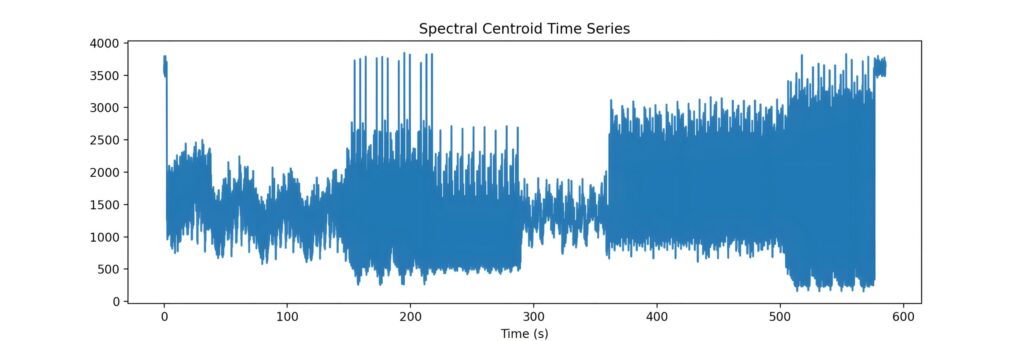
This indicates a center of gravity rooted in the low end while asserting a strong presence in the midrange. Rather than a pure bass rumble, it suggests a sound mass emerging upward. Compared to the brighter centroid typical of pop music (around 2 kHz and above), the lowered spectral balance preserves an earthy, grounded tone throughout the piece.
Spectral Rolloff: ≈ 2,962 Hz
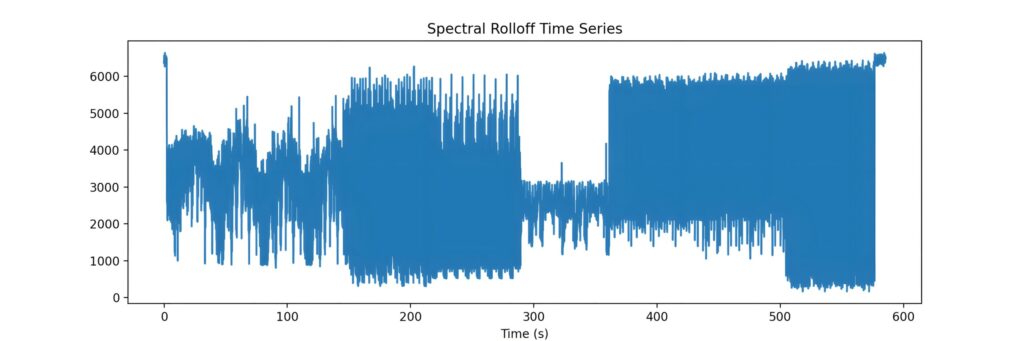
High-frequency energy extends toward 3 kHz without excessive emphasis, maintaining air and articulation. The result is a three-dimensional spectrum where low-end weight coexists with delicate high-end shimmer.
Together, these qualities create a perceived space with a tangible center of gravity — stable below, present in the middle.
A rooted resonance gathers mass in the midrange, lending quiet weight to the sonic field.
A Quiet Sea and Sudden Cliffs — Dynamics and Energy
The metrics defining motion reveal that this field is far from static calm.
Zero Crossing Rate: ≈ 0.081
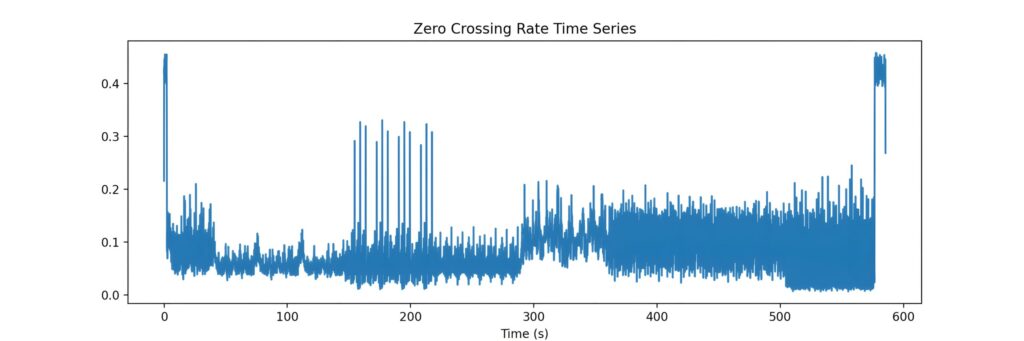
Still relatively low, indicating a foundation built on sustained tones and waveform undulation rather than noise.
Spectral Flatness: ≈ 26.8
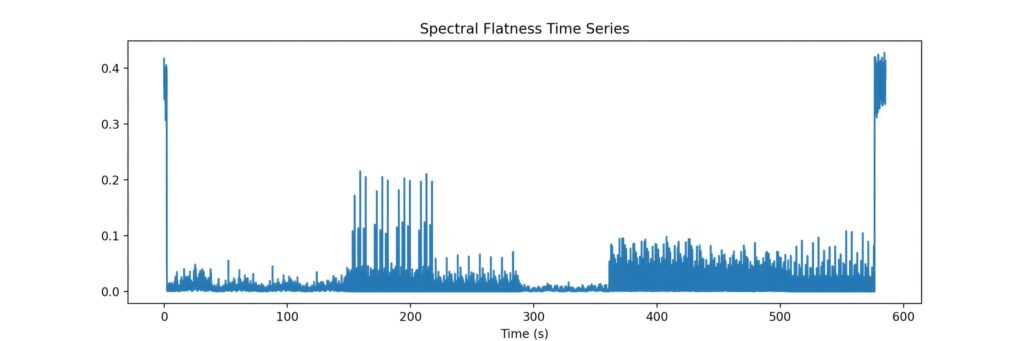
Energy is dispersed rather than concentrated, scattering textural grains across the spectrum.
Tempo: ≈ 110.3 BPM
A steady mid-tempo pulse.
RMS Energy: mean ≈ 0.089
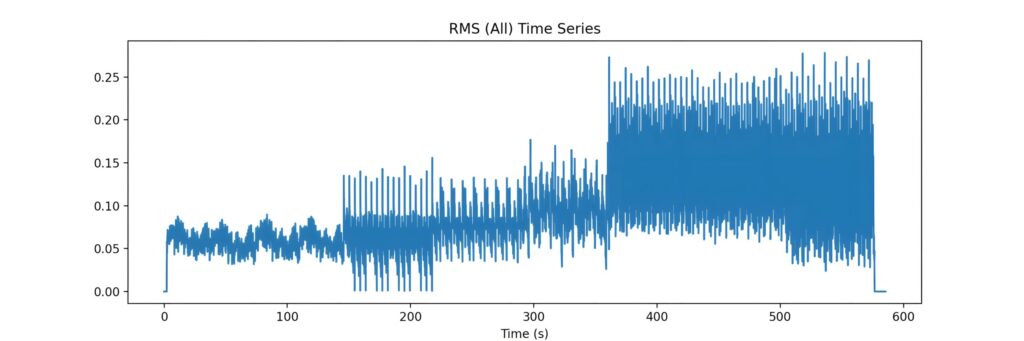
A firm acoustic presence suggests dense sonic particles.
RMS Harmonic: ≈ 0.073
RMS Percussive: ≈ 0.028
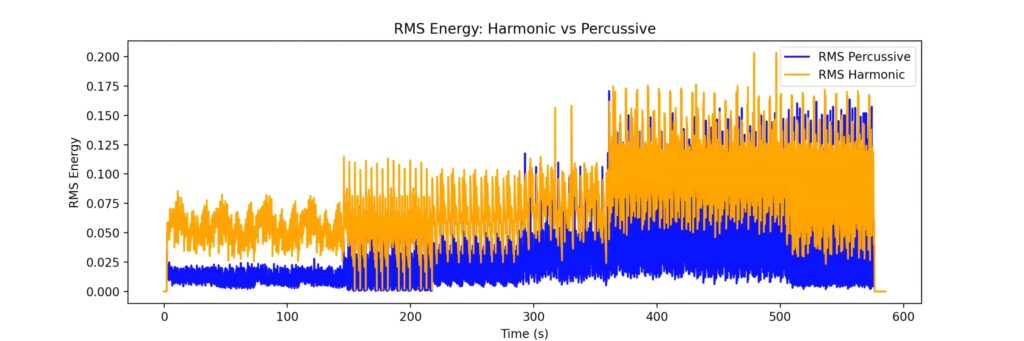
Sustained harmonic material dominates, punctured by transient spikes — producing a contrast between still surfaces and localized eruptions.
Onset Strength:
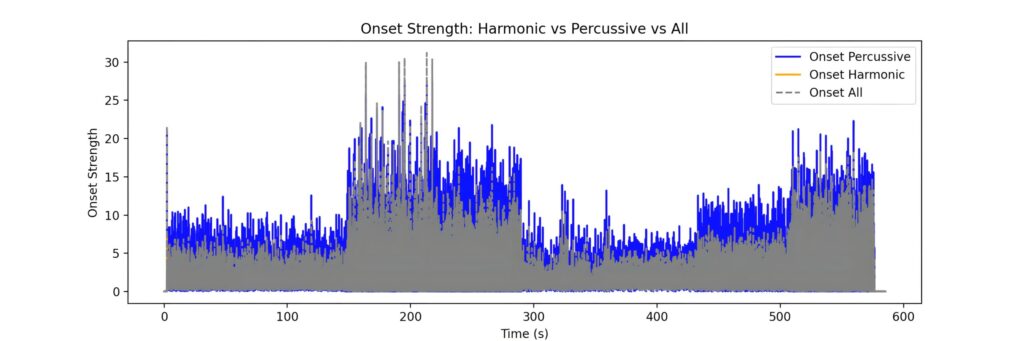
Percussive standard deviation (3.16) significantly exceeds the mean (2.38), implying bursts of irregular transients rather than predictable strikes. Where conventional rhythm stabilizes averages, this inversion mathematically signals nonstationary tension — sharp intrusions at unpredictable moments.
The piece thus layers instantaneous energy over a sustained plane.
Unexpected shocks ripple through a sea of calm, generating tension within stillness.
A Diffuse Field with a Center — Timbre and Harmony
A chromatic “ocean” where all twelve tones appear, yet distinct attractors emerge:
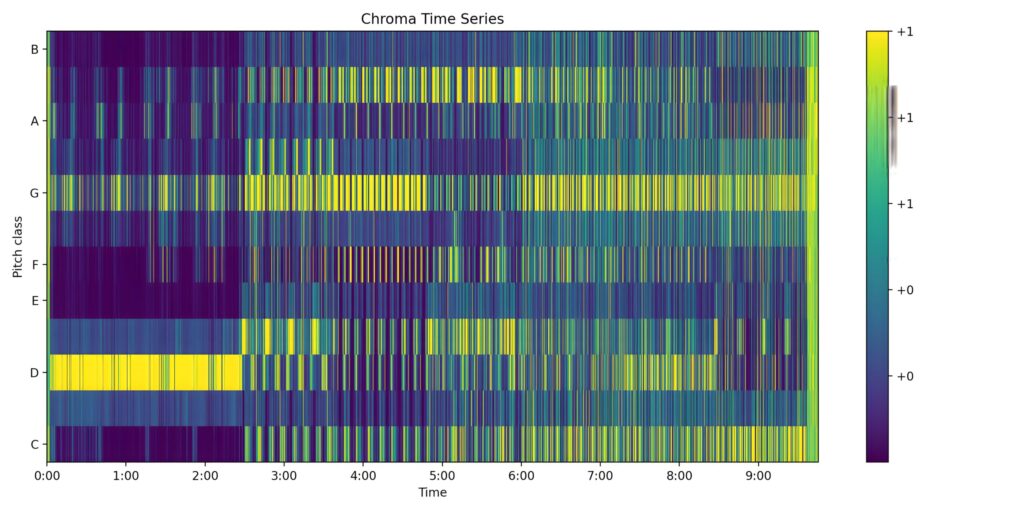
Table: Chromatic Distribution and State Interpretation
| Note | Mean Chroma | Interpretation of State |
| C | 0.3946 | Diffuse Coloration |
| C# / Db | 0.2862 | Background Mist |
| D | 0.5390 | Secondary Peak (Structural Perfect Fifth) |
| D# / Eb | 0.3999 | Diffuse Coloration |
| E | 0.2100 | Global Minimum |
| F | 0.2715 | Background Mist |
| F# / Gb | 0.2892 | Background Mist |
| G | 0.5835 | Maximum Peak (Central Attractor) |
| G# / Ab | 0.3093 | Background Mist |
| A | 0.2926 | Background Mist |
| A# / Bb | 0.3830 | Diffuse Coloration |
| B | 0.2405 | Background Mist |
Maximum peaks cluster around G (≈ 0.58) and D (≈ 0.54), while other tones hover near ≈ 0.2.
Despite broad distribution, these two tones define a structural axis. A sustained G–D synth pad anchors the harmonic field, while other tones drift statistically — a gravitational center quietly rising inside a wide harmonic expanse.
Harmony spreads evenly while retaining its core, allowing suspension and stability to coexist.
Timbre Control via MFCC
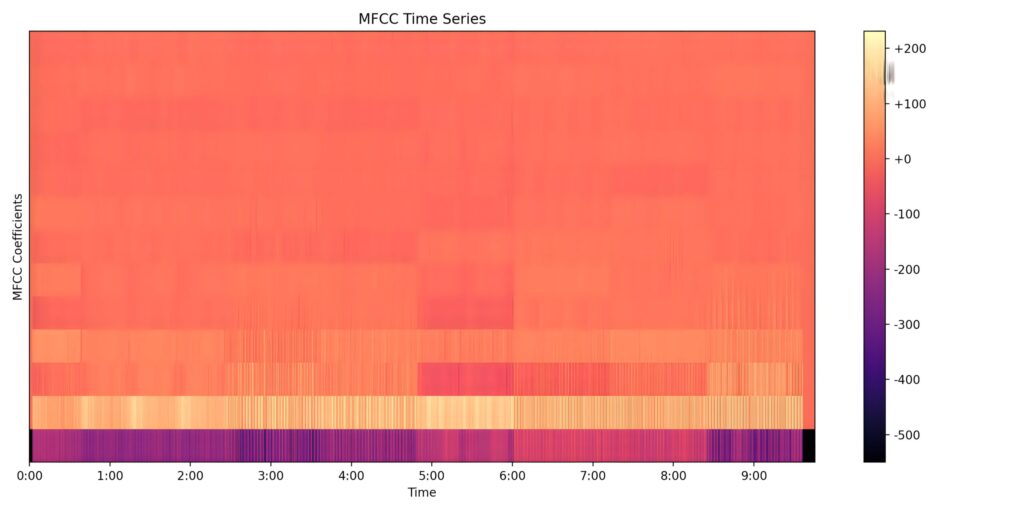
MFCC Coefficient 2: ≈ 109.98
A high value indicates spectral tilt toward the low end, reinforcing foundational weight.
MFCC Stability:
Early coefficients fluctuate strongly, while higher coefficients stabilize — signaling low-frequency motion paired with mid/high-frequency control. Mass and contour are balanced simultaneously.
Sound drifts yet is drawn toward an unseen center, wavering between belonging and suspension.
The G–D Framework — A Three-Layer Design of Space, Mass, and Motion
Key center: C minor
Sustained tones: G + D
Foundational Layer — The Gravity Pad
Rather than functioning as harmony in the traditional sense, this sustained perfect fifth fixes a perceptual coordinate system. The brain interprets continuous tones as spatial anchors. Removing the third suspends tonal identity, leaving directional tension without resolution — a dominant shadow without command.
When C minor material overlays this structure, dominant implication and tonic stability coexist ambiguously. Tension persists, but attraction remains unresolved — like a destination signposted with no open path.
A dominant that would normally contain a tritone — an augmented fourth or diminished fifth — carries an inherent pressure toward resolution.
Here, however, only the sense of direction remains while the command to resolve is withheld, suspending the harmonic system in a state where tension is present but no functional inevitability is enforced.
Mass Layer — Distorted Guitar
Heavy distortion transforms melody into spectral pressure. Harmonic overtones explode, increasing density, grain, and instantaneous attack. The listener perceives physical force rather than melodic contour.
Motion Layer — Primary Note Streams
The perfect fifth acts as a converter from harmonic meaning to kinetic energy. By suspending tonal identity, motion replaces resolution as the governing principle.
Sustained gravity, harmonic mass, and free motion operate in parallel. Sound becomes physical phenomenon rather than narrative progression.
Released from function, sound crosses space as movement rather than meaning.
A brief aside: classical counterpoint forbade parallel fifths to preserve independent voices. Modern acoustic thinking reclaims them as mass and texture — a principle extended across the composer’s broader work.
A Probabilistic Field with a Center
This piece documents physical processes more than musical events:
Vertical order dissolves: Harmony disperses through time, accumulating as perceptual afterimage rather than fixed progression.
Horizontal diffusion: Particle-like harmonic fragments populate the timeline, forming spectral memory in the listener.
Pseudo-steady state: Micro-level turbulence coexists with macro-level stability — entropy and equilibrium balanced statistically.
| Layer | Role | Acoustic Trait | Physical Interpretation |
| Foundation | Coordinate gravity | Sustained G–D pad | Immutable space resisting resolution |
| Mass | Texture density | Distorted harmonic clusters | Spectral weight creating tactile friction |
| Motion | Temporal flow | Probabilistic note streams | Kinetic particles drifting outside the structure |
The work portrays motion resisting tonal gravity while still drawn toward return — a dynamic tension between escape and belonging.
Layered amplitude fluctuations and spectral variation generate stochastic transients, carving time as tactile texture.
Tonality Without Predictable Progression
The central experiment is to free sound from the constraints of functional harmony and return it to physical phenomenon.
A gravitational field is established first; within it, sound moves probabilistically. Time is perceived not as progression, but as transformation of space.
This composition becomes a sculptural field where liberated tones exist rather than resolve. The numbers simply trace the outline of that phenomenon.