 Akihito Kimura
 Today, I will visualize “Samurai (momiji mix)”—a track from my 2019 album Ethereal 2—through three distinct layers: Sonic Texture (Cells), Tonal Framework (Bones), and Temporal Structure (Narrative).
Akihito Kimura / Samurai (momiji mix) A4=438Hz, Key of Am, 123BPM
Chapter 1: Sonic Texture (Cells)
Spectral / MFCC / RMS / ZCR
■ Timbre & Brightness
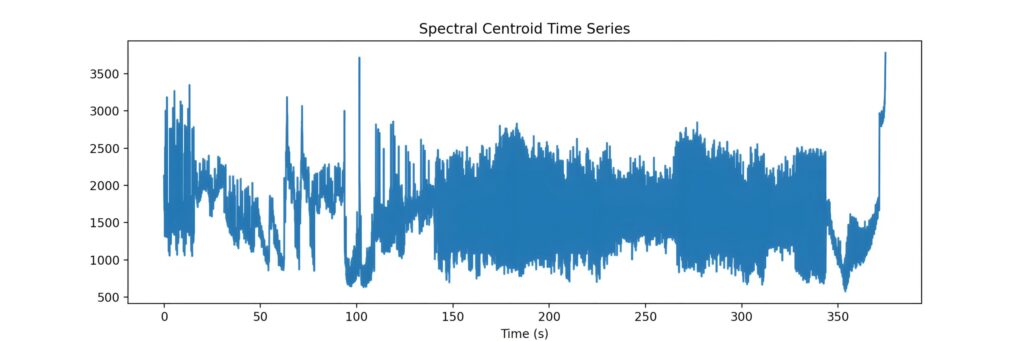
Spectral Centroid: ≈ 1,600 Hz
This index represents the “brightness” of the sound. A value of 1,600 Hz indicates a composed, well-rounded resonance with a rich midrange—neither muffled nor piercingly shrill.
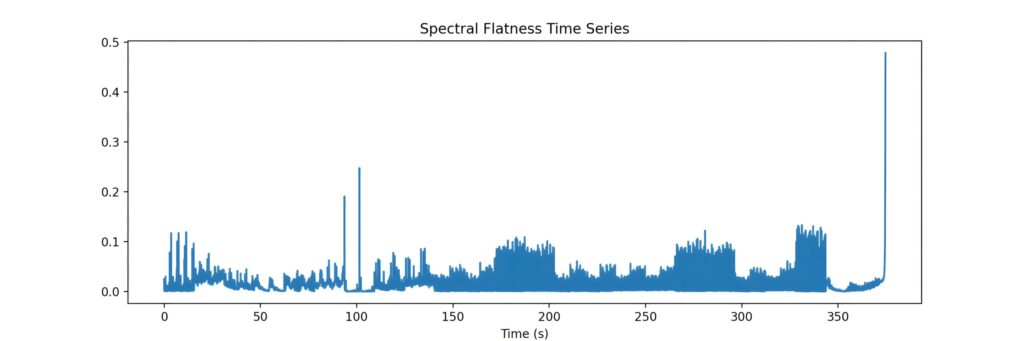
Spectral Flatness: 25.1
This relatively high value suggests a texture rich in noise components and complex overtones (such as synth leads and thick backing tracks) rather than simple pure tones.
■ Mid-High Range Definition (Spectral Contrast)
A standout feature is the Spectral_Contrast_Mean_5 value of 52.95, which is exceptionally high compared to other bands (≈ 18–20).
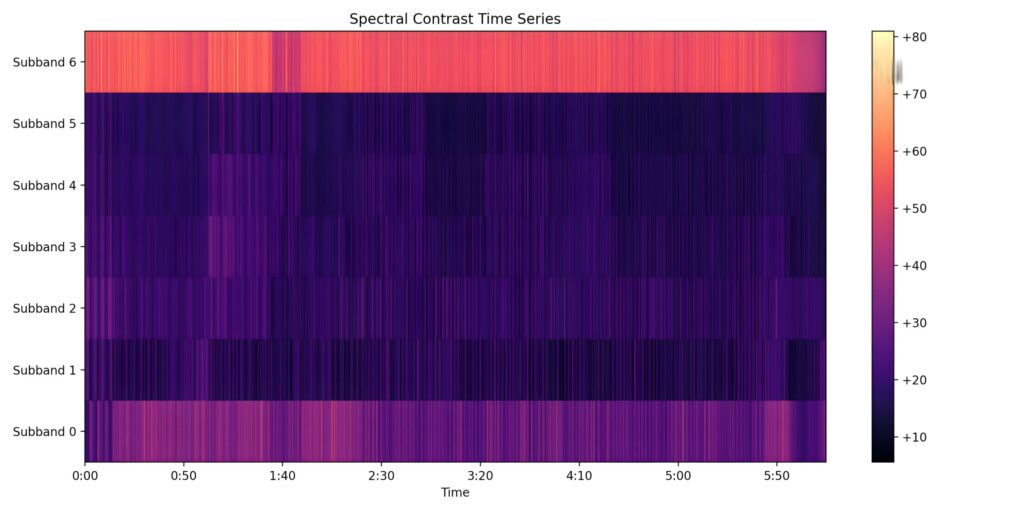
- Analysis: This signifies an extreme contrast between “active sound” and “silence” in the frequencies around 4kHz.
- Interpretation: It suggests that high-frequency elements—such as sharp percussion or the aggressive attack of the Koto (plucked string)—stand out clearly without being buried in reverb. This points to a high-resolution mix with well-organized sonic “gaps.”
■ The Sharpness of the Koto “Tsume” and Spectral Contrast
The abnormally high Spectral_Contrast_Mean_5 (52.95) is likely driven by the “crisp plucking sound” of the main Koto riff.
- Analysis: High contrast in this band indicates a sharp distinction between the moment a note is struck and the moment it vanishes.
- Interpretation: Within the 123 BPM rhythm, the attack of the Koto “tsume” (pick) striking the strings remains prominent, never washed away by muddy reverb. By separating “silence” from “sound” in this range while maintaining a thick low end, the mix achieves a focused core without any blurring.
■ A “Grounded” Acoustic Balance (MFCC Analysis)
The MFCC_Mean_2 shows a high positive value of 88.80, indicating a spectral slope that leans toward the lower frequencies. The high end is not overbearing; instead, the foundation of lows and low-mids (bass and drum resonance) provides the track’s persuasive power.
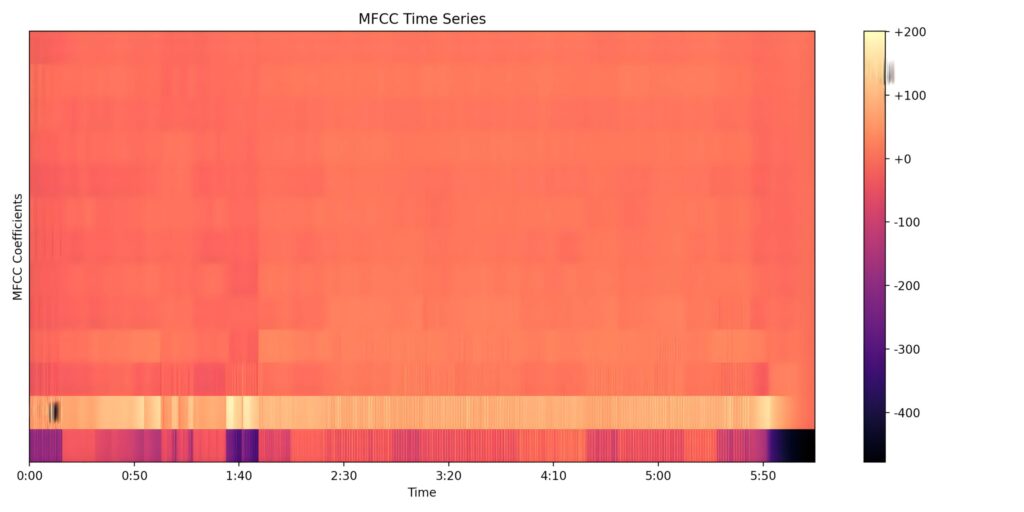
- Analysis: While the Koto is typically a “bright” instrument in the mid-high range, this data shows the track’s overall center of gravity is quite low.
- Interpretation: Combined with the solemnity of the A minor key and the calm 438Hz tuning, the grounded bassline and kick drum prevent the Koto’s brilliance from feeling “flighty.” This imbues the “Samurai” theme with weight and resolve rather than mere lightheartedness.
■ Energy & Dynamics
RMS (Sound Pressure) Composition: RMS_Harmonic_Mean (0.18) exceeds RMS_Percussive_Mean (0.06). While percussion creates the “onsets” (triggers) of the rhythm, the actual foundation of the track’s energy is sustained by harmonic components like bass, pads, and melodies.
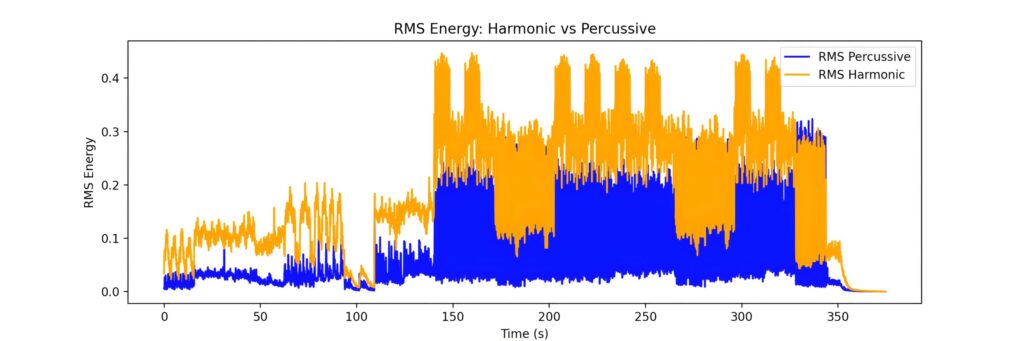
■ The Aesthetics of Decay (RMS & Zero Crossing Rate)
The Zero_Crossing_Rate_Mean is notably low at 0.073.
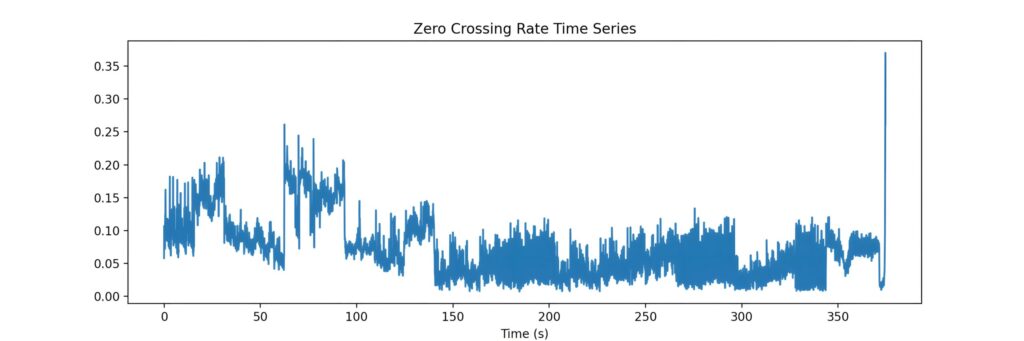
- Analysis: This indicates a very clean waveform with minimal distortion or noise components.
- Interpretation: This reflects a focus on the “beauty of resonance” as the Koto notes fade away. It’s a luxurious balance of “Japanese Minimalism”—utilizing space rather than filling it with noise—coexisting with a bass-heavy mix.
Chapter 2: Tonal Framework (Bones)
Key Strength / Tonnetz / Am–F Duality
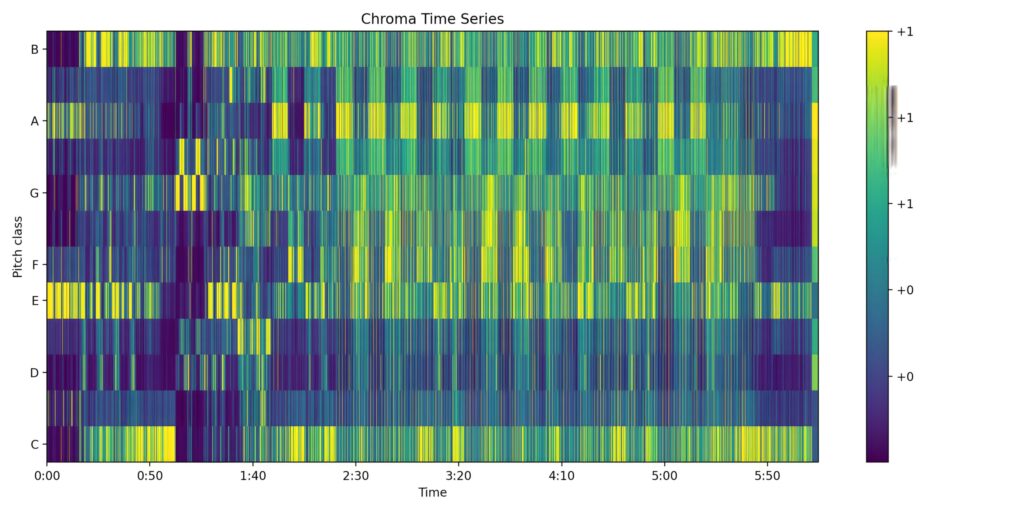
■ Harmony & Chroma Features
| Scale Index | Pitch Class | Mean Intensity | Variation (Std) | Interpretation |
| Chroma 1 | C | 0.571 | 0.302 | Minor 3rd of Am / C Major component |
| Chroma 2 | C# | 0.303 | 0.206 | |
| Chroma 3 | D | 0.280 | 0.244 | |
| Chroma 4 | D# | 0.318 | 0.228 | |
| Chroma 5 | E | 0.553 | 0.304 | Perfect 5th of Am |
| Chroma 6 | F | 0.447 | 0.306 | |
| Chroma 7 | F# | 0.429 | 0.315 | |
| Chroma 8 | G | 0.513 | 0.289 | 7th of Am (Natural Minor) |
| Chroma 9 | G# | 0.417 | 0.254 | |
| Chroma 10 | A | 0.498 | 0.330 | Root Note |
| Chroma 11 | A# | 0.390 | 0.248 | |
| Chroma 12 | B | 0.601 | 0.296 | 2nd of Am / Adds tension |
The Chroma vector reveals strong presence in C / B, E, and G, indicating a chord progression with transparency and stability based in A minor.
■ The “Depth” of the 438Hz Setting
The tuning, slightly lower than the standard 440Hz, is reflected in the variance of the Chroma data.
- Analysis: The values for Chroma 12 (B) and Chroma 1 (C) are nearly equally high.
- Interpretation: By tuning to 438Hz, the notes “lean” toward the adjacent semitone below in standard pitch detection. This creates a data-level “ambiguous shimmer.” This choice isn’t just a preference; it is etched into the data as a subtle fluctuation, likely evoking the “archaic weight” and “melancholy” associated with the Samurai theme.
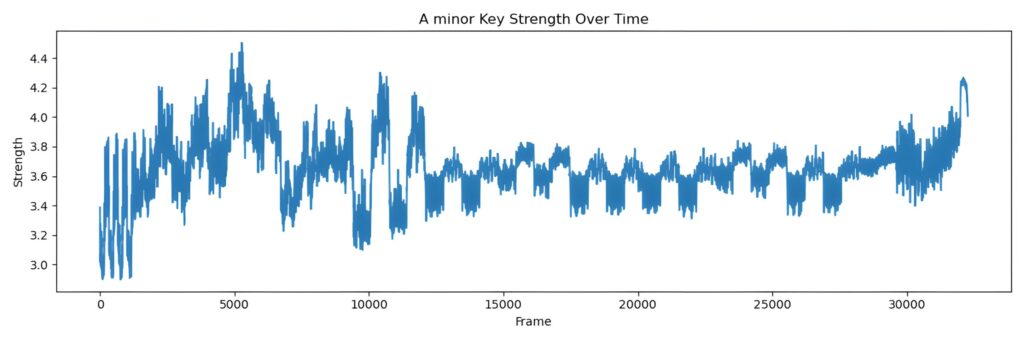
■ Absolute Tonal Stability (Key Strength Analysis)
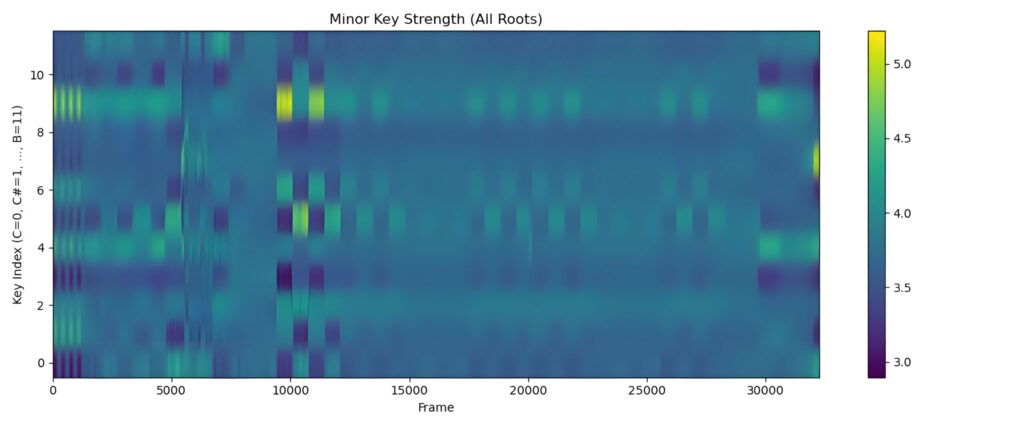
The average minor key strength across the entire duration identifies A minor (Am) as the absolute axis.
| Estimated Key (Minor) | Average Strength | Musical Interpretation |
| A minor | 21.35 | The absolute axis that dominates the composition. |
| E minor | 20.84 | Dominant of Am. Reinforces the Koto melody and harmonic components. |
| D minor | 20.68 | Subdominant of Am. A component that provides expansiveness to the track. |
- A minor (21.35): The dominant pillar of the track.
- E minor (20.84): The dominant of Am; reinforces Koto melodies and harmonies.
- D minor (20.68): The subdominant; adds expansiveness.
The narrow margin between A, E, and D signifies that the Pentatonic sound (specifically “La-Re-Mi”), common in Koto music, is clearly captured in the data.
■ Global Key Analysis: Coexistence of Duality
In the overall key estimation, Am and F Major are neck-and-neck (0.97 vs 0.96).
| Rank | Estimated Key | Strength | Musical Interpretation |
| 1 | A4 minor | 0.978 | The soul of the track. Stoic and quiet resolve. |
| 2 | F4 Major | 0.962 | The color of the track. Sentimentality and expansiveness (The “Momiji” scenery). |
| 3 | C4 Major | 0.958 | Sense of stability. Resonates as the relative major of Am. |
The tension between Am (Minor) and F (Major) speaks to the emotional depth of the composition.
■ A Dialogue between “Silent Am” and “Expansive F Major”
The section analysis shows a structure that frequently oscillates between Am and F Major.
- Am (Tonic): Stability, evoking the discipline and quiet determination of a warrior.
- F Major (Submediant): A moment where the field of vision suddenly opens up, and emotions overflow. This loop creates a dramatic, emotional progression rather than a simple “dark” track.
■ Tonnetz Analysis: The “Distance” between Tradition and Modernity
The Tonnetz data (geometric relationships between notes) shows how “close” or “far” harmonic changes are.
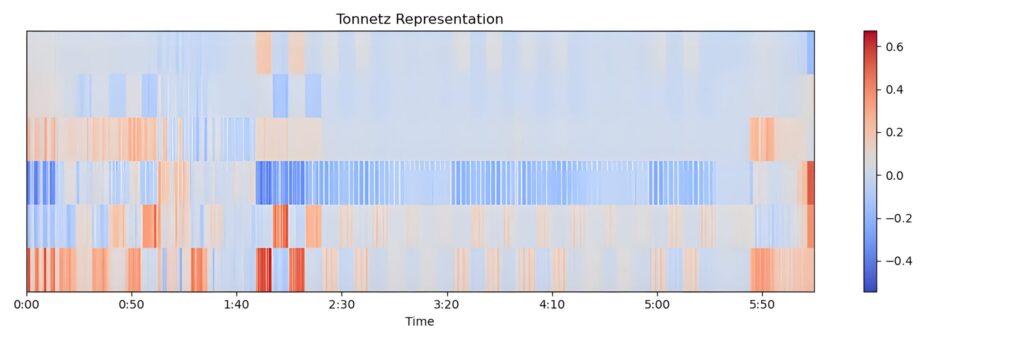
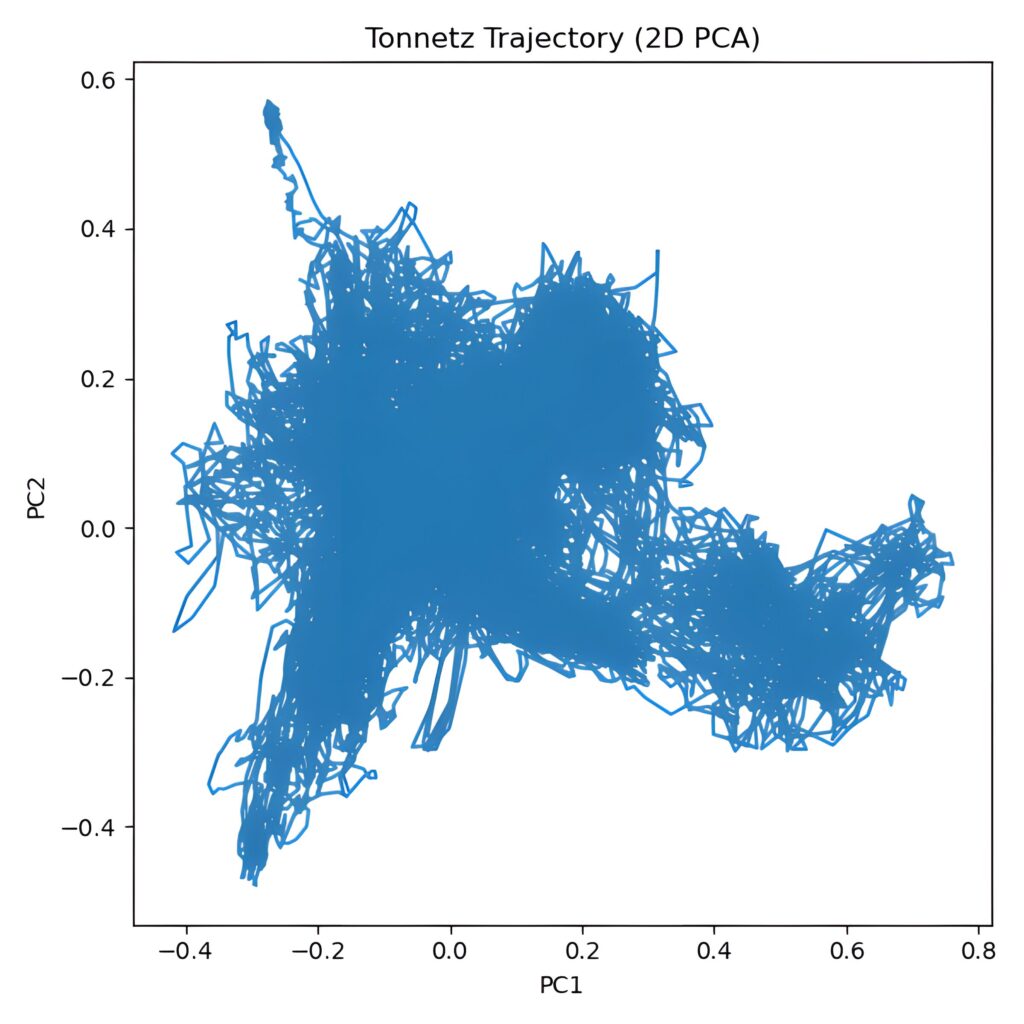
- Analysis: Tonnetz Dim 0 & 1 (Circle of Fifths relationships) remain stable.
- Interpretation: Shifts between Am, F Major, and G minor are “closely related” in music theory, making the transitions very smooth. Despite “edgy” elements like the 438Hz tuning and sharp attacks, the track maintains a dignified, accessible harmonic sense.
■ “Decisiveness” in the Tonnetz
The standard deviation of the tonnetz_dim_0 to 5 values is a very low 0.10.
- Analysis: Harmonic movement stays within a specific geometric range. Even when it sounds like a modulation, it is geometrically stationary. The story is driven by internal tension rather than flashy key changes.
- Interpretation: This visualizes a “stoic spirituality,” building a narrative through the addition and subtraction of timbre and rhythm within the single universe of A minor.
Chapter 3: Temporal Narrative (Story)
Section Structure / Similarity / Harmonic Change × Onset
■ Rhythm & Tempo
- The Fluctuation in Tempo Detection: Interestingly, while the DAW was set to 123 BPM, the analysis detected 125 BPM.
- Interpretation: The algorithm likely sensed a “driving” feel (playing ahead of the beat) or the abundance of 16th-note grace notes and ghost notes. It reflects the contrast between “stillness and motion”—moving instantly from a standstill, much like a Samurai.
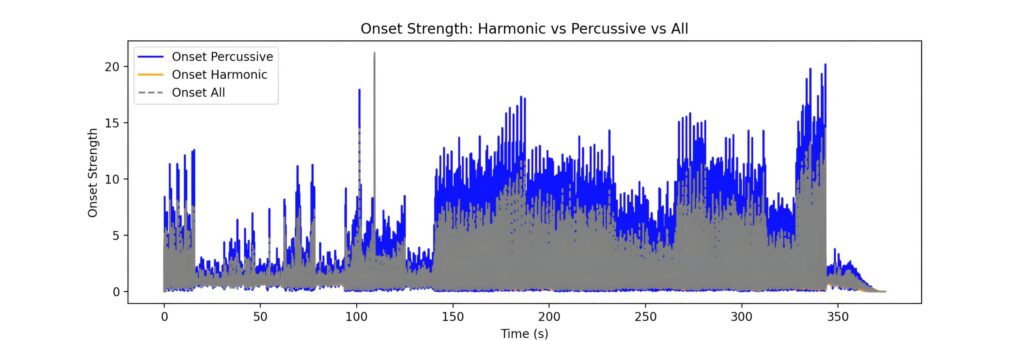
- Percussive Momentum: Onset_Percussive_Mean (1.92) is significantly higher than Harmonic_Mean (0.99), suggesting that drums and high-attack percussion drive the rhythm more than melodic transitions.
■ Harmonic Density and Narrative Flux
| Key | Average Harmonic Density | Role Inference |
| E minor / G minor | 3.0 – 3.1 (High) | Tension, conflict, bridge sections. |
| A minor / F Major | 2.7 – 2.9 (Standard) | Main theme, stability. |
- E minor / G minor (Density 3.0–3.1): High density. Represents tension, conflict, or “bridge” sections.
- A minor / F Major (Density 2.7–2.9): Standard density. Main theme and stability.
- Interpretation: The high-density sections likely depict “hesitation” or “intense conflict,” acting as bridges that build the listener’s anticipation for a resolution.
■ Scene Transitions via Harmonic Change
By identifying points where harmonic_change spikes (e.g., the shift to G minor at 62s), we can visualize where the “scenes” change.
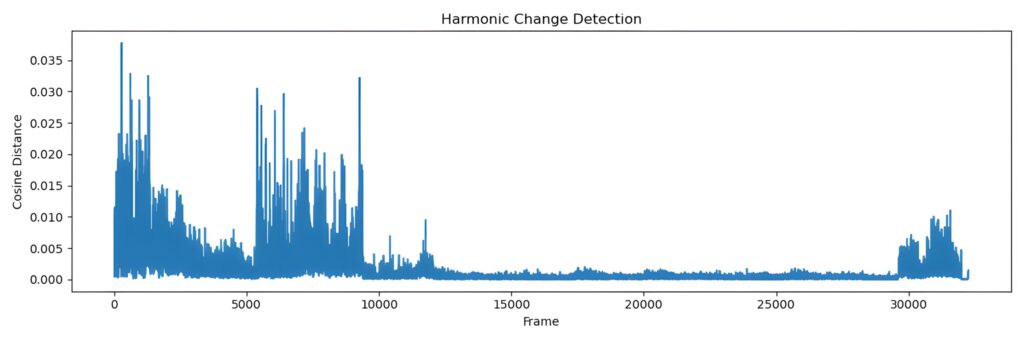
- Interpretation: These spikes represent “the moment the sword is drawn” or “the moment the landscape shifts from autumn to winter.” Combined with onset_strength, it proves that rhythm and harmony are perfectly synchronized to keep the listener engaged.
■ Synchronization of Rhythm and Harmony
There is a tight correlation between onset_strength (rhythmic impact) and harmonic_change.
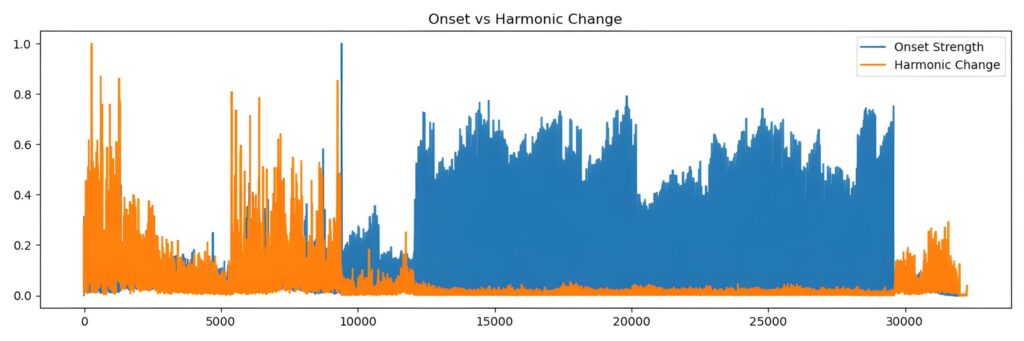
- Interpretation: Rather than mechanical MIDI coldness, the “humanized” recreation of a string instrument’s raw attack drives the groove of the track.
■ A 6-Minute 14-Second “Long Story”
- Start to Middle: Onset_strength increases and decreases periodically, like waves crashing.
- Toward the End: The amplitude of harmonic_change shifts, suggesting a movement toward either “silence” or a “tense finale.”
■ Section Cluster Analysis (Summary)
Estimated Clusters: 10
The story shifts from “The Blade” (Am) to “Maple Leaves” (F Major) to “Shadows” (Gm), a progression mathematically supported by key selection and density.
Section Definitions (Characteristics of Each Cluster)
| Section | Key | Strength | Harmonic Density |
| 0 | F4 Major | 0.920795 | 2.434925 |
| 1 | F4 Major | 0.945788 | 3.125001 |
| 2 | F4 Major | 0.964987 | 3.304865 |
| 3 | A4 minor | 0.944691 | 3.040811 |
| 4 | A#4 Major | 0.919984 | 2.797080 |
| 5 | A4 minor | 0.943370 | 2.467320 |
| 6 | G4 minor | 0.975448 | 3.100542 |
| 7 | G4 minor | 0.904142 | 2.865894 |
| 8 | E4 minor | 0.930007 | 3.155316 |
| 9 | E4 minor | 0.940868 | 3.164314 |
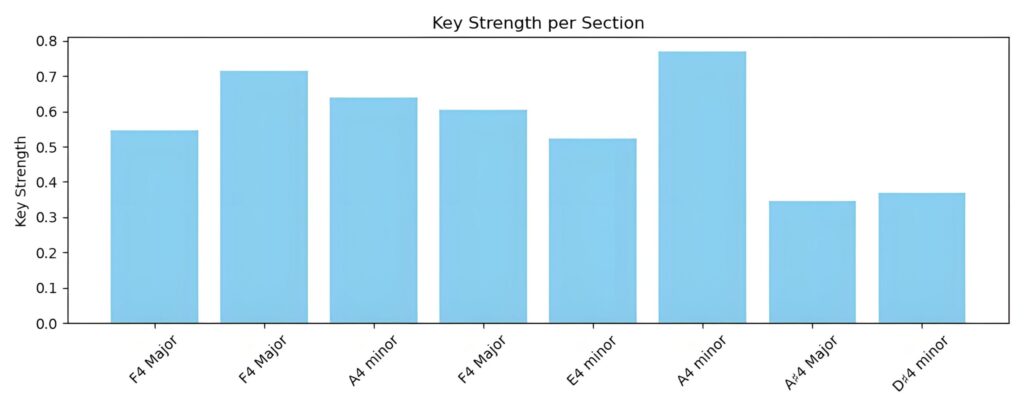
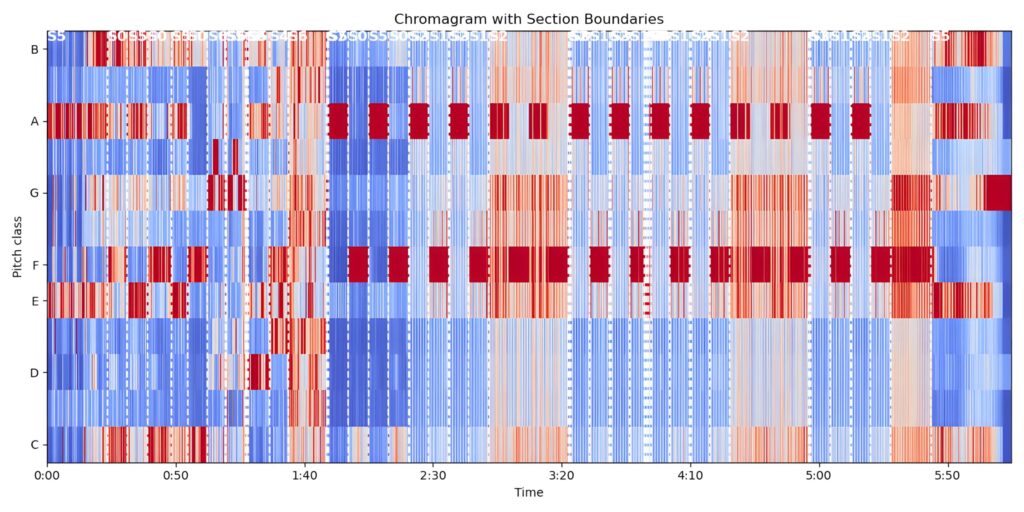
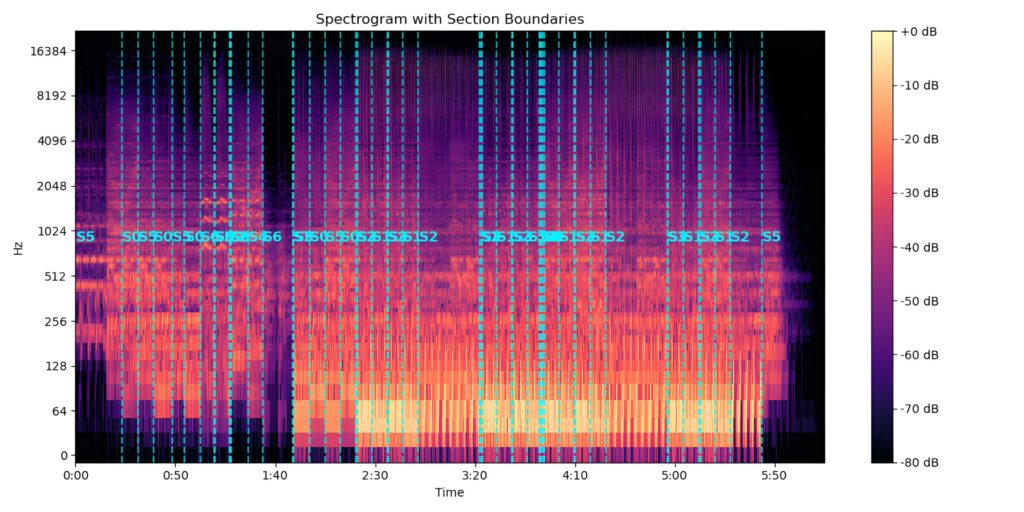
Ten clusters (S0–S9) each fulfill a distinct role within the track.
| Section | Primary Key | Density | Role Inference |
| S5 / S3 | Am | 2.4 – 3.0 | “Stillness / The Blade”: A sharp, stoic part where the main Koto riff stands out. |
| S0 / S1 / S2 | F Major | 2.4 – 3.3 | “Motion / Maple Leaves”: A part where harmonic expansiveness increases and the scenery unfolds. |
| S6 / S7 | Gm | 2.8 – 3.1 | “Tension / Shadows”: A slightly unsettling and dramatic development, as if shadows are momentarily falling. |
| S8 / S9 | Em | 3.15 | “Convergence toward the Finale”: An E minor resonance acting as the dominant of Am. Increase in density toward the end. |
- S5 / S3 (Am): “Stillness / The Blade.” Stoic parts where the Koto riff shines.
- S0 / S1 / S2 (F Major): “Motion / Maple Leaves.” Expansive harmony and scenery.
- S6 / S7 (Gm): “Tension / Shadows.” Dramatic, slightly ominous developments.
Section Time Ranges (Chronology)
| No. | Section (Cluster) | StartTime (s) | EndTime (s) |
| 0 | 5 | 0.000000 | 23.440544 |
| 1 | 0 | 23.440544 | 31.254059 |
| 2 | 5 | 31.254059 | 39.055964 |
| 3 | 0 | 39.055964 | 48.320726 |
| 4 | 5 | 48.320726 | 54.659773 |
| 5 | 0 | 54.659773 | 62.461678 |
| 6 | 6 | 62.461678 | 69.288345 |
| 7 | 5 | 69.288345 | 69.775964 |
| 8 | 6 | 69.775964 | 77.101859 |
| 9 | 2 | 77.101859 | 77.589478 |
| 10 | 6 | 77.589478 | 78.077098 |
| 11 | 5 | 78.077098 | 86.378231 |
| 12 | 4 | 86.378231 | 93.680907 |
| 13 | 6 | 93.680907 | 108.808707 |
| 14 | 7 | 108.808707 | 109.284717 |
| 15 | 5 | 109.284717 | 117.098231 |
| 16 | 0 | 117.098231 | 124.900136 |
| 17 | 5 | 124.900136 | 132.702041 |
| 18 | 0 | 132.702041 | 140.503946 |
| 19 | 2 | 140.503946 | 140.991565 |
| 20 | 3 | 140.991565 | 148.305850 |
| 21 | 1 | 148.305850 | 156.119365 |
| 22 | 2 | 156.119365 | 156.606984 |
| 23 | 3 | 156.606984 | 163.921270 |
| 24 | 1 | 163.921270 | 171.723175 |
| 25 | 2 | 171.723175 | 202.454785 |
| 26 | 1 | 202.454785 | 202.942404 |
| 27 | 2 | 202.942404 | 203.430023 |
| 28 | 3 | 203.430023 | 210.744308 |
| 29 | 1 | 210.744308 | 218.557823 |
| 30 | 2 | 218.557823 | 219.045442 |
| 31 | 3 | 219.045442 | 226.359728 |
| 32 | 1 | 226.359728 | 232.211156 |
| 33 | 2 | 232.211156 | 232.698776 |
| 34 | 9 | 232.698776 | 233.186395 |
| 35 | 8 | 233.186395 | 233.674014 |
| 36 | 2 | 233.674014 | 234.649252 |
| 37 | 3 | 234.649252 | 241.975147 |
| 38 | 1 | 241.975147 | 249.777052 |
| 39 | 2 | 249.777052 | 250.264671 |
| 40 | 3 | 250.264671 | 257.578957 |
| 41 | 1 | 257.578957 | 265.380862 |
| 42 | 2 | 265.380862 | 296.112472 |
| 43 | 1 | 296.112472 | 296.600091 |
| 44 | 3 | 296.600091 | 304.413605 |
| 45 | 1 | 304.413605 | 312.215510 |
| 46 | 2 | 312.215510 | 312.703129 |
| 47 | 3 | 312.703129 | 320.017415 |
| 48 | 1 | 320.017415 | 327.819320 |
| 49 | 2 | 327.819320 | 343.434739 |
| 50 | 5 | 343.434739 | 374.634127 |
The data density vividly illustrates the track’s dramatic arc, particularly through the rapid developments around the 140s mark (No. 19–33) and the extended outro starting at 343s (No. 50).
■ Structural Timeline Analysis
Within the 374-second journey, we observe a very compelling progression:
- 0s ~ 62s (Opening): The track alternates between S5 (Am) and S0 (F Major). This serves as an introduction that begins in silence and gradually reveals the landscape.
- 62s ~ 108s (Mid-track Turbulence): S6 (Gm) and S4 (A# Major) suddenly appear. Given the high Similarity (Sim) of 0.8–0.9, this suggests an evolution where new layers are added to existing sounds to heighten tension, rather than an abrupt change.
- 140s ~ 327s (Mid-to-Late Loop Development): S1, S2, and S3 repeat with an extremely high Similarity of 0.966. This can be considered the “peak groove zone,” where subtle additions and subtractions (dub-style arrangements or improvisational Koto variations) occur within a perfected groove.
- 343s ~ End (Conclusion): The track returns to S5 (Am), concluding with a sense of resolute stability.
| No. | Transition | Similarity (Sim) |
| 1 | S5 → S0 | 0.737 |
| 2 | S0 → S5 | 0.737 |
| 3 | S5 → S0 | 0.737 |
| 4 | S0 → S5 | 0.737 |
| 5 | S5 → S0 | 0.737 |
| 6 | S0 → S6 | 0.793 |
| 7 | S6 → S5 | 0.836 |
| 8 | S5 → S6 | 0.836 |
| 9 | S6 → S2 | 0.961 |
| 10 | S2 → S6 | 0.961 |
| 11 | S6 → S5 | 0.836 |
| 12 | S5 → S4 | 0.803 |
| 13 | S4 → S6 | 0.887 |
| 14 | S6 → S7 | 0.908 |
| 15 | S7 → S5 | 0.875 |
| 16 | S5 → S0 | 0.737 |
| 17 | S0 → S5 | 0.737 |
| 18 | S5 → S0 | 0.737 |
| 19 | S0 → S2 | 0.886 |
| 20 | S2 → S3 | 0.916 |
| 21 | S3 → S1 | 0.827 |
| 22 | S1 → S2 | 0.966 |
| 23 | S2 → S3 | 0.916 |
| 24 | S3 → S1 | 0.827 |
| 25 | S1 → S2 | 0.966 |
| 26 | S2 → S1 | 0.966 |
| 27 | S1 → S2 | 0.966 |
| 28 | S2 → S3 | 0.916 |
| 29 | S3 → S1 | 0.827 |
| 30 | S1 → S2 | 0.966 |
| 31 | S2 → S3 | 0.916 |
| 32 | S3 → S1 | 0.827 |
| 33 | S1 → S2 | 0.966 |
| 34 | S2 → S9 | 0.934 |
| 35 | S9 → S8 | 0.999 |
| 36 | S8 → S2 | 0.934 |
| 37 | S2 → S3 | 0.916 |
| 38 | S3 → S1 | 0.827 |
| 39 | S1 → S2 | 0.966 |
| 40 | S2 → S3 | 0.916 |
| 41 | S3 → S1 | 0.827 |
| 42 | S1 → S2 | 0.966 |
| 43 | S2 → S1 | 0.966 |
| 44 | S1 → S3 | 0.827 |
| 45 | S3 → S1 | 0.827 |
| 46 | S1 → S2 | 0.966 |
| 47 | S2 → S3 | 0.916 |
| 48 | S3 → S1 | 0.827 |
| 49 | S1 → S2 | 0.966 |
| 50 | S2 → S5 | 0.869 |
The consecutive high values in the latter half (from No. 21 onwards), such as 0.966 and 0.999 (S9→S8), confirm a structure with extremely high harmonic consistency. This allows for an engaging experience where listeners can enjoy the subtle timbral shifts and rhythmic nuances while the core foundation remains rock-solid.
Summary: The Track Profile Revealed by Analysis
“Samurai (momiji mix)” achieves a listener-friendly texture that avoids over-emphasized high frequencies while maintaining a pleasant 123 BPM beat. While the percussion drives the rhythm, the core is filled with rich harmonies (synths and instrumental resonances). The analysis suggests a track that conveys a “robust core strength” rather than mere flashiness.
The main Koto riff exhibits a unique combination of a “sharp attack” and “elegant decay.” The deliberate choice to lean the mix toward the low end manifests in the data in a very compelling way. The track essentially bonds “modern sub-bass power” with the “traditional delicate attack of Japanese instruments” through the unique atmosphere of 438Hz. The fact that the Koto phrases remain “crisp” and do not get buried despite the heavy low end is proof of extremely meticulous dynamics management across each frequency band.
While previous analyses focused on the “Sonic Cells (Texture),” this latest breakdown has brought the “Sonic Skeleton (Narrative)” into focus. It is a meticulously structured story that paints a landscape through the dialogue between Am and F, while heightening tension through the complex harmonies of G minor and E minor.
Insights as an Engineer and Composer
The most striking discovery in this analysis is the high “Similarity (Sim)” during section transitions. The fact that many transitions exceed 0.8 to 0.9 indicates that this track is not a patchwork of disparate parts. Instead, it maintains a single, massive flow—a “grand river” of a groove—where only the harmonic colors (Keys) shift smoothly.
This high similarity serves as evidence that the baseline and rhythmic foundation dominate and unify the composition from start to finish.
Conclusion: The Value of “Samurai (momiji mix)” as Shown by Data
The data proves that this track “upholds a rigid framework of tradition (Tonnetz stability in Am) while facilitating a high-density sonic dialogue (Onset & Key Strength) within that space.”