 Akihito Kimura
 私にとって音とは、単なる空気振動の記録ではありません。
それは「世界の見え方そのもの」が変容する瞬間の痕跡です。
今回取り上げる「Akihito Kimura (木村哲人) / Sun In The Rain (single version) 」は、これまでの作品にあった「躍動する生命感」を受け継ぎながらも、より深い層でのテーマ—侵食と維持の同時進行—を内包した楽曲です。
雨は境界線を曖昧にし、輪郭を滲ませます。
しかしその中でも、陽光は直進性を失いません。
この相反する二つの力が、音響データの上でどのように衝突し、そして最終的に一つの秩序へと収束しているのか。
本作の特徴量から、その「壊れながら保たれる骨格」を紐解いていきます。
To me, sound is not merely a record of air in motion.
It is a trace left behind at the moment when our perception of the world itself begins to transform.
The piece discussed here,
“Akihito Kimura / Sun In The Rain (Single Version),”
inherits the vivid sense of life present in my earlier works, while carrying a deeper underlying theme:
erosion and preservation unfolding simultaneously.
Rain blurs boundaries. It softens edges and dissolves outlines.
And yet, even within rainfall, sunlight does not lose its sense of direction.
This piece examines how those two opposing forces collide within the acoustic data — and how, in the end, they converge into a single emergent order.
By exploring its audio features, we begin to uncover the framework that remains intact even as it breaks.
ダイナミクス構造 – 不規則な雨と、止まらない歩幅
まずは楽曲のエネルギー設計から見ていきましょう。
RMS:ハーモニックとパーカッシブの相克
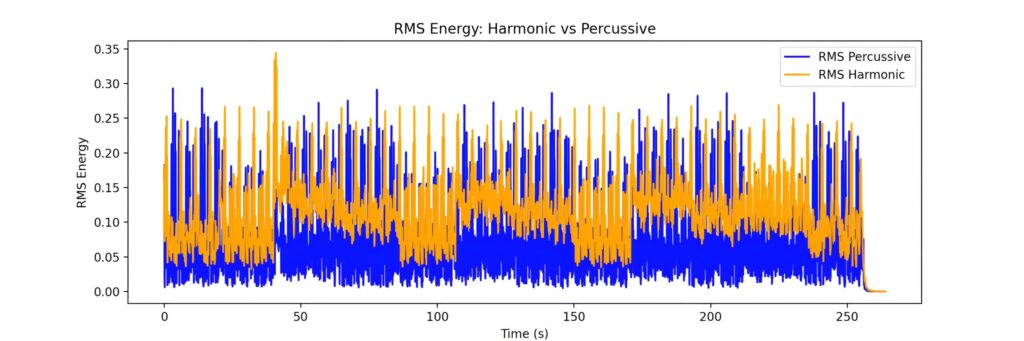
- 橙:RMS_Harmonic_Mean:0.1126
- 青:RMS_Percussive_Mean:0.0699
旋律成分が主軸ではあるものの、打撃音の存在感が非常に強いバランスです。
これは「旋律の上にリズムが乗っている」状態ではなく、旋律の世界に、ノイズ的な打撃が常時侵入している構造です。
特に注目すべきはパーカッシブ成分の変動(Std)の高さです。
- RMS_Percussive_Std:0.0537
この数値は、リズムが機械的に安定した一定のグルーヴではないことを示しています。まるで雨粒が屋根を叩くように、あるいは風に煽られるように、不規則に降り注いでいる様子が浮かび上がります。
Dynamics Structure — Irregular Rain, Unstoppable Steps
Let us begin with the energy design of the piece.
RMS: The Tension Between Harmonic and Percussive Forces
RMS Harmonic Mean: 0.1126
RMS Percussive Mean: 0.0699
Although melodic elements form the central axis, the presence of percussive components is remarkably strong.
This is not a case where rhythm simply rides on top of melody. Rather, noise-like percussive impacts constantly intrude into the melodic space.
Especially notable is the high fluctuation in the percussive component:
RMS Percussive Std: 0.0537
This indicates that the rhythm is not mechanically stable as a fixed groove. Instead, it falls irregularly — like raindrops striking a roof, or gusts of wind scattering patterns.
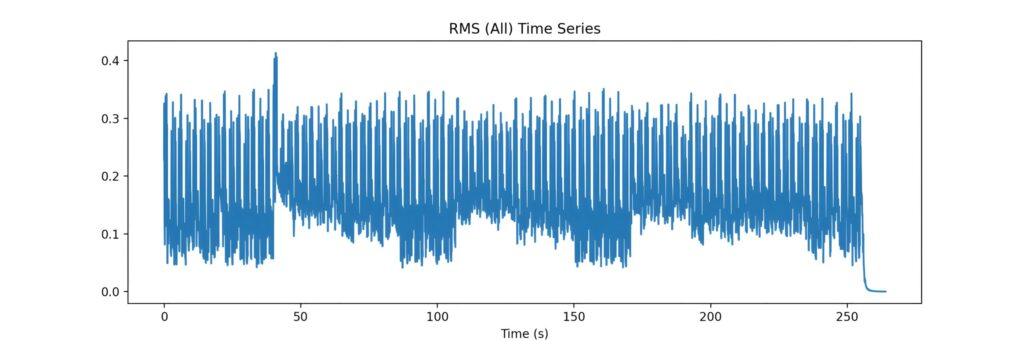
- 全体の音量平均(RMS_All_Mean:0.1588)
- 全体ダイナミクスの変動幅(RMS_All_Std:0.0727)
個々の要素(雨粒)は激しく明滅し、互いの領域を侵食し合っています。
それでも楽曲全体のエネルギー推移は極端に暴れません。
全体ダイナミクスの変動幅(Std)が抑えられていることは、この楽曲が「叫び」ではなく「対話」であることを示唆しています。外界がどれほど騒がしくても、世界の時間が急に止まらないのと同じ構造です。崩れながらも続いていく運動。しかし、観測者であるリスナーの視点は常に一定の高さを保っています。
この「安定した揺らぎ」こそが、本作の持つ知的な叙情性の正体です。
Meanwhile:
RMS All Mean: 0.1588
RMS All Std: 0.0727
Individual elements flicker intensely and encroach upon one another.
Yet the overall energy trajectory of the piece never spirals out of control.
The restrained global dynamic variation suggests that this is not a cry, but a dialogue. No matter how chaotic the outside world becomes, time itself does not suddenly stop. Motion continues even while structures erode — and the listener’s perspective remains at a constant perceptual height.
This “stable fluctuation” is the essence of the piece’s intellectual lyricism.
スペクトル特徴 – 侵食される音程、残り続ける残像
次に音色の質感を見ていきます。
重心の高まりと「光の粒子」
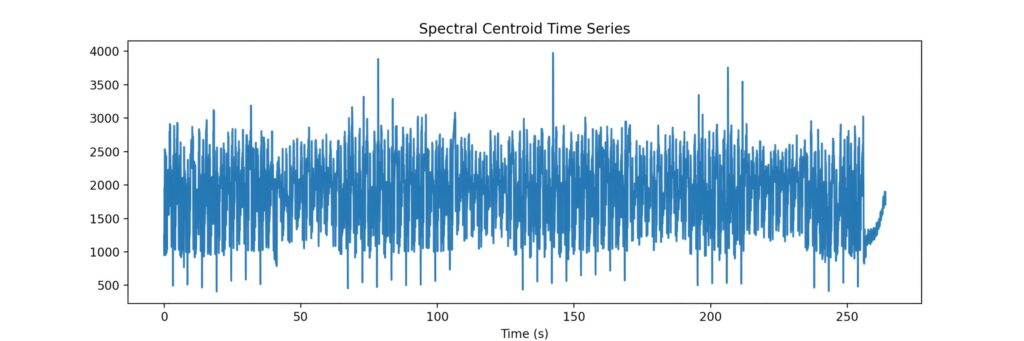
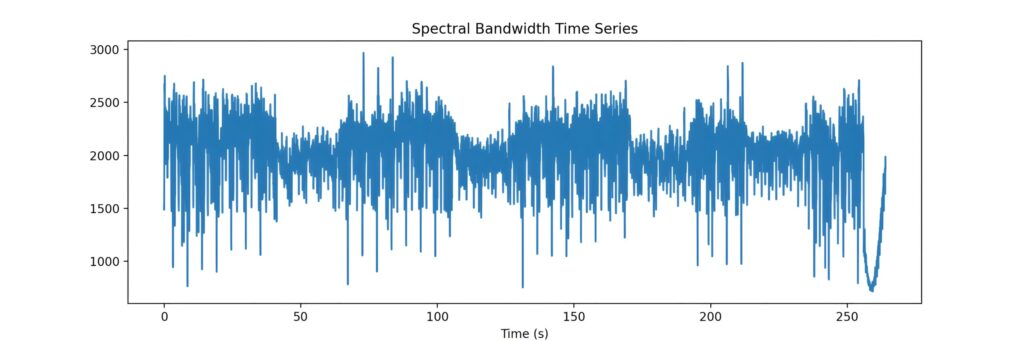
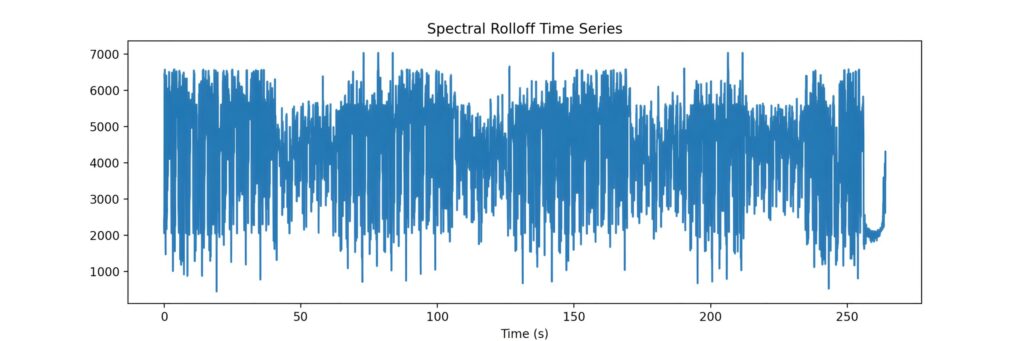
- 上:Spectral Centroid Mean:1916 Hz
- 中:Spectral Bandwidth Mean:2029 Hz
- 下:Spectral Rolloff Mean:4385 Hz
これらの値は、音の「高さ」ではなく、音色の明るさや粗さの分布を示す指標です。
音響重心(Centroid)は1916Hzと比較的高めですが、これは鋭利な刃物のような高音ではなく、空間全体に「微細な粒子が漂っている状態」を示しています。帯域幅(Bandwidth)が広いことは、エネルギーが特定の周波数に固執せず、中域から高域にかけて拡散していることを意味します。
これは「明るいメロディ」という主観的な表現よりも、「空気そのものがざわついているサウンドデザイン」と言った方が正確でしょう。雨によって乱反射した光が、視界を白く埋め尽くしていくような感覚です。
Spectral Qualities — Eroding Pitch, Lingering Afterimages
Now we turn to timbral texture.
Rising Spectral Centroid and “Particles of Light”
Spectral Centroid Mean: 1916 Hz
Spectral Bandwidth Mean: 2029 Hz
Spectral Rolloff Mean: 4385 Hz
These values describe not pitch height, but the brightness and distribution of timbre.
A centroid around 1916 Hz does not imply piercing sharpness. Instead, it suggests a space filled with fine floating particles of sound. The wide bandwidth indicates that energy is not confined to specific frequencies but diffuses broadly from mid to high ranges.
Rather than calling this a “bright melody,” it is more accurate to describe it as the air itself becoming texturally animated — like light scattering through rainfall and filling vision with a pale haze.
ゼロ交差率(ZCR)が描く「ノイズの洗礼」
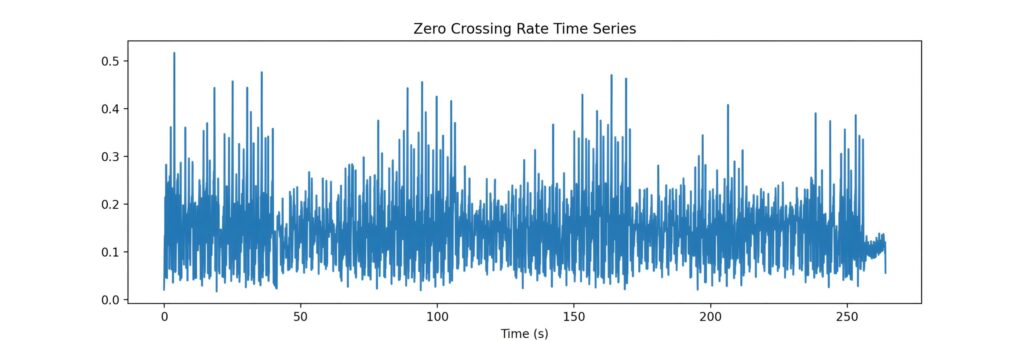
- Zero Crossing Rate Mean:0.148
この数値は特筆すべき高さです。通常、澄んだ楽器音では低くなるこの値が高いということは、音が純粋なピッチの「線」ではなく、摩擦を帯びた「粒子の集合」に変化していることを意味します。
ここで起きているのは、音程の破壊ではありません。音程がノイズによって摩耗している状態です。雨は世界を消すのではなく、輪郭を滲ませる。この楽曲の高ZCRは、まさにその物理的な証拠です。音が鳴った瞬間に、その輪郭が雨(ノイズ)によって削り取られていく。そして、その摩耗の痕跡までもが、楽曲のテクスチャを豊かにしているのです。
Zero Crossing Rate — The Baptism of Noise
Zero Crossing Rate Mean: 0.148
This value is unusually high for tones with clear pitch. A high ZCR means the sound is no longer a clean line of pitch, but a cluster of friction-like particles.
This is not the destruction of pitch, but its abrasion.
Rain does not erase the world; it blurs its contours. The high ZCR here is physical evidence of that process: the moment a tone appears, its edges are worn away by noise. Those traces of erosion become part of the music’s texture.
調性の慣性 – 崩壊の淵で維持される「秩序」
もっとも衝撃的なデータは、12音の分布を示すChroma(クロマ)解析に現れています。
クロマベクトルの拡散と偏り
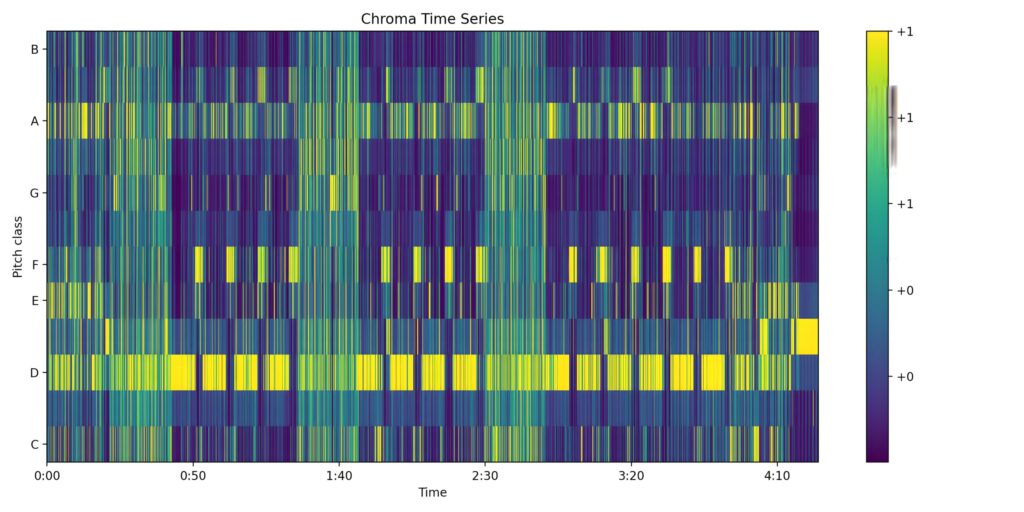
ここには、私が本作に込めた「社会的なメタファー」が如実に反映されていました。
クロマベクトルの拡散と「12音の民主主義」
データを見ると、特定の音(例えばCやGなど)が突出するのではなく、12音全体にエネルギーが広く分散している傾向があります。
- Chroma_Mean_1〜12の分散が小さい(=12音それぞれの平均エネルギーがほぼ均等に近い)
つまり、Chroma各次元の平均値が拮抗しており、特定音に支配的なピークが見られない。これは一見すると、調性の弱体化や音程中心の崩壊を示しているように見えます。しかし、聴感上、楽曲は決して無調には感じられません。ここに現れているのは、秩序の消失ではなく、「秩序の慣性」です。
社会という名のアンサンブル
価値観は多様化し、中心は曖昧になり、ノイズは増え続ける。それでも社会は突然止まらない。同じようにこの楽曲では、調性の中心が拡散し、それぞれの音が勝手に主張を始めても、進行の「流れ」そのものが秩序を保ち続けているのです。
音程はもはや絶対的な支配者ではなく、かつての重力がまだ世界を回し続けている。この「壊れかけの調和」が、リスナーに不思議な安堵感と切なさを同時に与えるのです。
Tonal Inertia — Order Maintained at the Edge of Collapse
The most striking data appears in the chroma analysis, which represents the distribution of the twelve pitch classes.
Chroma Diffusion — The “Democracy of Twelve Tones”
Energy is widely distributed across all twelve pitch classes. No single tone (such as C or G) dominates.
At first glance, this suggests a weakening tonal center — perhaps even collapse.
Yet perceptually, the piece never feels atonal.
What we are witnessing is not the disappearance of order, but the inertia of order.
Society as an Ensemble
Values diversify. Centers blur. Noise increases.
Yet society does not suddenly stop.
Likewise, in this piece, even as tonal centers diffuse and individual tones assert themselves freely, the flow of progression itself continues to maintain order.
Pitch is no longer an absolute ruler. Instead, the gravity that once defined the system still keeps the world turning. This fragile, half-broken harmony gives the listener both comfort and quiet sorrow.
スペクトル・コントラスト:明瞭さと曖昧さの境界線
今回、新たに追加解析した「Spectral Contrast」のデータが、本作の「Sun(光)」と「Rain(雨)」のバランスを鮮やかに証明しています。
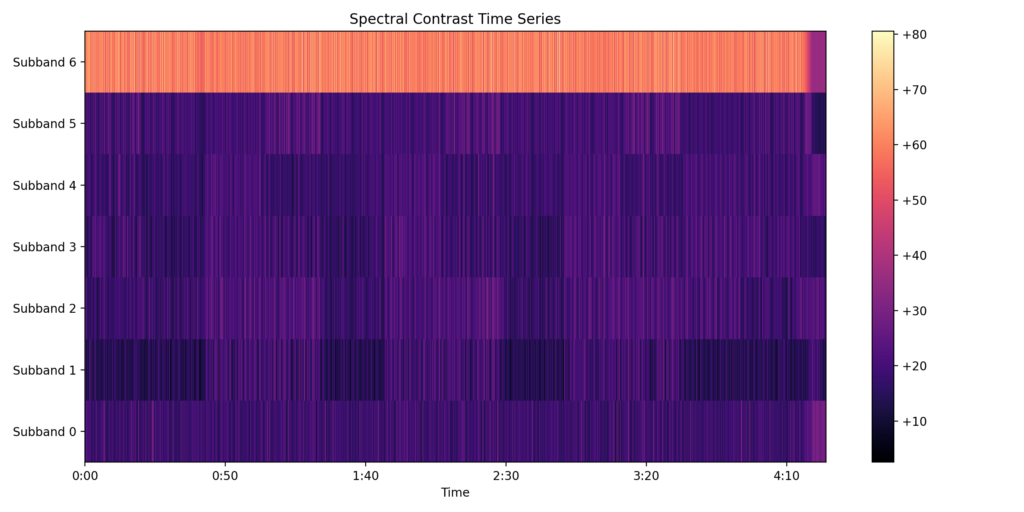
| 帯域 | コントラスト値(Mean) | 音響的解釈 | メタファーとしての意味 |
| 中域 (Band 3-4) | 19.19 ~ 20.24 | 標準的なコントラスト | 地に足のついた現実、歩行 |
| 中高域 (Band 5) | 59.18 | 極めて高いコントラスト | 雲を割って差す、強烈な直進光 |
| 高域 (Band 6-7) | 4.26 ~ 5.14 | 極端に低いコントラスト | 視界を白く染める、激しい雨のノイズ |
霧散する高域、孤立する中高域
高域(Band 6-7)のコントラストが4〜5台という極端に低い値を示している点は驚異的です。これは、高音域において「音のピーク(尖り)」と「バレー(谷間)」の差がほとんどない、つまり音が完全に飽和し、ノイズとして充満していることを意味します。まさに、雨が空を塗りつぶし、世界の輪郭を奪い去っている状態です。
しかし、そのすぐ下のBand 5において、コントラスト値は59.18という異様な跳ね上がりを見せます。これは、ノイズの海の中で、特定の周波数成分だけが周囲を寄せ付けない鋭さで屹立していることを示しています。 雨に濡れ、すべてが滲んでいく中で、そこだけが異常な明度で輝いている。この「59.18」という数字こそが、本作における「Sun(太陽)」の正体に他なりません。この異様な数値の突出は、ノイズに覆われた世界の中で、それでも失われない「方向性」の物理的証拠なのです。
Spectral Contrast — Where Light and Rain Divide the Sky
Newly analyzed spectral contrast data vividly illustrates the balance between “Sun” and “Rain.”
- Mid bands (3–4): Moderate contrast — grounded reality
- Band 5: Extremely high contrast (59.18) — piercing, directional light
- High bands (6–7): Extremely low contrast (4–5) — fully saturated noise
The highest frequencies show almost no contrast. Peaks and valleys vanish, meaning the region is completely saturated with noise — like rain whitening the sky and dissolving the world’s outlines.
Yet just below, Band 5 spikes dramatically. A specific frequency range stands sharply isolated, refusing to dissolve into the surrounding noise.
This number — 59.18 — is the acoustic embodiment of the “Sun” in this piece.
It is physical proof that directionality survives even within a world of noise.
MFCCが映し出す「作曲家の指紋」
音のテクスチャを多次元的に捉えるMFCC(メル周波数ケプストラム係数)を見ると、私の過去作とも共通する興味深い傾向が見て取れます。
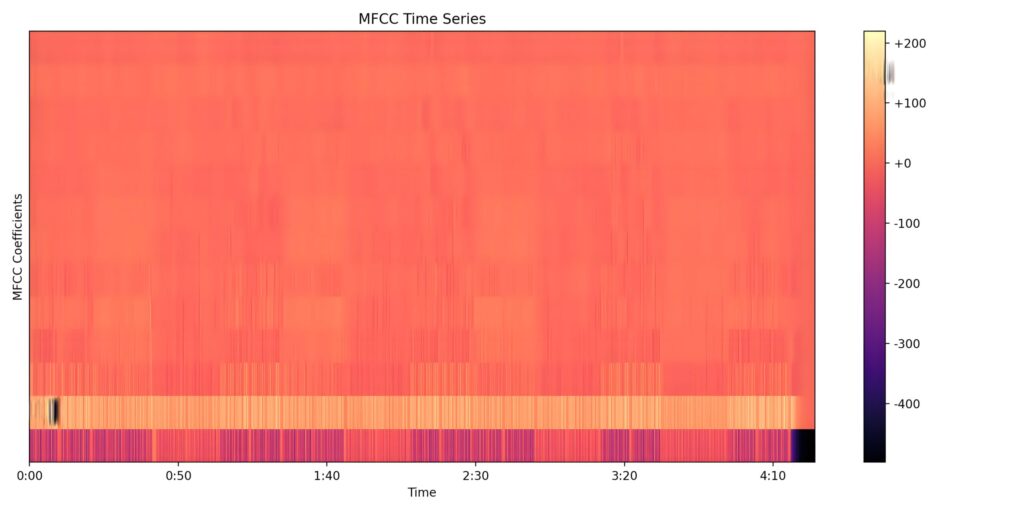
- MFCC_Std_1:85.5
この値は、音の密度が時間とともに大きく揺れていることを示します。
静かな雨音の層から、光が差し込むような密度の上昇まで、テクスチャが大きく呼吸している。
重要なのは、この「密度の揺らぎ方」が過去作とも共通する傾向を持っている点です。
楽器編成やジャンルが変わっても、音の密度をドラマとして設計する感覚は変わらない。
これは旋律でもコード進行でもなく、音の触感そのものに刻まれた作曲家の指紋と言えるでしょう。
MFCC — The Composer’s Fingerprint
MFCC Std 1: 85.5
This indicates that the density of sound shifts dramatically over time — from delicate rain-like layers to surges of illuminated mass.
More importantly, this pattern of density fluctuation mirrors tendencies found across my earlier works. Instrumentation and genre may change, but the instinct to shape density itself as drama remains constant.
This is not melody or harmony.
It is the composer’s fingerprint embedded in the tactile surface of sound.
壊れても、世界は止まらない
「Sun In The Rain」が描いているのは、単純な破壊ではありません。
- リズムは侵食される(RMS_Percussive_Std)
- 音程は摩耗する(High ZCR)
- 中心は拡散する(Chroma Diffusion)
- 高域の輪郭は失われる(Low Contrast Band 6-7)
それでも楽曲は進み続けます。
これは、秩序が守られている世界 ではなく、秩序が慣性によって「まだ回っている世界」の音です。
雨は光を消すために降るのではなく、光を乱反射させ、見え方そのものを変えるために降っている。
高いZCR、拡散するChroma、揺れるMFCC。
それでも崩れない全体のダイナミクス。
この曲の中で起きているのは、「壊れながら続くこと」そのものが、新しい秩序になる瞬間なのかもしれません。
そしてそれは、音楽の話であると同時に、今を生きる私たちの世界の構造そのものでもあるのです。
だからこそ私は、音楽を分析しているのではなく、音楽という形をした「世界の振る舞い」を観測しているのだと思います。
Even When Breaking, the World Does Not Stop
“Sun In The Rain” does not portray simple destruction.
Rhythm is eroded.
Pitch is worn down.
Centers disperse.
High-frequency contours dissolve.
And yet the piece continues forward.
This is not the sound of a world where order is protected.
It is the sound of a world where order continues by inertia.
Rain does not fall to extinguish light, but to scatter it — to change how the world is seen.
High ZCR. Diffused chroma. Breathing MFCC textures.
Yet the global dynamics never collapse.
What happens here may be the moment when continuing while breaking becomes a new form of order.
And this is not only about music.
It mirrors the very structure of the world we live in now.
That is why I do not feel I am analyzing music.
I feel I am observing the behavior of the world — in the shape music has taken.