 Akihito Kimura
 Akihito Kimura: A Pale Warmth in the Sky, a Watery Departure
Have you ever heard the faint warmth of the sky at the exact moment when a deep fog lifts and light breaks across the horizon?
End To Begin (Version Classic) by Akihito Kimura captures precisely that moment in sound. As its title suggests, this piece does not merely mark an ending—it gently cradles it, allowing a fresh, translucent beginning to emerge. Strength and elegance coexist here, unfolding with quiet dignity.
Reimagined through an orchestral dialogue distinct from the original version, the question arises: how does this music breathe?
By examining its sonic architecture through data, we find meticulously designed dynamics and a spectrum suffused with light.
Below, I explore the work’s dynamic structure, spectral characteristics, and textural evolution, visualized and interpreted through audio analysis.
Dynamic Architecture
Melodies That Breathe and Command Space
RMS – Harmonic vs. Percussive Components (dB)
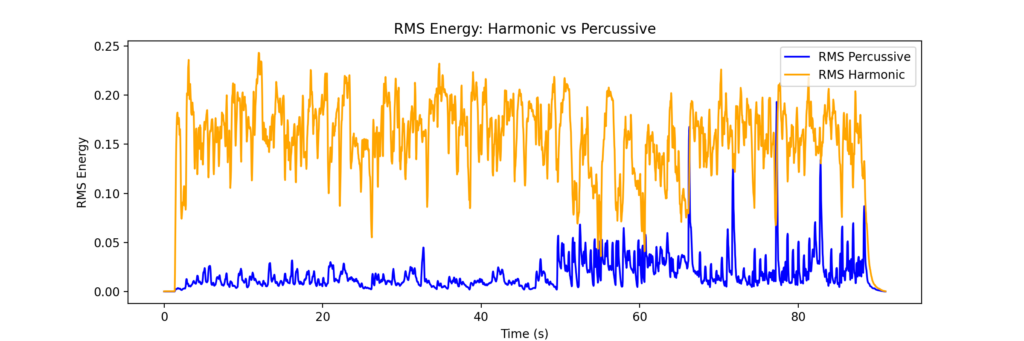
- RMS Harmonic Mean: 0.1526 dB
(harmonic content: strings, winds, harmonic layers) - RMS Percussive Mean: 0.0177 dB
(percussive content: rhythmic elements)
RMS – Overall Loudness (dB)
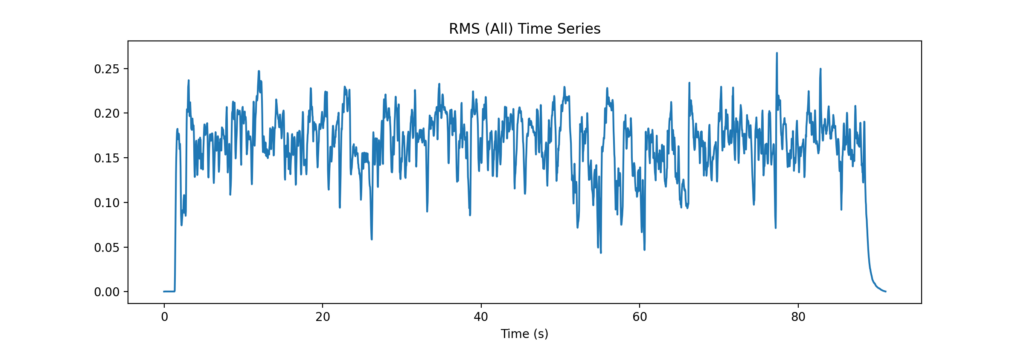
- RMS All Mean: 0.0984 dB
The harmonic components outweigh the percussive ones by a factor of approximately 8.6.
This is not music driven by rhythm, but by the undulating force of melody itself. Layered strings and winds form the true heartbeat of the piece.
Emotional Contours in Motion
RMS Standard Deviation: 0.0815 dB
Compared to the average loudness, this is an unusually wide dynamic range. From hushed pianissimo to full orchestral tutti, the music spans an expansive emotional terrain.
This fluctuation—the breathing of sound—is what gives the piece its dramatic pull.
These figures describe more than volume.
They map where the music inhales, and where the world opens.
Spectral Characteristics
Sunlit Brightness and Refined Transparency
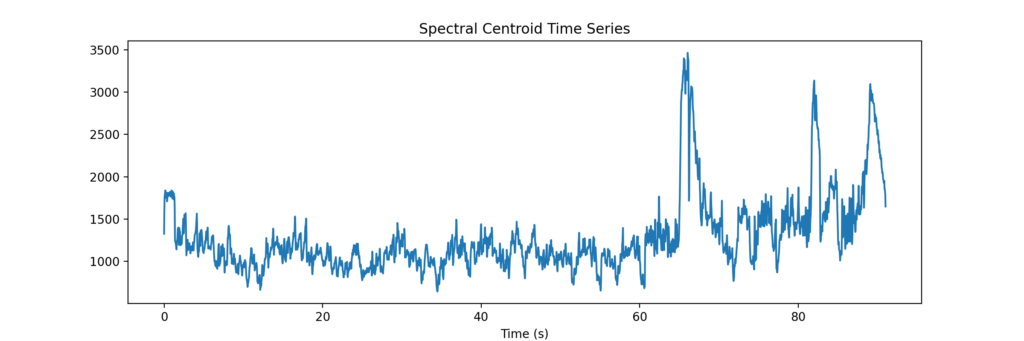
Spectral Centroid (Mean): 1,673.7 Hz
A relatively high value for orchestral music, suggesting a luminous tonal quality. The upper harmonics of strings and woodwinds shine clearly, producing an open, airborne sound.
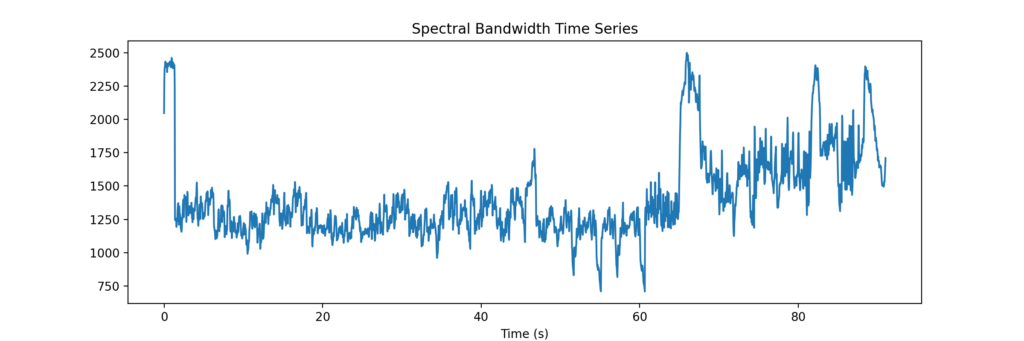
Spectral Bandwidth (Mean): 1,712.9 Hz
A broad frequency spread where multiple instrumental layers occupy their own space, creating a richly woven sonic fabric.
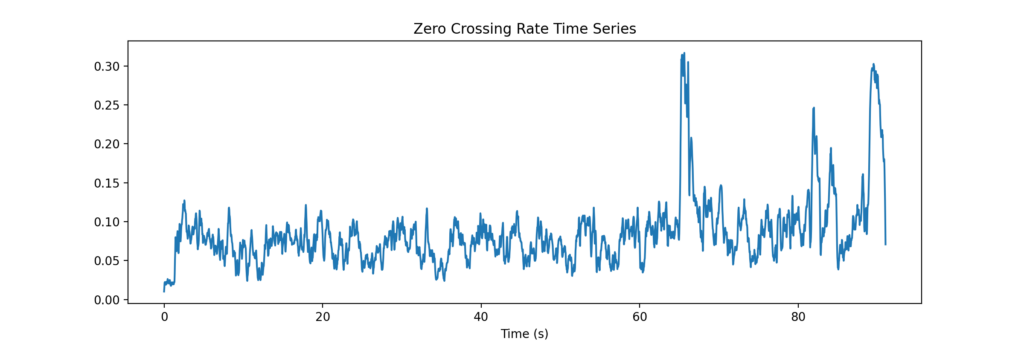
Zero Crossing Rate (Mean): 0.0826
Exceptionally low—indicating minimal noise and a smooth, pitch-centered sound. Instrumental tones resonate cleanly and fluidly.
Shifting Colors of Sound
Centroid Standard Deviation: 781.0 Hz
Brightness fluctuates dramatically throughout the piece. Deep low-frequency immersion gives way to soaring highs, with tonal colors transforming moment by moment—almost visually perceptible in their contrast.
MFCC & Chroma Analysis
Dense Textures and Harmonized Motion
MFCC – The Weight of Textural Movement
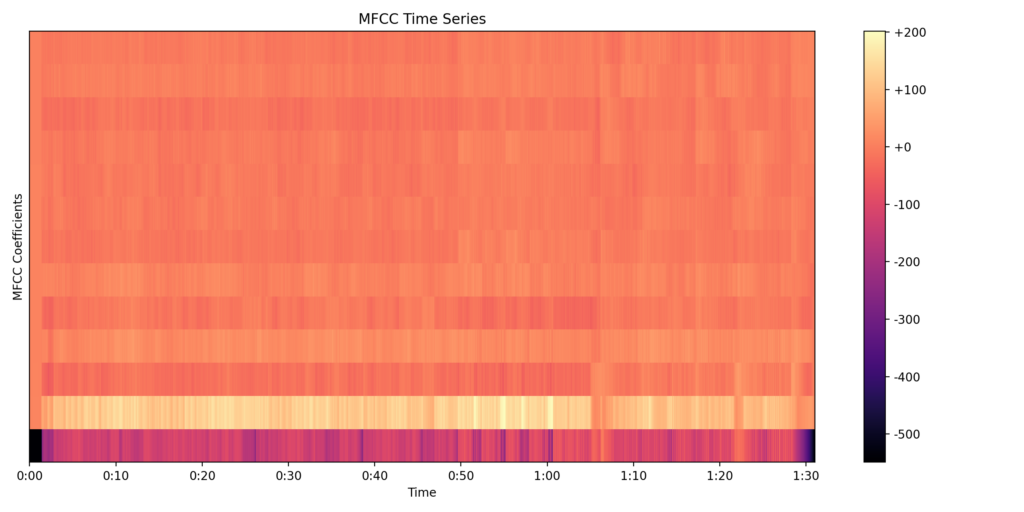
The first MFCC coefficient shows a remarkably high standard deviation (137.9), revealing dramatic changes in energy density.
Rather than a static orchestral backdrop, the music continuously reshapes the tactile feel of each sound, weaving a narrative through shifting textures.
Chroma Analysis – Harmonic Richness and Stability
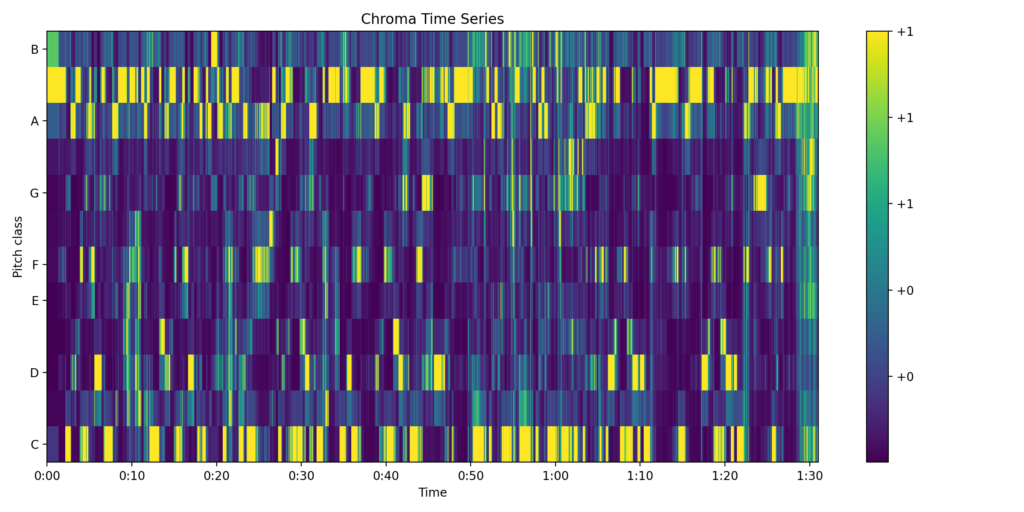
Energy is distributed evenly across all twelve pitch classes (mean values ranging from 0.076 to 0.103).
This balance reflects layered instruments rich in overtones, creating a full-bodied harmonic presence without tonal bias.
From Ending to Beginning: Sound as Transfiguration
When these data points converge, a clear profile emerges:
Sonic Character and Energy
- Wide dynamic range typical of orchestral writing
- Clear, transparent timbre with luminous high frequencies
Spectral Extension:
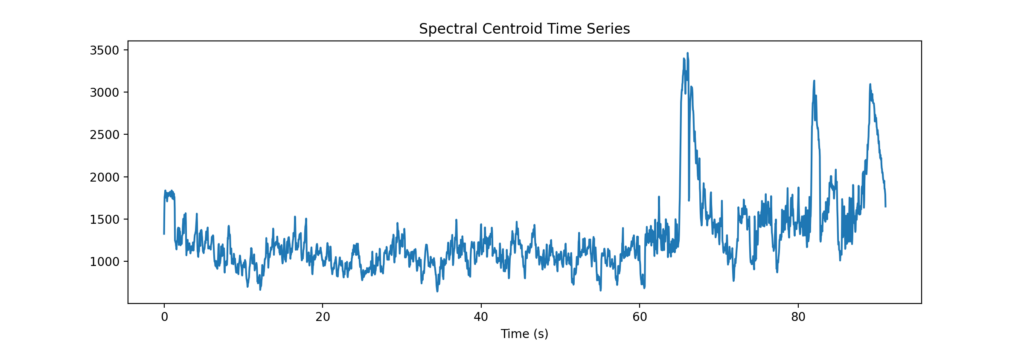
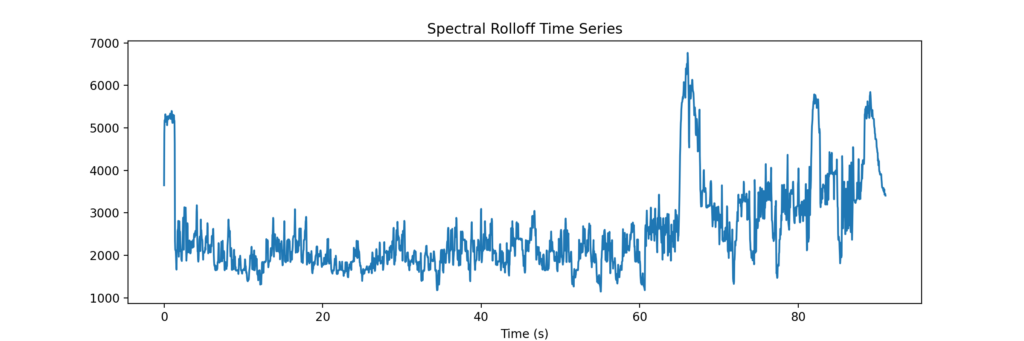
- Spectral Centroid ≈ 1,673 Hz
- Spectral Rolloff ≈ 3,418 Hz
High frequencies extend gracefully, allowing string harmonics and wind overtones to bloom without harshness.
Melody over Rhythm:
Harmonic energy vastly exceeds percussive energy, confirming an emotionally driven structure centered on melody and harmony rather than rhythmic propulsion.
Rhythm and Temporal Flow
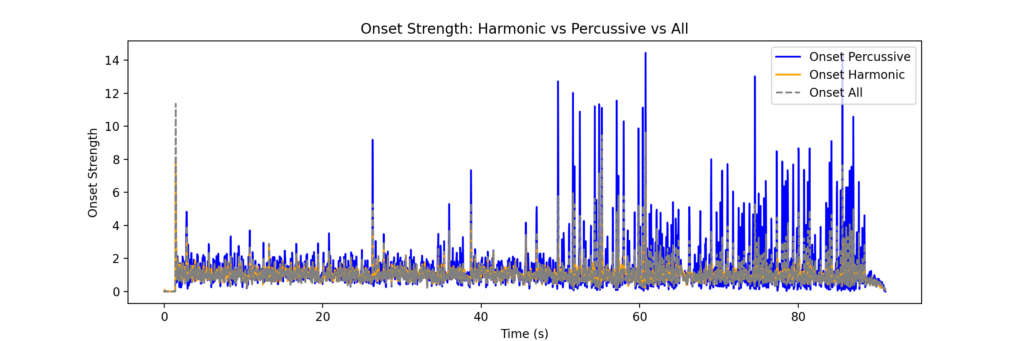
- Estimated Tempo: ~117.45 BPM
A gentle forward motion—slightly faster than walking pace—imbuing the piece with natural momentum. - Onset Characteristics:
Low onset prominence suggests legato phrasing, where sounds connect as flowing lines rather than discrete points—a hallmark of orchestral expressiveness.
Timbre, Harmony, and Emotional Grounding
- Textural Contrast:
Spectral contrast reveals strong differentiation between low and high frequencies. Deep, grounding basses coexist with radiant upper registers, reinforcing orchestral depth. - Harmonic Stability:
Relatively low chroma variance indicates a stable tonal center throughout, offering the listener a sense of emotional security and coherence.
What the Data Reveals
- A melody-driven structure dominated by harmonic content
- An expansive dynamic range in both volume and timbre
- Radiant, unclouded high frequencies (high centroid, low ZCR)
What emerges is a portrait of a grand yet refined orchestral work, anchored in delicate melodic lines and enriched by luminous overtones.
The contrast between crystalline highs and grounded lows sustains the piece’s dramatic arc.
The coexistence of dramatic fluctuation and smooth continuity embodies an act of transformation—sublimating the past while stepping forward with resolve.
Beginning in stillness, then gradually reshaping the world through sound,
End To Begin gains new wings in its orchestral form—carrying us higher, and deeper, into its story.