 Akihito Kimura
 Akihito Kimura: Under the Blue of an Upward-Gazing Night Sky — Beyond Möbius Time
Have you ever felt the strength of a single step forward—not with your body, but through sound?
For me, sound is not an event.
It is the instant when the way the world appears quietly shifts.
End To Begin (Version Pop) by Akihito Kimura shares the same soul as the orchestral version previously discussed—a quiet prayer at its core—but here it is clothed in kinetic vitality and a contemporary edge. This is the original form of the piece: a walk taken with conviction, a movement defined by forward momentum.
Where the classical arrangement revealed the surge of melody, what kind of skeletal structure does this original version possess?
The data tells a clear story: rhythm as motion, and shimmering sonic particles sketching another vision of “beginning.”
Below, I examine the dynamic architecture and spectral characteristics of the pop version, in direct comparison with its orchestral counterpart.
Dynamic Architecture
A Beating Pulse, Energy Shaped by Certainty
RMS – Harmonic vs. Percussive Components (dB)
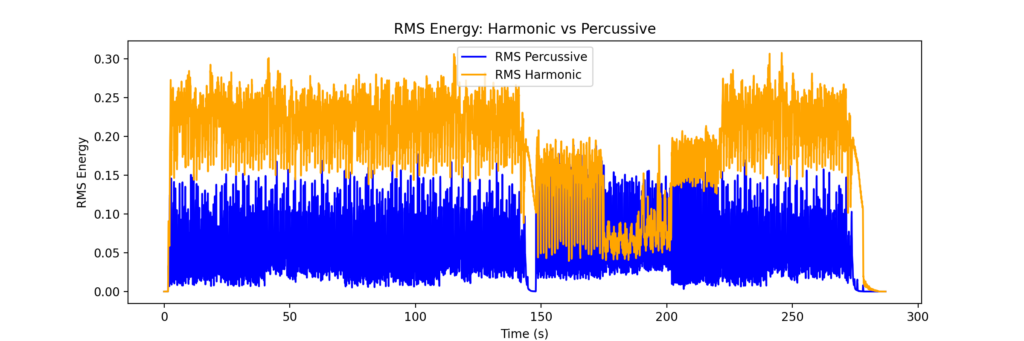
- Harmonic Mean: 0.1850 dB (Orchestral: 0.1526 dB)
- Percussive Mean: 0.0593 dB (Orchestral: 0.0177 dB)
RMS – Overall Loudness
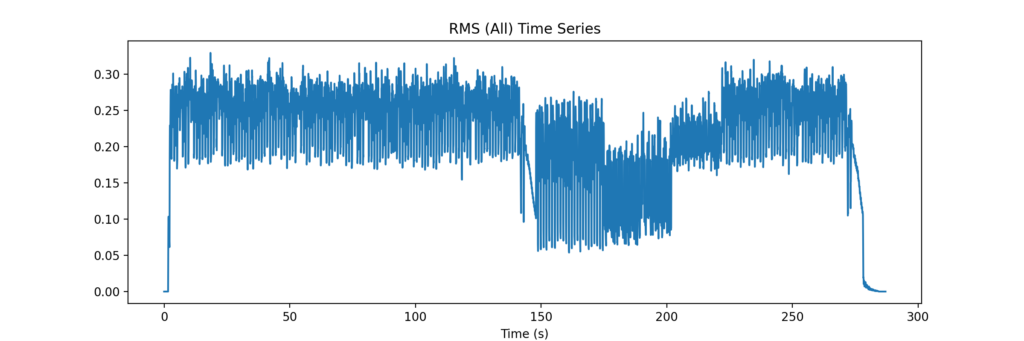
- RMS All Mean: 0.1257 dB (Orchestral: 0.0984 dB)
The most striking feature is the dramatic increase in percussive energy—more than three times that of the orchestral version.
This confirms that the track is driven not only by melody, but by a clearly articulated beat. The overall loudness is also elevated, lending the song a distinctly pop-oriented assertiveness—music that leans forward and gently urges the listener onward.
RMS Variability – A Consistent Will
RMS All Std: 0.0818 dB
Nearly identical to the orchestral version (0.0815 dB), this shows that despite the difference in instrumentation, both versions share the same dramatic trajectory: a restrained opening that gradually unfolds toward an uplifting climax. Different forms, one blueprint.
Spectral Characteristics
Urban Sparkle and Sharpened Edges
The spectral data reveals not the orchestral version’s transparency, but a heightened sense of color saturation.
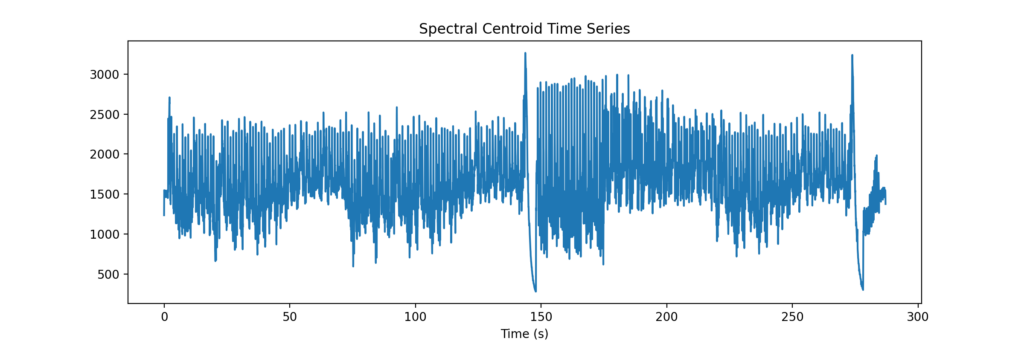
Spectral Centroid (Mean): 1,954.1 Hz
(Orchestral: 1,673.7 Hz)
The centroid approaches 2 kHz, reflecting the brilliance of synthesizers and modern instrumentation. Bright, well-defined high frequencies intensify the song’s sense of clarity and forward motion.
Celtic Section – When the Wind Passes Through
Midway through the track, a Celtic-inflected passage emerges. Here, the spectral centroid drops, and artificial high-frequency shine recedes. Midrange harmonics come forward, and the sound transforms from light into wind.
Within the narrative of constant motion, this moment feels like pausing at the horizon—one expansive breath before moving on.
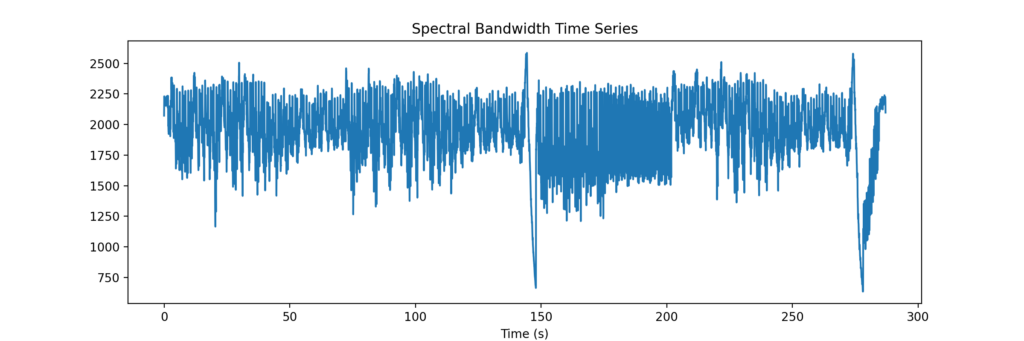
Spectral Bandwidth (Mean): 2,079.9 Hz
(Orchestral: 1,712.9 Hz)
The pop version spans a wider frequency range, fully exploiting the breadth of modern sound design—from deep lows to sparkling highs—resulting in a dense, contemporary sonic field.
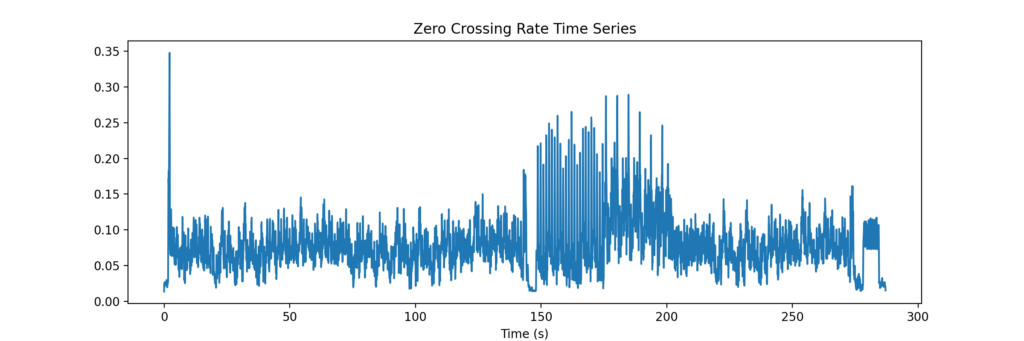
Zero Crossing Rate (Mean): 0.1119
(Orchestral: 0.0826)
The higher ZCR points to sharper attacks and more aggressive timbres. Sound functions not only as continuous lines, but as discrete points—audible particles that define rhythmic precision.
Hard-Rock Break – Radiation
During the hard-rock–influenced break, both percussive RMS and ZCR spike sharply. Smooth particles give way to a shower of sparks. This is less an emotional swell than an outward release—the exposure of an inner drive suddenly made visible.
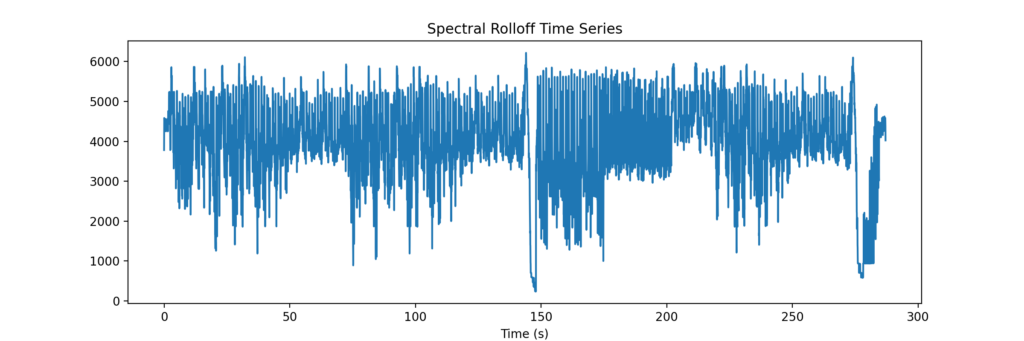
Spectral Rolloff: 4,284 Hz
(Orchestral: 3,418 Hz)
Energy extends far higher into the spectrum, reflecting contemporary mixing aesthetics—shimmering synths, crisp hi-hats, and an unapologetically modern brilliance.
Low-frequency spectral contrast remains firmly defined, preventing the sound from blurring. This clarity is the source of the track’s edge.
MFCC & Chroma Analysis
An Unwavering Authorial Signature
MFCC – Textural Certainty
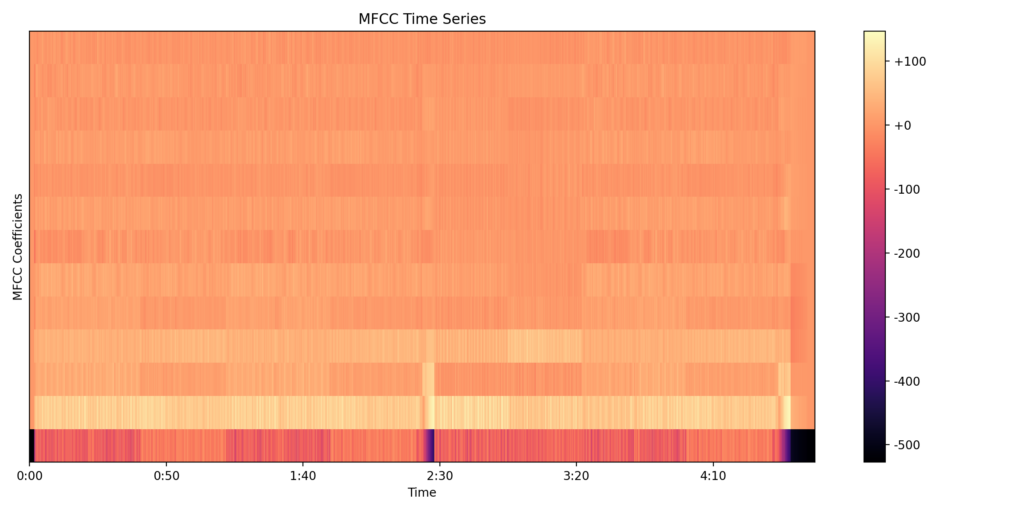
The standard deviation of the first MFCC coefficient is 137.9—exactly the same as the orchestral version.
Even as the instrumentation changes, the way texture density is dramatically shaped remains constant. This is less a stylistic choice than a compositional fingerprint.
Chroma Analysis – Dissolving Boundaries
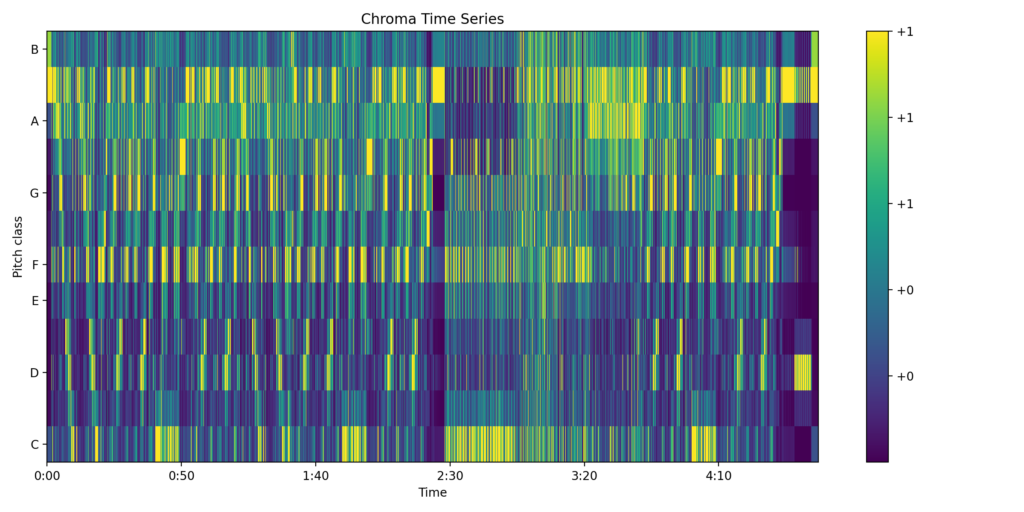
Energy is evenly distributed across all twelve pitch classes (mean values between 0.077 and 0.091).
Though framed as pop, the harmony resists simplicity, favoring gradients of resonance that include overtone behavior. This attention to sonic color gives the track its singular identity.
Weightless Choir – A Precursor to Dissolution
Just before the chorus, a choir deviates from the established tonality. Chroma dispersion captures this moment clearly: harmonic gravity briefly lifts, and the ground seems to vanish.
This is not hesitation—it is a state of weightlessness, preparing the leap toward the next light.
The chorus’s sense of release may exist precisely because the world dissolves for an instant beforehand.
From Walking to Motion: Two Indivisible Truths
Taken together, the data reveals the core of End To Begin (Version Pop):
- A beat structure that generates undeniable forward momentum
- Reinforced percussive presence
- A modern, wide-ranging color palette
- Elevated centroid and bandwidth values
- A consistent dramatic design shared with the orchestral version
If the orchestral version represents introspection and sublimation, the pop version embodies release and advance. Its heightened energy and luminous spectrum translate the everyday courage to take a single step forward into physical sound.
What makes this piece compelling is not its traversal of genres—pop, Celtic, metal, contemporary choral writing—but the way each shift in sonic physics corresponds to a change in the protagonist’s mode of being.
Yet it never fragments into separate songs. Beneath surface styles, the deeper DNA—pitch architecture and acoustic texture—remains unified.
This is not a sequence of DJ-style scene changes, but an experience akin to standing beneath the same sky as the density of air subtly transforms.
Forms change. Colors change.
But at the center is a world that belongs neither to addition nor subtraction.
Listening—or seeing—these two versions side by side illuminates the full arc of the story.
Afterword
All figures in this series were captured from feature logs visualized in TensorBoard.
Seeing sounds I once shaped purely by intuition reappear later as graphs often brings a quiet realization:
Ah—this is where I altered the brightness of the world.
It feels less like verifying answers, and more like tracing the path my ears have already taken.
I have occasionally been told that the title End To Begin sounds “unnatural.” English does offer contrastive constructions such as “not A but B,” where emphasis always falls on the but-clause.
But this title is intentional.
The to here signifies connection, not opposition—continuity rather than denial.
Perhaps it reflects my own view of life: that even when forms of expression change, the underlying soul remains linked.
An ending does not disappear.
It merely changes shape and touches the next beginning.
Beyond Möbius time.