 Akihito Kimura
 1. Diffusing Functional Harmony Across Time
Today, we will analyze “Beast Moans,” a track from my album Fantasia 2 released under the name Tetsujin (Akihito Kimura).
The construction method used in this piece liberates traditional functional harmony from vertical stacking and statistically disperses it along the time axis through digital granulation.
By manipulating temporal resolution via stuttering, I intentionally blur the Acoustic Succession Boundary (ASB)—the threshold between rhythm and pitch. This fuses “discrete notes” and “resonance”—elements that are usually separate—within the spectral domain.
Through this process, harmony moves away from deterministic chord progressions and is redefined as a “spectral cloud” diffused over time. This represents a dynamic approach to atonality that erodes existing tonal systems while strictly maintaining a “melody-first” philosophy.
This data is not merely a musical analysis; it is a record of how I chose to “deconstruct order and reconstruct a new tonality within noise.” In other words, it is the transition from “breaking notes” to “creating a probability field.”
Transposition from Vertical Order to Horizontal Spectrum
Traditional functional harmony controls tension and relaxation through the stacking of notes at a specific moment (the vertical axis). My approach, however, involves decomposing those vertical chord components into microscopic units (Granules) and rearranging them along the timeline.
- Quantitative Approach: While standard harmonic analysis looks at a pitch set at a specific moment t, in my music, the integral value of the spectrum within a “window” from t_1 to t_2 forms a single harmonic sense (Chroma).
- Academic Definition: This can be termed the “Replacement of Harmony with Statistical Distribution.” Instead of sounding a single chord, I probabilistically scatter the frequency components of that chord along the time axis. The listener’s brain then integrates these components, perceiving them as a “faint harmony.”
2. The Reality Shown by Acoustic Data
1. Overall Atmosphere: A Dark and Warm Soundscape
Spectral Centroid: ≈ 993 Hz
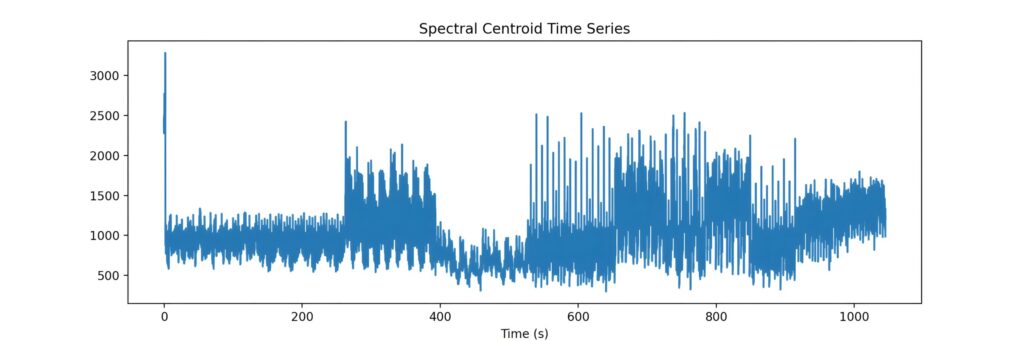
- While bright pop tracks often sit between 2000 Hz and 3000 Hz, a value under 1000 Hz is remarkably low. This suggests a “dark,” “thick,” and “massive” texture where high-frequency irritation is suppressed.
Spectral Rolloff: ≈ 1845 Hz
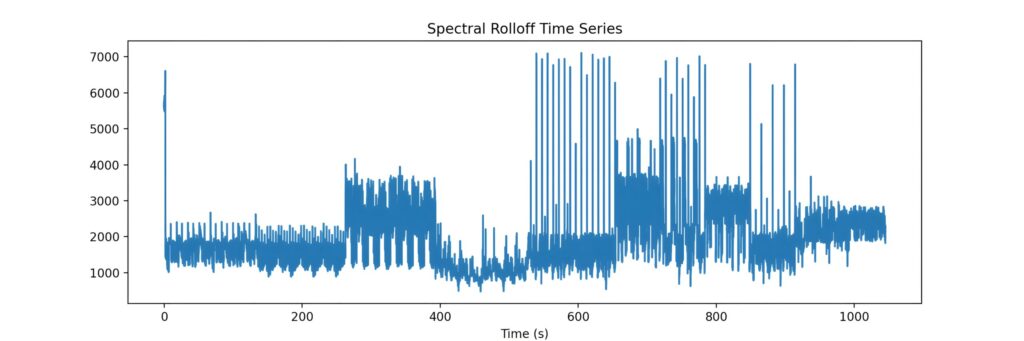
- Most energy is concentrated below 2 kHz. This indicates a muffled or intentionally low-passed sound with vintage depth.
2. Texture: Coexistence of Smoothness and Impact
Zero Crossing Rate: ≈ 0.075
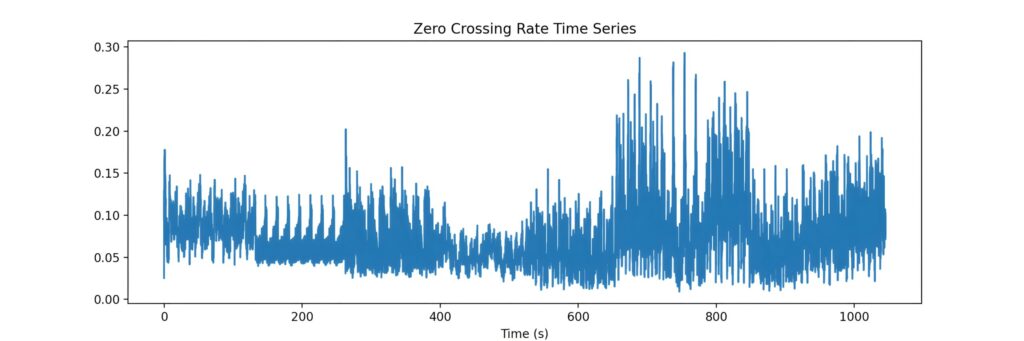
- This relatively low value shows that sustained tones and smooth waveforms dominate over noisy, abrasive sounds (like snare rattles or heavy distortion).
Spectral Flatness: ≈ 25.6
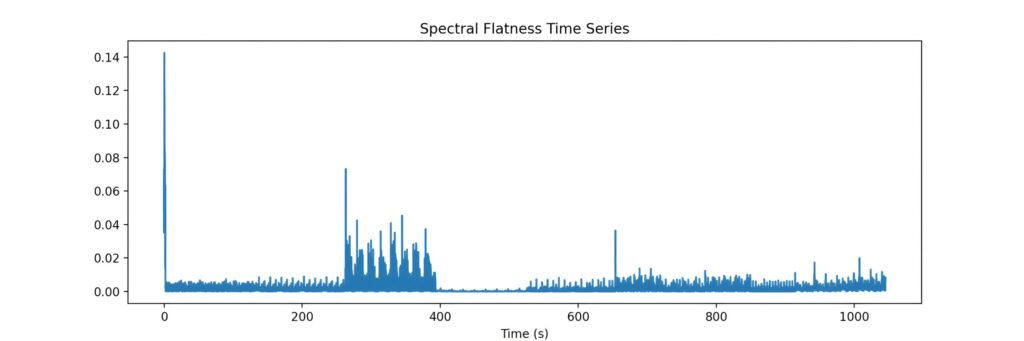
- This indicates a texture with significant spread and complexity, where energy isn’t overly concentrated in specific frequencies, balancing “pure tone” and “noise.”
3. Rhythm and Energy
Tempo: ≈ 117.2 BPM
- A stable mid-tempo slightly faster than walking speed.
RMS (Loudness): mean ≈ 0.058
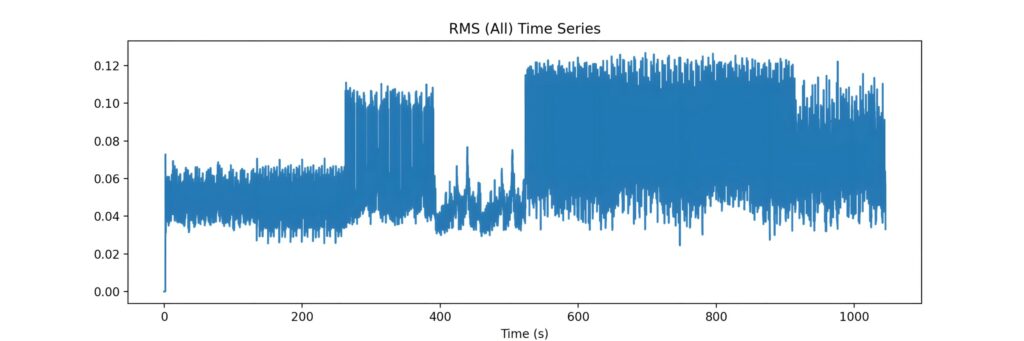
- Modest compared to maximized modern tracks (0.15–0.2+). This suggests a mix that values “breath” and “depth” by preserving dynamic range.
Onset Strength:
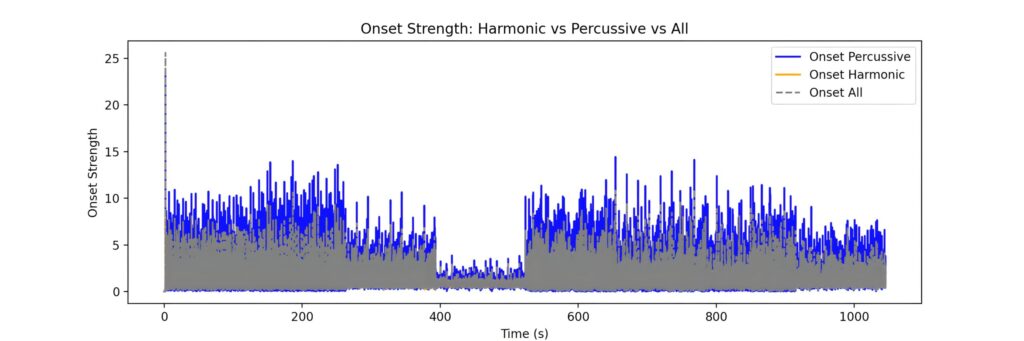
- The standard deviation of the percussive component is larger than the mean, suggesting a dramatic rhythmic structure with occasional strong accents rather than a constant, flat beat.
4. Timbre and Harmony (MFCC & Chroma)
MFCC (Timbral Features):
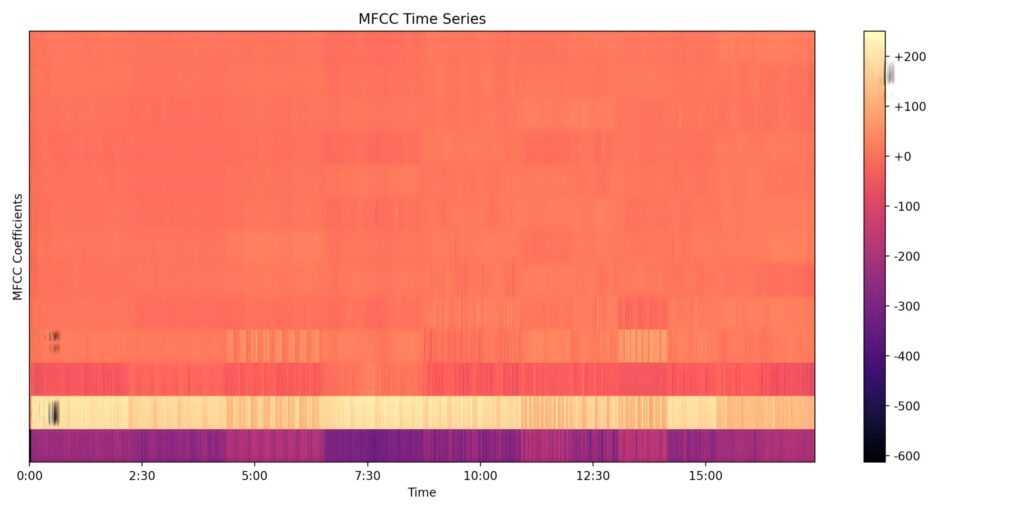
- The 2nd coefficient is extremely high at 167. This suggests a steep spectral slope, pulling the center of gravity toward the low end. True to the title “Beast Moans,” the track is characterized by a “growling” bass.
Chroma (Harmonic Components):
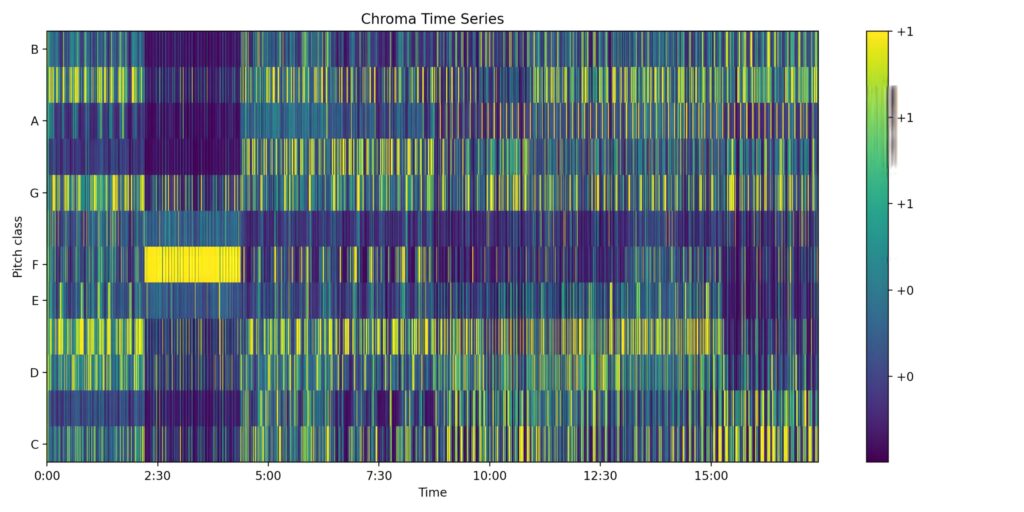
The following notes stand out in order of energy: D# / Eb, G, and A# / Bb.
| Note | Mean Intensity | Std Dev |
| C | 0.4005 | 0.3217 |
| C# / Db | 0.3357 | 0.2743 |
| D | 0.4245 | 0.2859 |
| D# / Eb | 0.4798 (Peak) | 0.3493 |
| E | 0.2918 | 0.2189 |
| F | 0.3528 | 0.3341 |
| F# / Gb | 0.2328 (Min) | 0.1890 |
| G | 0.4438 | 0.3219 |
| G# / Ab | 0.3470 | 0.2909 |
| A | 0.2955 | 0.2579 |
| A# / Bb | 0.4415 | 0.3246 |
| B | 0.3083 | 0.2528 |
| Note | Bar Chart (Relative Value) | Value |
| C | ■■■■■■■■ | 0.4005 |
| C# / Db | ■■■■■■ | 0.3357 |
| D | ■■■■■■■■ | 0.4245 |
| D# / Eb | ■■■■■■■■■ (Peak) | 0.4798 |
| E | ■■■■■ | 0.2918 |
| F | ■■■■■■■ | 0.3528 |
| F# / Gb | ■■■■ (Min) | 0.2328 |
| G | ■■■■■■■■■ | 0.4438 |
| G# / Ab | ■■■■■■■ | 0.3470 |
| A | ■■■■■ | 0.2955 |
| A# / Bb | ■■■■■■■■■ | 0.4415 |
| B | ■■■■■■ | 0.3083 |
The 12-Tone Probability Distribution (Chroma Mean)
The graph shows that no single note stands out excessively; all notes flow within a “0.2 to 0.5” range. This is the “chromatic sea where 12 tones appear equally” that I often describe. However, slight “elevations” appear at D#, G, and A#. This is the exact moment the data captures a state where harmony exists not as a “point” but as a “plane” of probabilistic order—a floating afterimage of a chord.
3. Calculated Destruction and the “Singularity”
Atonality Told by the “Flatness” of Chroma Vectors
In a track with clear tonality (e.g., C Major), specific notes (C, E, G) would show high values while others would be extremely low. In “Beast Moans,” the difference between the max (0.479) and min (0.232) is very small. This “narrow gap” is the essence of the chromaticism I pursue: every note has a “reasonable” presence, showing a tendency for all 12 tones to appear equally.
The Identity of “Faint Order”
In completely random atonality (like white noise), the values would be even flatter. But this data has a clear “wave.” The peaks at D# (0.47) / G (0.44) / A# (0.44) suggest a “field where the center of gravity is slightly tilted.” Rather than clear functional harmony, it’s more like a tritone axis or a symmetrical structure with a pseudo-center caused by broken symmetry—as if glimpsed through a thick fog.
“Texture Control” via Timbre (MFCC)
Because the harmony is chromatic and floating, the track’s identity relies heavily on timbre. The MFCC data shows high variance in the first three coefficients but stability from the 6th onwards. This means that while the low-end dynamics and “thickness” change drastically, the “perceived texture” in the mid-high range is controlled by strict rules. “Pitch is free, but the sonic touch is consistent.” This is the “Order as a Singularity” that I constructed.
Multilayered Textures and “Quasi-Stationary States”
While IDM and Glitch often aim for “disruption itself,” my method layers these disrupted fragments to create a statistical “Quasi-stationary state.”
Structure of the Singularity: The stability in higher MFCC coefficients shows that sounds which are macroscopically changing (being destroyed) maintain a consistent sonic character microscopically.
The Gravity of Tonality: The slightly higher Chroma values for specific notes (D#, G) mean that within physical chaos, there exists a center—much like an “attractor” in physics. This is the secret of the “faint order” that prevents the music from falling into total atonality.
Critical Thresholds of Temporal Resolution via Stuttering
From an acoustical perspective, the deconstruction of rhythm through stutter effects constitutes a forced transition from the Time Domain to the Frequency Domain.
Physically, as the stutter period T descends below approximately 50ms (≈ 20 Hz), the human auditory system ceases to perceive discrete rhythmic impulses and begins to interpret the signal as continuous timbre or pitch. This phenomenon is defined as the Acoustic Succession Boundary (ASB).
Mathematical Formulation of Pitch Transmutation: By asymptotically reducing the period T, what was originally a rhythmic element is transmuted into a “pitch granule” possessing a complex harmonic structure.
Harmonic Reconstruction: The concept of “diffusing functional harmony along the temporal axis” refers to the manipulation of T to trigger chordal constituents at asynchronous points in time. The resulting auditory afterimage—driven by temporal masking effects—facilitates the cognitive reconstruction of a pseudo-harmony. Physically, the relationship between the repetition period T and the resulting frequency f is expressed as:
The “vestigial tonality” perceived within the composition is therefore not merely a product of the instrumental melody, but is significantly bolstered by stutter-derived pitches contributing to the broader chromatic resonance.
Empirical Evidence of “Calculated Destruction”
Onset_Percussive_Std: ≈ 1.48
- The standard deviation (1.48) is notably high relative to the mean (1.42). This statistical variance confirms the absence of an isochronous beat; instead, it indicates a violent, rapid alternation between high-intensity transients (stochastic “bursts”) and interstitial silence, mediated by the stutter process.
Spectral Contrast (Mean_5 ≈ 52.41):
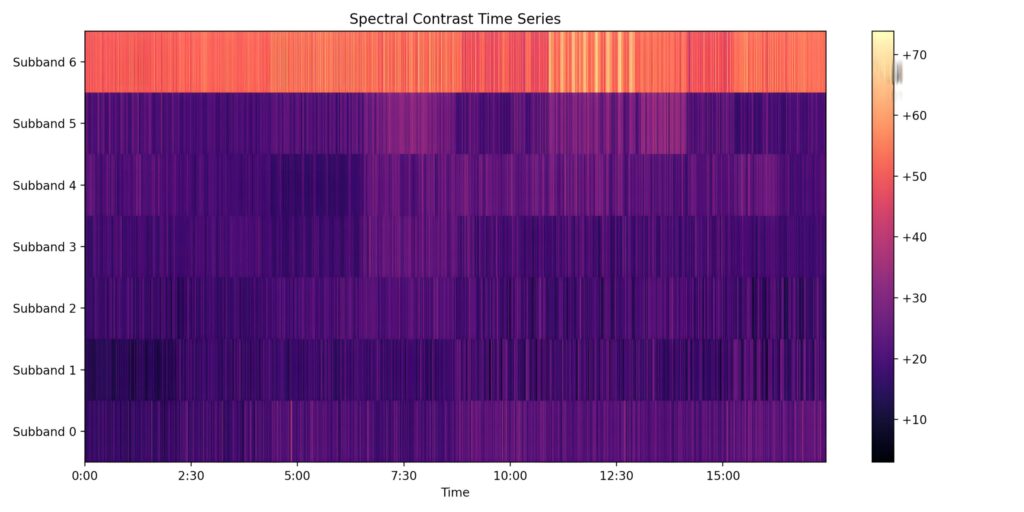
- The contrast within the fifth sub-band (mid-high frequency range) is anomalously high. This is a direct result of the resonance filters and glitch-processing characteristic of iZotope Stutter Edit. It represents a state where specific frequency bands “flicker” intensely between white noise and tonal clarity, creating a high-contrast spectral texture.
Contextualizing the Work within the 2013 Musical Landscape
The fundamental concepts of stuttering—”segmentation,” “fracturing,” and “repetition”—were already established by 1990s IDM (notably Autechre and Aphex Twin), the Glitch movement (Oval, Alva Noto), and early breakbeat editing cultures; thus, the technique itself was not inherently revolutionary. However, even by 2013, rhythmic deconstruction remained, for most practitioners, a purely ornamental device.
Crucially, the aesthetic frameworks of IDM and Glitch are generally not predicated upon functional harmony; they do not assume the maintenance of tonality. In those genres, noise and fragments serve as the primary generative materials.
Conversely, my objective was to deconstruct rhythm and utilize the resulting atonal resonances while tethering them to a vestigial tonal order (e.g., D# or G#). This represents a structural approach: rather than merely diluting the harmonic center, I sought to probabilistically redefine it. My body of work has consistently maintained clear pitch centers, chordal structures, and a primacy of melodic intent. The essence of this experiment, therefore, lies in destroying the vertical structure while subtly retaining its gravitational center, thereby avoiding absolute atonality.
- Glitch: Granulation is the primary objective (destruction as an end in itself).
- IDM: Redefinition of rhythmic and formal structures.
- My Approach: Destruction as a mechanism for the erosion and redefinition of tonality.
By decomposing the harmonic structure of melodies and chords, the 12 tones are leveled statistically, yet they never reach a state of total randomness. This precise calibration—the “dosage” of entropy—is the defining singularity of my musical language.
4. New Resonances Derived from Temporal Diffusion
For years, I have described music as being inherently “chromatic,” a concept that even my contemporaries struggled to conceptualize. This work is constructed through “sound granules and their vectors” and composed of “timbral textures and multilayered fluctuations.” It invites the listener to experience music not as a series of “points (discrete notes)” but as a series of “planes (spectrums).” The listener’s expectation for tonal resolution is constantly subverted, pulled back into a “12-tone sea.”
This can be concisely termed the “Temporal Diffusion of Functional Harmony.” Perceptually, the listener does not encounter a sounding chord so much as a harmonic afterimage. This context—granulating harmony along the temporal axis rather than simply disrupting verticality—marks a distinct departure from post-tonal IDM.
Comparative Framework: Traditional vs. Diffused Harmony
| Dimension | Traditional Harmony (Vertical) | My Approach (Horizontal Diffusion) |
| Perceptual Unit | Point: Synchronous pitch stacking | Plane: Spectral distribution in a time window |
| Order | Deterministic Functional Harmony | Statistical “Vestigial Tonality” |
| Intent of Deconstruction | Ornamental or glitch effects | Erosion/Redefinition of tonal structures |
| Role of Time Axis | Linear carrier of melodic information | Probability Field: Granulation of harmony |
While I lacked the lexicon of acoustic physics to articulate this structural hypothesis in 2013, the current data provides empirical support for these original intuitions.