 Akihito Kimura
 This track was composed based on the design philosophy that “the same sound can take on different meanings.” For instance, the synth pads in this piece stay on common scale tones. Rather than changing the notes to fit the chord progression, I am simply assigning them different “meanings” as the harmony evolves around them.
Chapter 1: Sonic Texture (The Cells)
Spectral / MFCC / RMS / ZCR
The sound of this track cuts through not with sharpness, but with sheer resolution.
Boundary Control and High-End “Presence” (Spectral Rolloff)
Spectral Rolloff: ≈ 4,359 Hz
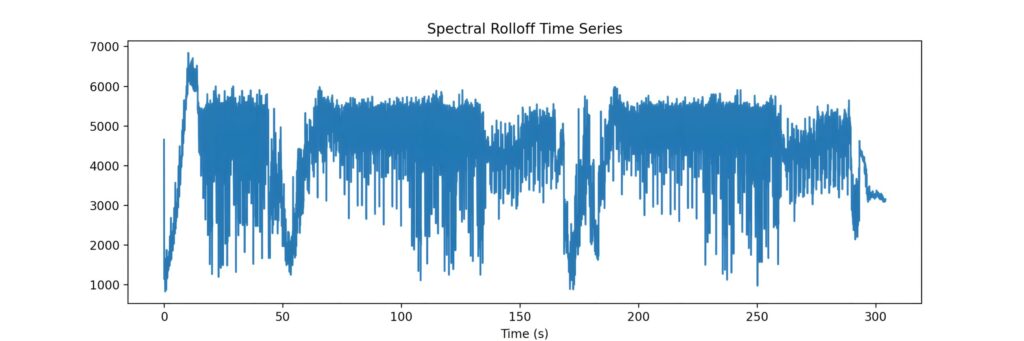
- Analysis: 85% of the total acoustic energy is concentrated below this frequency (≈ 4.3 kHz).
- Interpretation: The 4.3 kHz mark represents the “sweet spot”—the core high-frequency components—of the music. Frequencies above this line are reserved for “air” and “shimmer.” This creates a structured soundscape where the contours of the track are crystal clear, yet harsh high-frequency noise is effectively mitigated to prevent ear fatigue. High-hats and synth attacks pierce through clearly without hitting the “pain points” of the human ear.
Sonic “Thickness” and Information Spread (Spectral Bandwidth)
Spectral Bandwidth: ≈ 2,001 Hz
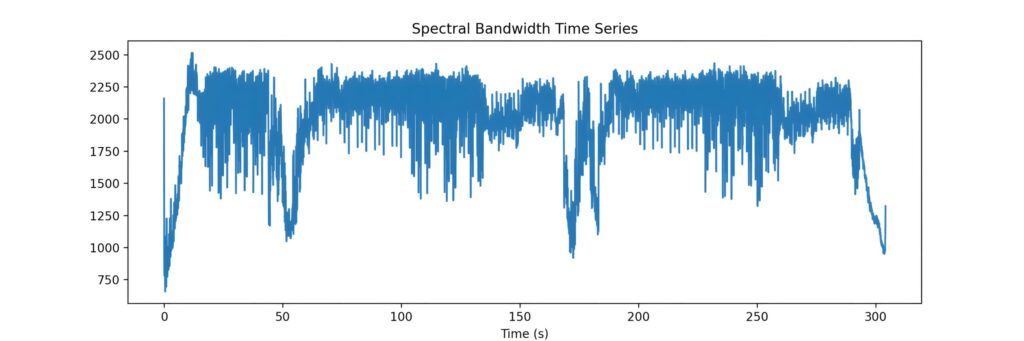
- Analysis: This indicates the “width” of the spectrum spread from its center (centroid).
- Interpretation: A wide bandwidth of 2,000 Hz suggests a rich, thick, and expansive sound rather than a thin, linear one. This correlates with high Spectral Flatness; the data reflects dense synth layers and instruments with complex overtones luxuriously filling the sonic space. By managing energy with a clear 4.3 kHz Rolloff while maintaining a 2 kHz Bandwidth, the track achieves a rare balance of “density” and “transparency.”
Timbre and Brightness
Spectral Centroid: ≈ 1,936 Hz
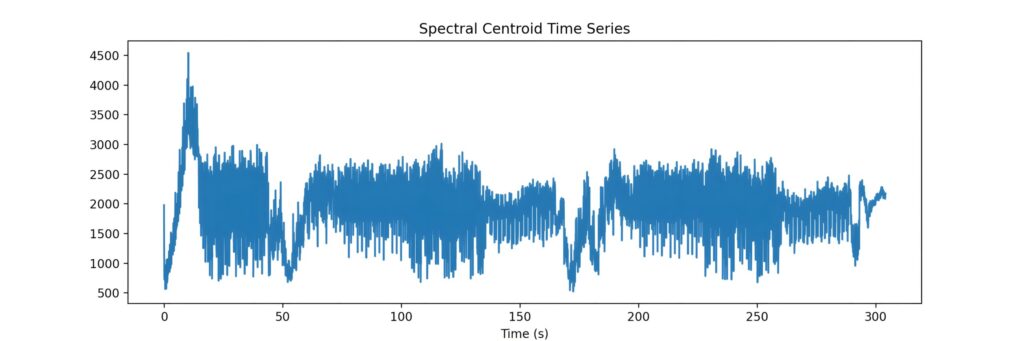
Indicates “brightness.” The track features “crystalline, transparent highs” that are vivid and intellectual, stopping just short of being piercing.
Spectral Flatness: 22.53
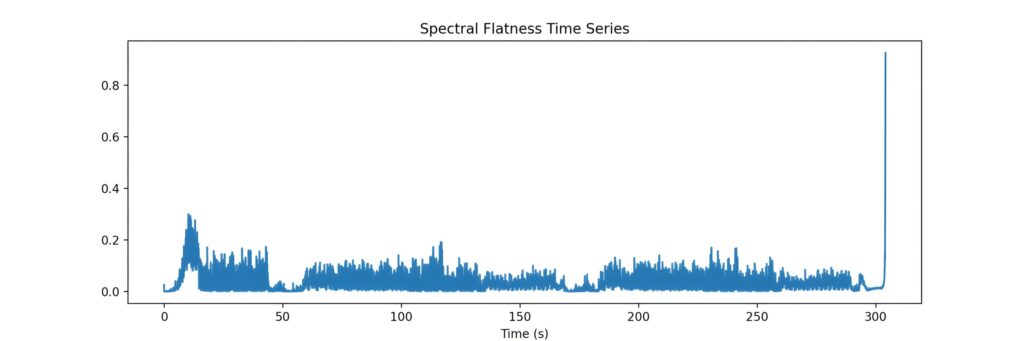
This value confirms that the sound is distributed richly across the entire spectrum. The synth layers are meticulously stacked, creating a sophisticated, gapless texture.
Mid-High Contrast (Spectral Contrast)
Spectral_Contrast_Mean_5: 53.22 (Outstandingly higher than other bands).
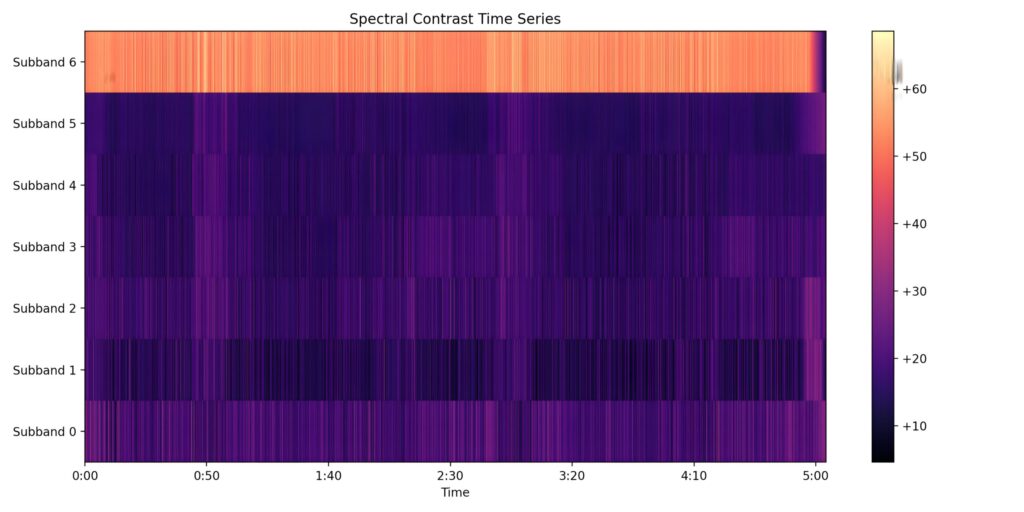
- Analysis: Extreme contrast between “sound” and “silence” around the 4 kHz range.
- Interpretation: Sharp synth staccatos and high-attack percussion exist as distinct “points” without being buried in reverb. It is a high-resolution mix that feels like synapses firing in the brain.
Modern and Tight Balance (MFCC Analysis)
MFCC_Mean_2: 75.14
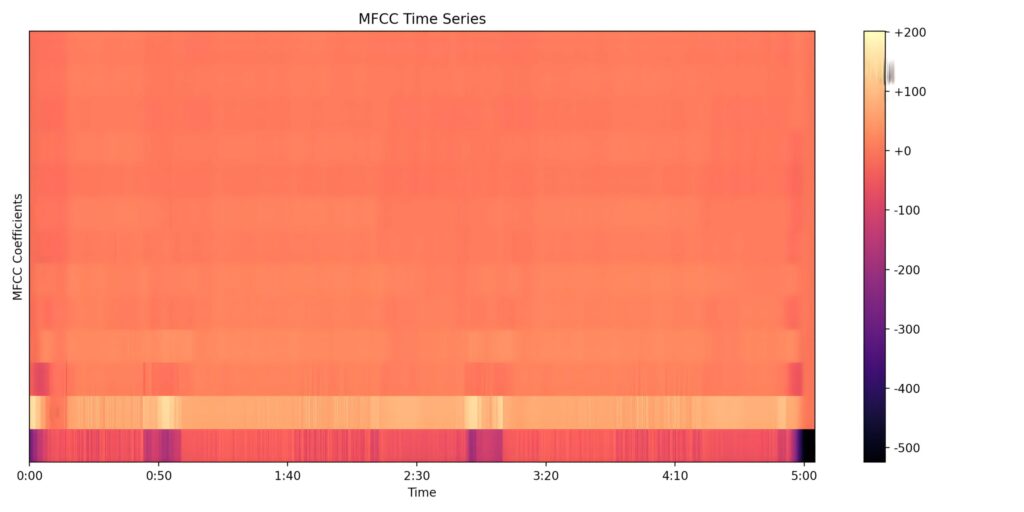
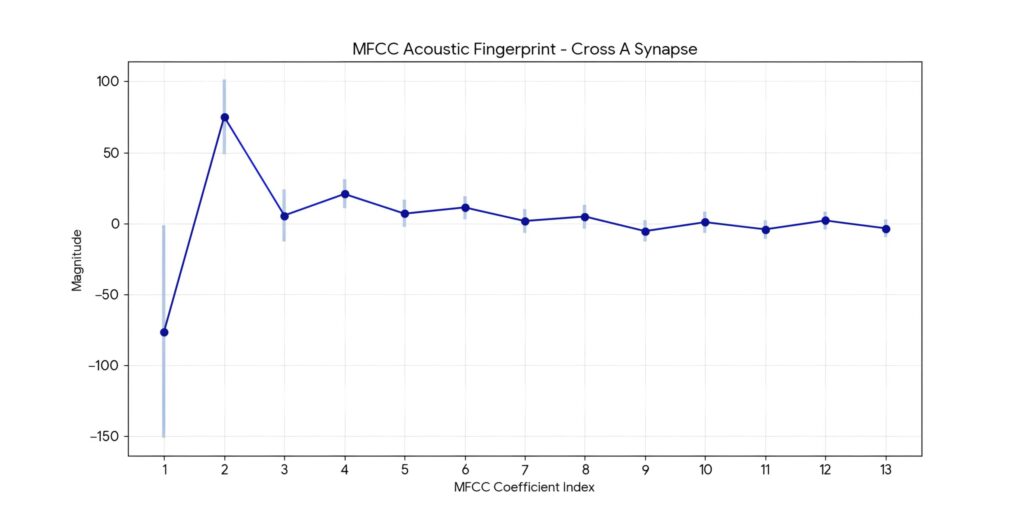
- Analysis: A high positive value indicates a solid foundation in the low to mid-low frequencies.
- Interpretation: While maintaining a heavy low-end, the focus remains on mid-high detail—a coexistence of grounded stability and ethereal, light electronic textures.
Energy and Dynamics
RMS Composition: RMS_Harmonic_Mean (0.09) > RMS_Percussive_Mean (0.05)
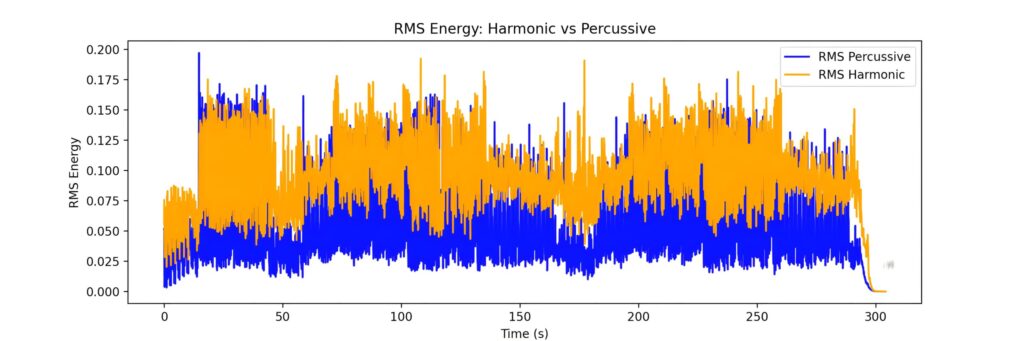
While the percussive elements drive the rhythm, the “wall of sound” and perceived energy come from the harmonic components—dense chord work and sustained pads.
Clean Waveforms
Zero Crossing Rate: 0.11
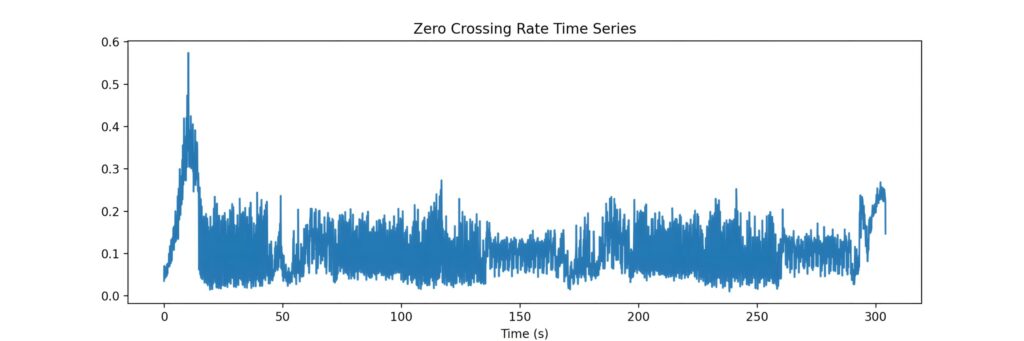
Lower than average, indicating exceptionally clean waveforms. By eliminating excessive distortion and enhancing the purity of every note, the arrangement remains muddy-free despite its complexity.
Chapter 2: Tonal Skeleton (The Bones)
Key Strength / Stability / F# minor–C# minor Duality
Key and Harmony (Chroma Features)
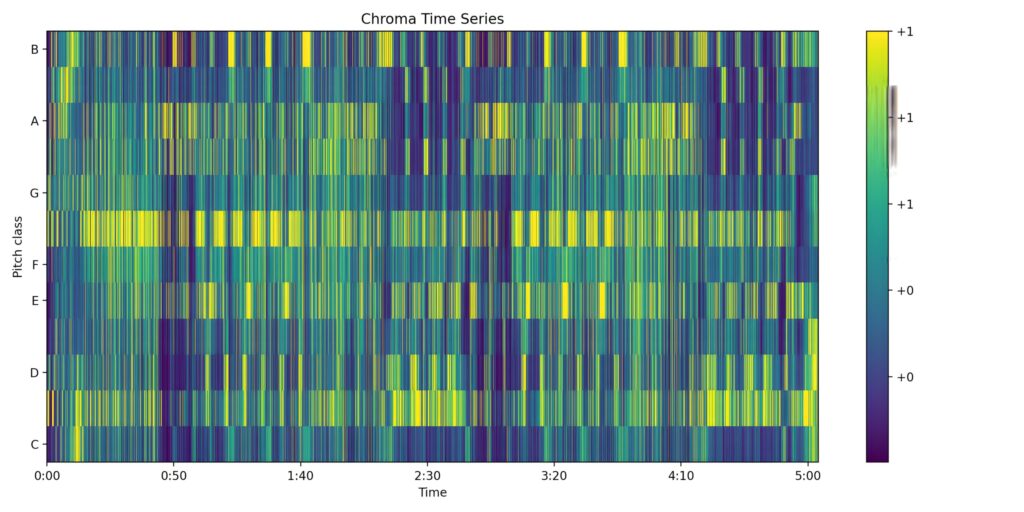
| Chroma Index | Pitch | Mean Intensity | Stability (Standard Deviation) | Interpretation |
| Chroma 7 | F# | 0.614 | 0.323 | Root: The highest intensity; the core of F#m. |
| Chroma 2 | C# | 0.551 | 0.301 | Perfect 5th: A solid dominant tone supporting F#m. |
| Chroma 5 | E | 0.515 | 0.296 | Minor 7th: Adds spatial expansion and an ethereal feel. |
| Chroma 10 | A | 0.458 | 0.296 | Minor 3rd: Defines the characteristic color of the minor key. |
| Chroma 9 | G# | 0.456 | 0.285 | Major 2nd: Provides tension and decorative movement. |
| Chroma 6 | F | 0.453 | 0.230 | Passing tone: Near Maj 7th/b6 relative to F#m. |
| Chroma 3 | D | 0.431 | 0.291 | Major 6th: Suggests lyrical and emotive development. |
| Chroma 8 | G | 0.413 | 0.233 | – |
| Chroma 12 | B | 0.403 | 0.311 | Perfect 4th: Represents subdominant elements. |
| Chroma 4 | D# | 0.385 | 0.242 | – |
| Chroma 11 | A# | 0.351 | 0.225 | – |
| Chroma 1 | C | 0.338 | 0.220 | Lowest intensity. |
The F# (Chroma 7) and C# (Chroma 2) values are dominant. This confirms the absolute reign of F# minor and a powerful Circle of Fifths relationship, ensuring the basslines and harmonic foundations are rock-solid. The presence of E (Chroma 5) and A (Chroma 10) adds melodic color and floating upper structures.
Overwhelming Tonal Stability
F# minor Stability Index: 0.0345
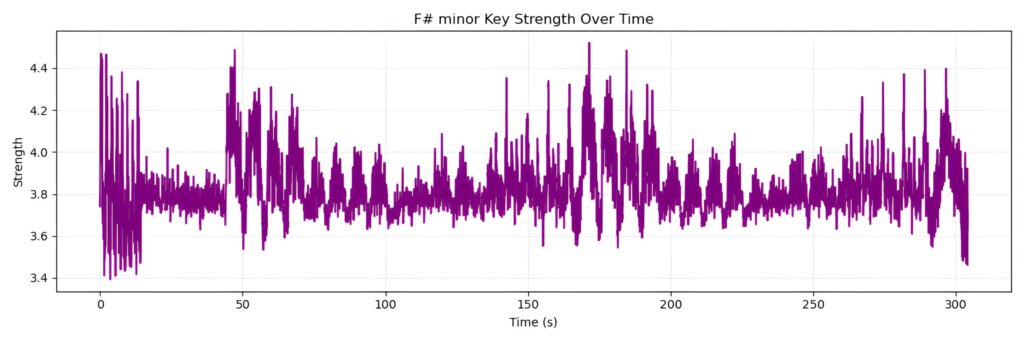
- Interpretation: The “axis” of F#m never wavers from start to finish. This reflects a stoic, singular mental focus etched directly into the track’s tonality.
Global Key Analysis: Resonance with the Dominant
F#4 minor (0.97) / C#4 minor (0.96)
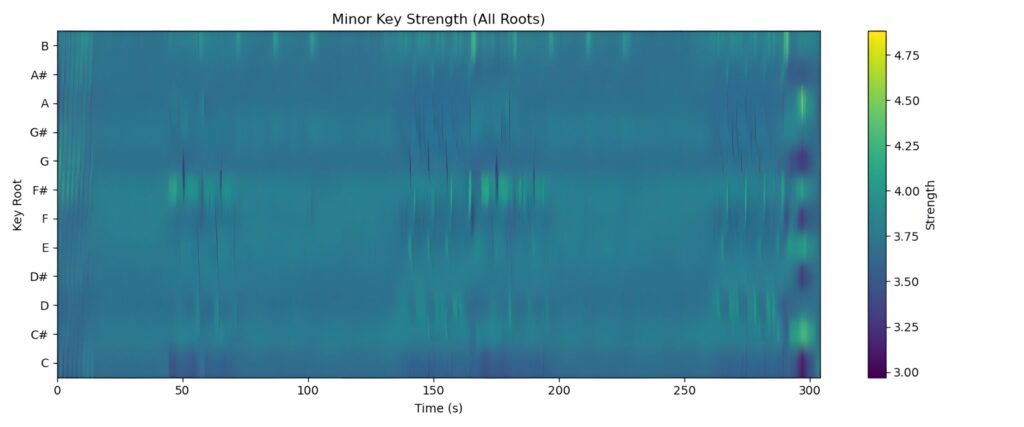
The tonic key, F# minor, and its dominant key, C# minor, exhibit nearly equal intensity, creating a compelling harmonic tension.
- Interpretation: The track maintains a persistent sense of high tension while simultaneously evoking a cosmic sense of expansion. This is likely the result of a deliberate, conscious approach to the dominant key, leveraging its relationship with the tonic to build a vast, structured sonic space.
Geometric Beauty in the Tonnetz
Tonnetz Standard Deviation: 0.10
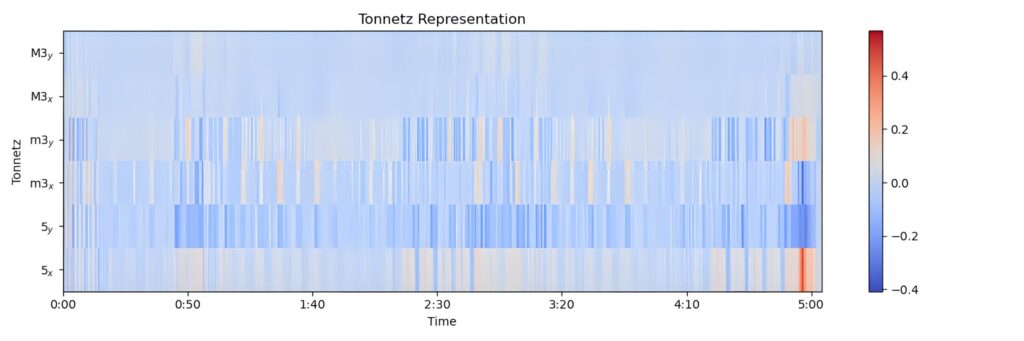
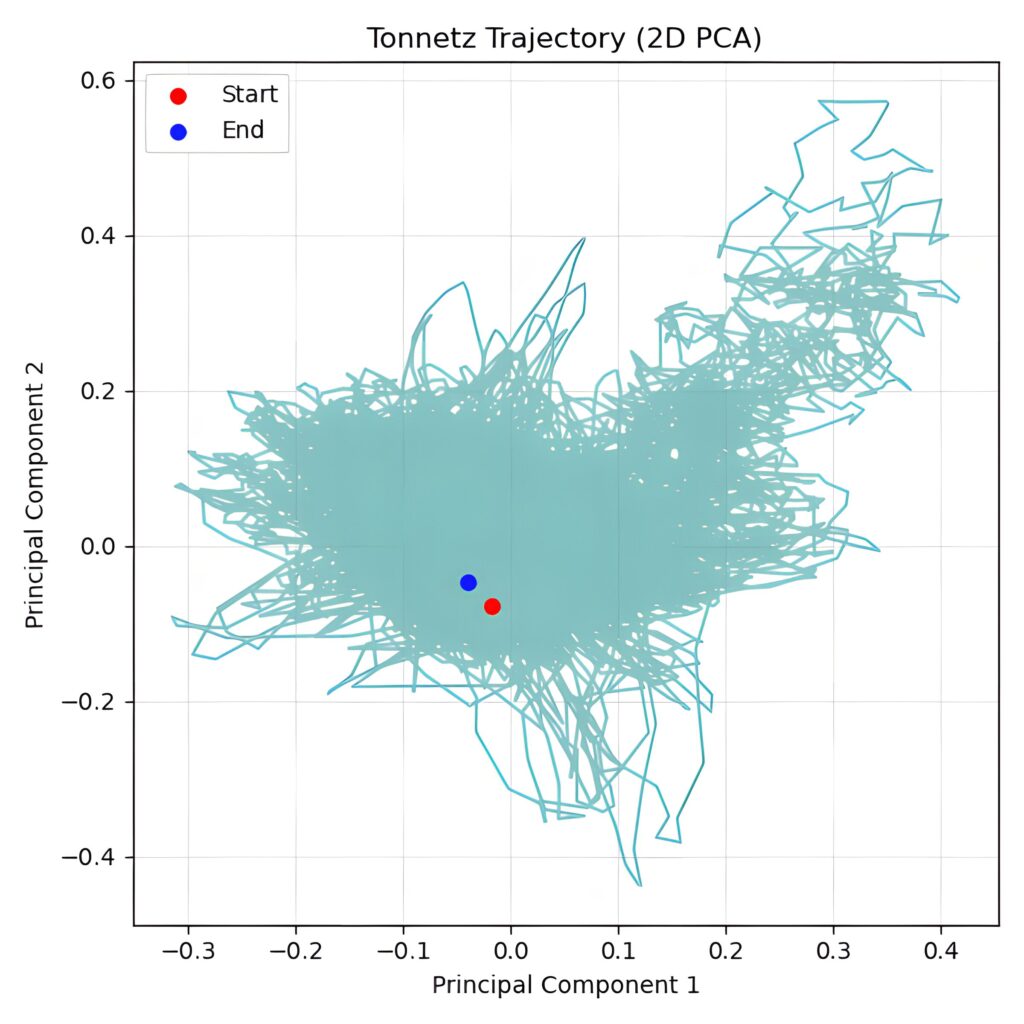
Harmonic movement is highly regular and moves across near-geometric distances. The narrative is built through the addition/subtraction of timbres and rhythmic transformation within a limited “tonal universe,” rather than relying on eccentric modulations.
1. Definition of Tonnetz
In audio analysis (using libraries such as librosa), the 6-dimensional Tonnetz vector projects intervallic relationships as follows:
- Tonnetz 0, 1: The Perfect Fifth axis
- Tonnetz 2, 3: The Minor Third axis
- Tonnetz 4, 5: The Major Third axis Tonnetz_5 quantifies the prevalence of “Major Third” intervals within the track and indicates the directional bias of these harmonic relationships.
2. Why does the “Major Third” axis react to F# minor?
One might assume that in the key of F# minor, the minor third would be the primary driver. However, decomposing the chord reveals the underlying logic:
- Components of an F# minor chord: F# (Root), A (Minor Third), C# (Perfect Fifth)
- Internal Intervallic Relationships:
- F# to C# = Perfect Fifth
- F# to A = Minor Third
- A to C# = Major Third
An F# minor triad inherently contains a Major Third relationship between A and C#. Consequently, when F# minor is played, the “Major Third” axis (Tonnetz_5) in the harmonic network exhibits a strong response.
3. Interpretation of Analysis Results
The strong correlation between Tonnetz_5 and F# minor in this dataset implies the following:
- Emphasis on the “A–C#” Resonance: The relationship between the 3rd (A) and the 5th (C#) of the F# minor chord is rendered with extreme clarity and stability throughout the track.
- Geometric Purity of Tonality: Despite complex overtones, the mathematical balance of the “Major Third” remains undisturbed.
- Mathematical Evidence: Tonnetz_5 does not directly refer to an A# (the major third of F#); rather, it acutely captures the internal major third interval within the F# minor triad. This serves as mathematical proof reinforcing the structural certainty of the F# minor key.
- Specific Correlation: A high positive correlation of 0.70 exists between Tonnetz_5 and F# minor intensity.
- Analysis: This indicates that the harmony is consistently drawn toward a “geometrically organized direction.” The gravitational pull of the F#m tonality is entirely dependent on this specific axis within the Tonnetz space.
Temporal Singularities
Mathematical Correlation (Tonnetz_5 and F# minor)
- Phenomenon: A high positive correlation of 0.70 exists between the intensity of the F# minor key and Tonnetz_5 (the axis representing Major Third intervals).
- Analysis: An F# minor triad consists of F# (Root), A (Minor Third), and C# (Perfect Fifth). While the relationship between the Root and the 3rd is a minor third, the interval between the 3rd (A) and the 5th (C#) is a Major Third. The data reveals that Tonnetz_5 acutely captures this specific internal resonance within the chord. The high correlation score proves that the “Major Third” component of the F#m triad is rendered with exceptional clarity and mathematical stability.
- Interpretation: This stable relationship provides the mathematical “backbone” for the track’s dignity. Even within a minor key, the purity of this internal interval ensures that the tonality remains firm and unwavering. It suggests a state of “unmoved intensity,” where the harmonic foundation provides a stoic, grounded sense of elegance amidst the track’s high-speed evolution.
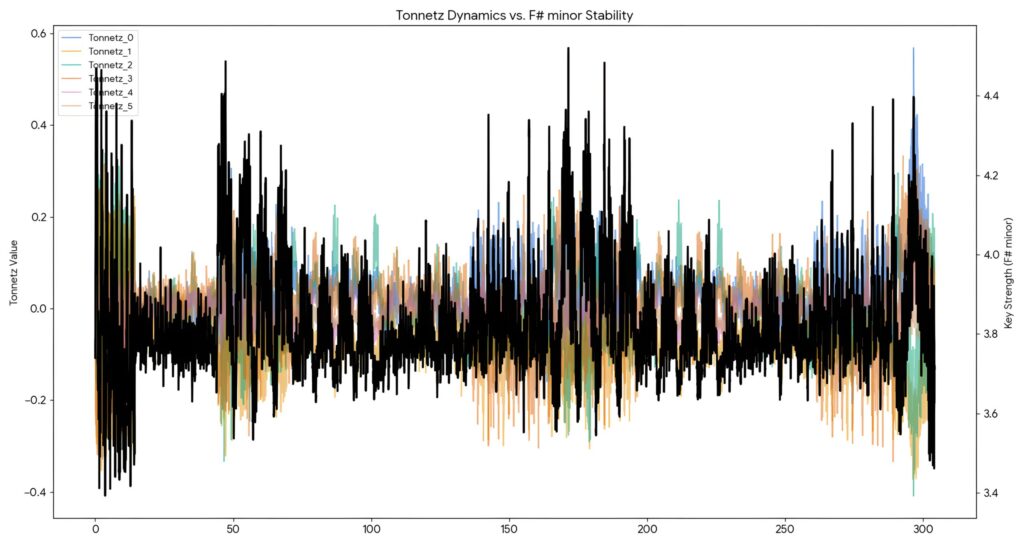
The “Collapse” (Around 290s)
The most significant singularity appears toward the end of the track, between 290s and 304s.
- Phenomenon: At the right edge of the graph, the F# minor intensity (black line) drops sharply, while the blue and green lines (Tonnetz 0, 2) fluctuate violently.
- Interpretation: This is not a mere fade-out. It represents a “physical acoustic collapse” or a “chaotic demise,” where the tonal framework vanishes and the sound oscillates wildly through the geometric space. It marks the specific point where the “synapses” (connections) are severed.
Harmonic “Compression and Ignition” (Around 170s)
- Phenomenon: Around the 170s mark, the various Tonnetz dimensions converge before F# minor intensity shows a sharp spike.
- Analysis: The geometric arrangement of sound momentarily “aligns,” transforming into energy that instantaneously boosts the tonal confidence level.
- Interpretation: This represents a “Kime” (musical peak) or a moment where an exceptionally clear chord is struck—a singularity where structural beauty reaches its maximum.
The Hierarchical Relationship Between Tonnetz and Key
In this composition, the Tonnetz initially serves as a mathematical “validation” for the key. However, toward the end of the track, this hierarchy is inverted. The piece exhibits a unique dynamic where pure acoustic energy breaks free from tonal constraints, spiraling into a state of liberated chaos.
Specifically, the stable trajectory of Tonnetz_5 acts as the mathematical backbone, upholding the “dignity” (the F#m axis) of the piece.
Ultimately, the track possesses a paradoxical structure: while it may sound as if it is constantly in motion, it is, in fact, virtually static—a singular point of intensity that remains fundamentally unmoved.
Chapter 3: Narrative Timeline (The Story)
Sectional Structure / Similarity / Harmonic Change × Onset
Rhythm and Momentum
Detected Tempo: 133.93 BPM
A driving speed faster than a resting heartbeat, designed to induce a trance-like state.
Percussive Impact: Onset_Percussive_Mean (1.84) > Onset_Harmonic_Mean (1.04).
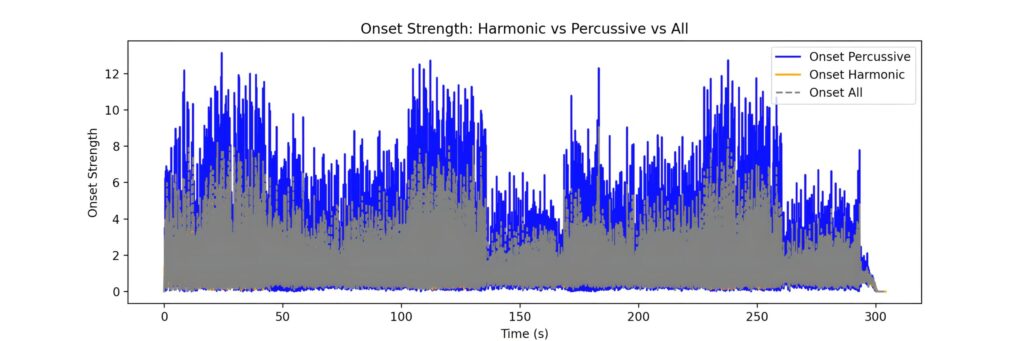
The sharp rhythmic “attack” is designed to provide direct auditory stimulation.
Fluctuation via Harmonic Density
Harmonic Change Density: 6.53 peaks / sec
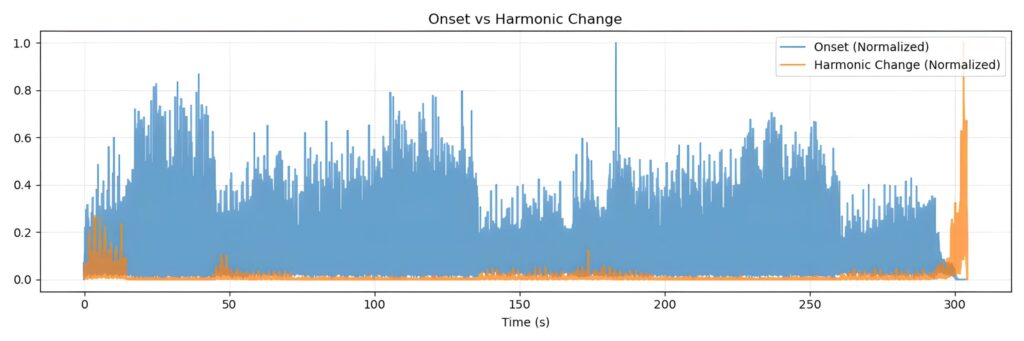
With over 6 harmonic changes per second, the track is a “flood of sound.” This speed nears the limit of human perception, creating a sense of continuous immersion where the next change arrives before the previous one is fully processed.
Perfect Alignment and Independence of “Vertical Lines”
Analysis of Synchronicity
- Upon closer examination (around the 60s–70s mark), the peaks of “Onset Strength” (Blue: Impact) and “Harmonic Change” (Red: Harmonic Shift) align perfectly at numerous points. This indicates that chord and melody transitions occur simultaneously with the impact of drum kicks and snares. Structurally, this design allows the rhythm to affect the body while the harmony engages the consciousness. The “vertical lines” are exceptionally tight and synchronized.
Rhythmic Independence
- Conversely, there are many sharp blue peaks (Onsets) that are not accompanied by red peaks (Harmonic Changes). This provides evidence of the abundant use of hi-hats and percussive ornaments that maintain the rhythm without altering the harmonic state.
The Balance Between “Impact” and “Color”
Correlation Coefficient: -0.103
The low overall correlation (leaning toward a negative correlation) is a particularly interesting finding.
- Analysis: It demonstrates that “rhythmic intensity (physical impact)” and “harmonic change (tonal color shifts)” do not necessarily scale in proportion to each other.
- Interpretation: This reveals the coexistence of distinct instrumental layers with contrasting roles: “striking hard without changing pitch (the drum parts)” versus “playing softly while rapidly shifting pitch (fast arpeggios).” This separation prevents the rhythm from becoming a monotonous “thump-thump” and instead creates a deep, multi-layered auditory experience.
This proves that the track possesses a high-level duality—a “dance of vivid, organic melodies” layered atop a “cold, inorganic grid of drums.” In particular, the sections where harmonic changes occur more frequently than onset peaks keep the listener in a state of constant anticipation, wondering where the music will move next—a hallmark of an incredibly exciting composition.
Synchronicity and Independence
The peaks of Onset Strength (impact) and Harmonic Change (color) align perfectly at key points, syncing the body (rhythm) with the consciousness (harmony). Simultaneously, numerous independent percussive “onsets” provide depth, ensuring the track never feels like a flat, monotonous grid.
Structural Timeline Analysis
The total performance duration of 304 seconds is composed of the following primary structural movements:
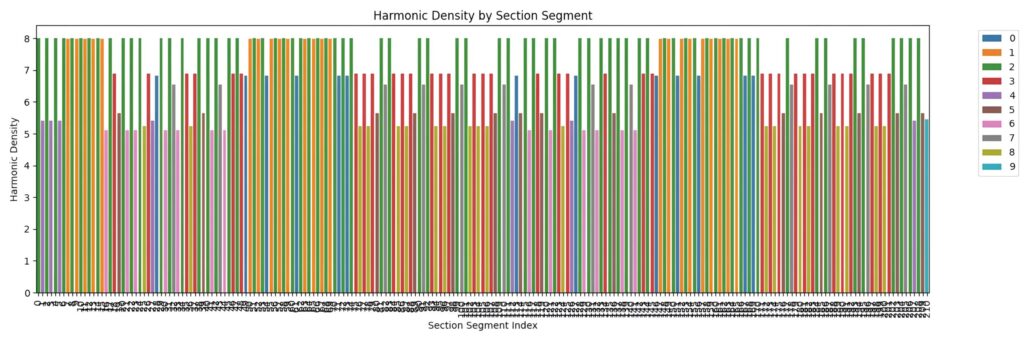
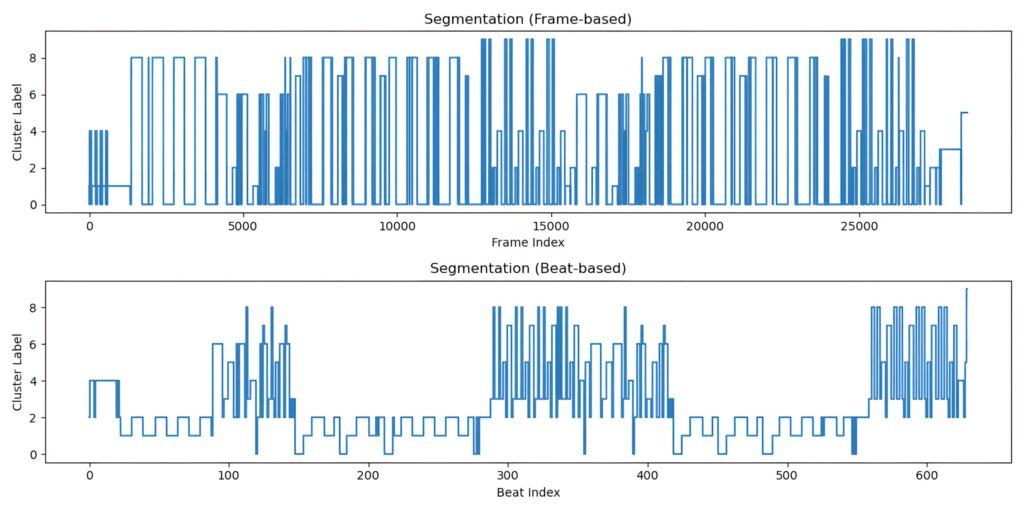
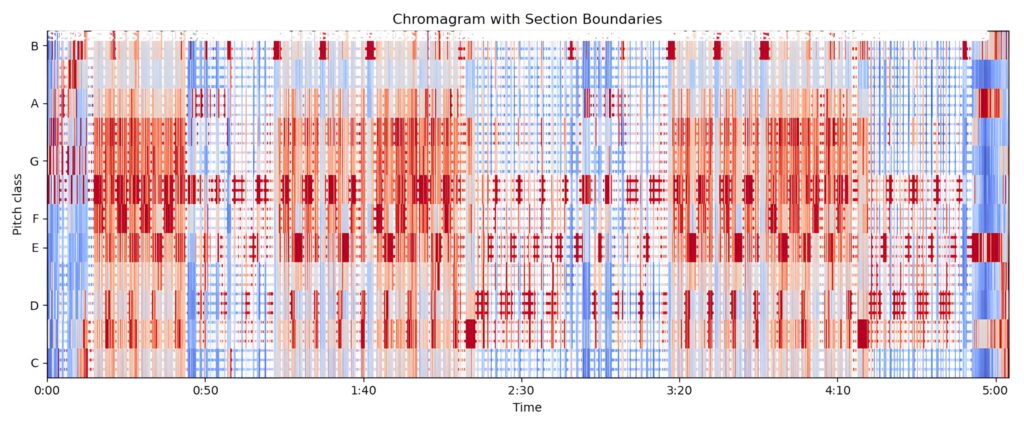
| Section | Start Time (s) | End Time (s) | Duration (s) | Key | Key Strength | Harmonic Density |
| 2 | 0.00 | 4.37 | 4.37 | C♯4 minor | 0.968 | 8.0044 |
| 4 | 4.37 | 5.75 | 1.38 | B4 minor | 0.961 | 5.4012 |
| 2 | 5.75 | 6.21 | 0.46 | C♯4 minor | 0.968 | 8.0044 |
| 4 | 6.21 | 13.08 | 6.87 | B4 minor | 0.961 | 5.4012 |
| 2 | 13.08 | 13.54 | 0.46 | C♯4 minor | 0.968 | 8.0044 |
| 4 | 13.54 | 13.99 | 0.46 | B4 minor | 0.961 | 5.4012 |
| 2 | 13.99 | 14.45 | 0.46 | C♯4 minor | 0.968 | 8.0041 |
| 1 | 14.45 | 18.11 | 3.66 | F4 minor | 0.956 | 7.9852 |
| 2 | 18.11 | 21.77 | 3.66 | C♯4 minor | 0.968 | 8.0041 |
| 1 | 21.77 | 25.66 | 3.89 | F4 minor | 0.956 | 7.9852 |
| 2 | 25.66 | 29.33 | 3.67 | C♯4 minor | 0.968 | 8.0041 |
| 1 | 29.33 | 32.99 | 3.66 | F4 minor | 0.956 | 7.9852 |
| 2 | 32.99 | 36.66 | 3.67 | C♯4 minor | 0.968 | 8.0041 |
| 1 | 36.66 | 40.32 | 3.66 | F4 minor | 0.956 | 7.9852 |
| 2 | 40.32 | 43.98 | 3.66 | C♯4 minor | 0.968 | 8.0041 |
| 1 | 43.98 | 44.34 | 0.36 | F4 minor | 0.956 | 7.9856 |
| 6 | 44.34 | 47.54 | 3.20 | F♯4 minor | 0.952 | 5.1042 |
| 2 | 47.54 | 48.00 | 0.46 | C♯4 minor | 0.968 | 8.0043 |
| 3 | 48.00 | 49.38 | 1.38 | D4 Major | 0.952 | 6.8895 |
| 5 | 49.38 | 51.20 | 1.82 | E4 Major | 0.962 | 5.6410 |
- Tension and Release in the Opening: The rapid alternation between Section 2 (C#m, High Density) and Section 4 (Bm, Low Density) creates a rhythmic “pulsation” from the very start of the track.
- Stability of the Main Part (from 14s): From approximately 14 seconds, Section 1 and Section 2 appear alternately, maintaining an extremely high Harmonic Density of around 8.0. This segment represents the “core” of the track—its most vibrant and information-rich portion.
- Transition from 44s: Around the 44-second mark, new elements such as Section 6 (F#m) and Section 3 (D Major) emerge with different keys and densities (5.1–6.8). This serves as a structural bridge, cooling down the intensity of the main part and building anticipation for the next development.
- The Power of Section 2: The prominent presence of Section 2, characterized by its high Harmonic Density, provides the entire composition with “power” and “depth”—a fact clearly supported by the numerical data.
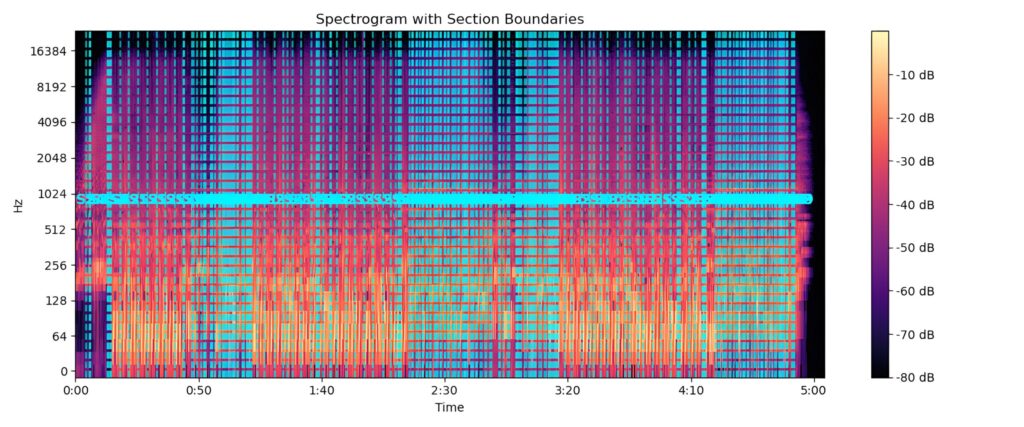
Spectral Insights: The frequency bands above 4 kHz are rendered not as “noise,” but as distinct “particles.” A cyan line near 1,024 Hz functions like an “acoustic horizon,” stabilizing the overall center of gravity. The high-frequency rolloff is as precise as if drawn with a ruler, while the mid-to-low range is packed with an incredibly dense concentration of energy, visible at a single glance.
Section Transition and Similarity (Sim Data)
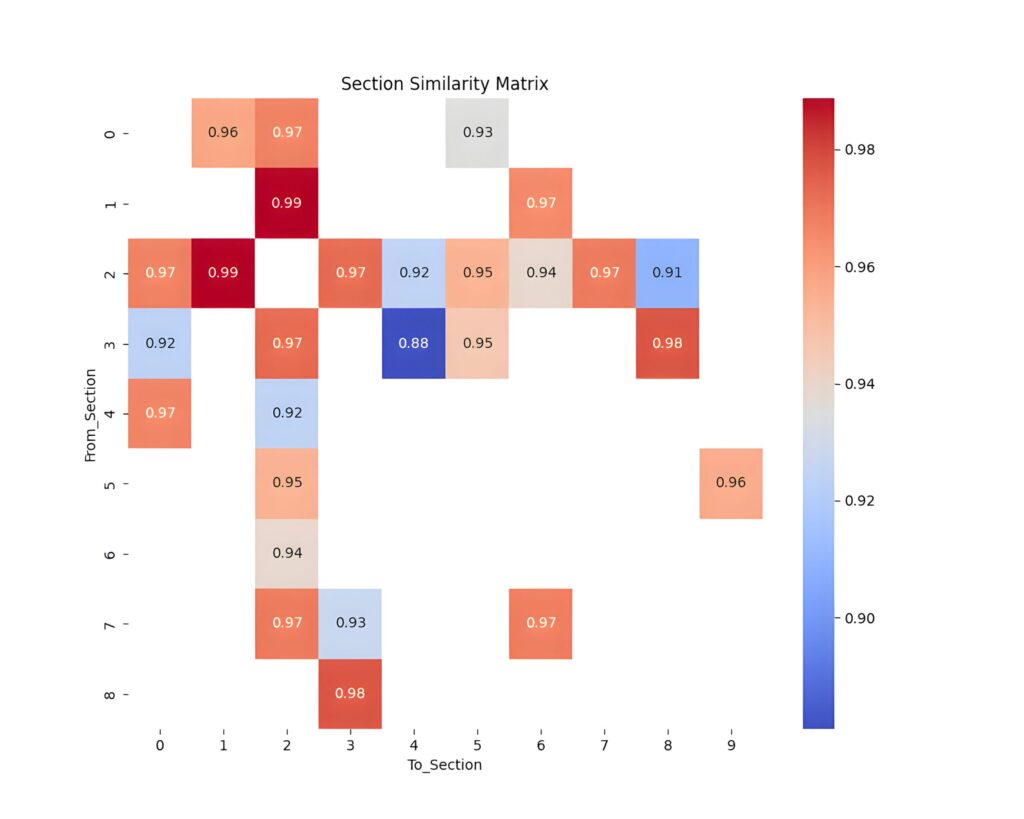
The following table summarizes the transitions between sections and their corresponding Similarity Index (Commonality).
| No. | Transition | Similarity | Musical & Structural Interpretation |
| 1 | S2 → S4 | 0.924 | Subtle textural shifts in the introduction. |
| 2–6 | S4 ↔ S2 | 0.924 | (Repetition of the above) |
| 7 | S2 → S1 | 0.989 | Transition into the main theme. Extremely high continuity. |
| 8–14 | S1 ↔ S2 | 0.989 | (Repetition of the above) |
| 15 | S2 → S1 | 0.989 | Seamless looping while maintaining high energy. |
| 16 | S1 → S6 | 0.966 | Development section. Shift toward slightly ominous G minor (S6) elements. |
| 17–24 | Various | 0.939~ | Cyclical transitions between core sections. |
| 25 | S2 → S8 | 0.910 | Transition to E minor (S8), setting the stage for the finale. |
| 26 | S8 → S3 | 0.977 | |
| 27 | S3 → S4 | 0.881 | Lowest similarity recorded. Sharp development or rhythmic break. |
| 28–48 | Various | 0.923~ | Complex interweaving of motifs and variations. |
| 49 | S3 → S0 | 0.923 | |
| 50 | S0 → S1 | 0.958 | Final sections merging as the track approaches its conclusion. |
Exceptional Consistency: Most transitions record extremely high similarity scores between 0.93 and 0.98. This indicates that the track is not merely a collection of fragmented parts stitched together, but a singular, massive “swell” (groove) where timbre and harmony are seamlessly and robustly interconnected.
The “Golden Loop” of S2 ↔ S1: The 0.989 value observed in steps No. 7–15 is musically equivalent to “near-perfect synchronization.” This structure ensures that during the main hooks, the listener’s immersion remains uninterrupted, facilitating a consistent and pleasurable trance-like state.
The Accent at No. 27 (0.881): This point marks the lowest similarity across all transitions. It can be inferred that this is a pivotal moment where a deliberate “change in atmosphere” or a “dramatic shift” was introduced to the composition.
Chapter 4: The DNA of Sound (Acoustic Fingerprinting)
MFCC / Spectral Flatness / Texture Analysis
A deeper dissection of the acoustic properties of “Cross A Synapse” reveals the unique DNA that shapes the track’s distinctive “tactile feel” and “atmosphere.”
MFCC Profile as an Acoustic Fingerprint
MFCC (Mel-Frequency Cepstral Coefficients) quantifies the “texture of sound” as perceived by the human ear. The shape of this graph represents the track’s unique “voice” or acoustic identity.
- MFCC 2 (75.14) — “Brilliance and Presence”: A very high positive value. This indicates that the spectrum extends smoothly and powerfully from lows to highs. It goes beyond mere bass strength; this value reflects a “tangible presence,” where the contours of the sound are sharp and feel as if they are manifesting directly in front of the listener.
- MFCC 4 (20.69) & MFCC 6 (11.20) — “The Core of Resonance”: Positive swings in these mid-range coefficients prove that the “soul” of the track resides firmly in the mids. The richness in this band ensures that synth leads and other textures possess “persuasive density” rather than feeling hollow.
- MFCC 9 (-5.47) & MFCC 11 (-4.23) — “Subtractive Transparency”: Slight negative dips prevent specific bands from becoming oversaturated. This is the “secret sauce” of the mix: it allows for high transparency without muddiness, even with such high Harmonic Density.
Complexity and Purity of Texture (Spectral Flatness)
- Spectral Flatness: 22.53
- Analysis: This metric indicates whether a sound is closer to a “pure tone” (sine wave) or “noise.”
- Interpretation: A value of 22.53 represents an exquisite balance. It is a sophisticated blend of “digital purity” from the synths and “complex noise components” (the sharp, synapse-like sparks in the attacks), creating a refined texture that is neither too sterile nor too cluttered.
The True Identity of “Cross A Synapse”
Integrating all data, the DNA of this track is defined by three pillars:
- “Ultra-Resolution”: The extraordinary height of Spectral Contrast 5, showing the beauty in the sharp “ignition” and “decay” of every note.
- “Mathematical Elegance”: The rigid correlation between Tonnetz 5 and F#m, signifying an unwavering harmonic geometry.
- “Weighty Transparency”: The perfect coexistence of a grounded low-end and crystal-clear highs, as shown in the MFCC profile.
The Spirit of “Iai” (The Art of the Quick-Draw)
My production style for this track resonates with the spirit of Iai—where the outcome is decided not by repeated swings of the blade, but at the very moment it is drawn from the sheath.
- The Stance (Sound Selection): Precise back-calculation considering octaves and intervals.
- The Strike (Keying): Sharp, raw attacks preserved without being crushed by compression.
- Zanshin (The Mix): Adding just a hint of “body heat” (roundness) to the final resonance.
Because of this process, the track achieves a unique equilibrium: “stoically mathematical” in structure (Tonnetz), yet “deeply organic” in texture (MFCC 2).
Insights as an Engineer and Composer
What struck me most in this analysis was the synergy between the “absolute stability of F# minor (0.0345)” and the “high-frequency contrast (53.22).” Mathematically, this proves a state where a “sparking, razor-sharp intelligence” (highs/rhythm) dances upon an “unwavering spiritual pillar” (lows/tonality).
“Cross A Synapse” is a 134 BPM journey that constructs a cold, immutably stable space in F#m. It is a piece where sharp particles of sound are meticulously placed; while the low-end and tonality remain virtually motionless, the high-end and temporal structures continue to shift with intense, violent precision.