 Akihito Kimura
 Introduction: Sound as Cognition
Sound is not merely a physical phenomenon that vibrates the eardrum.
It is an accumulation of perception—interpreted and reconstructed by the brain.
At times, this reconstructed perception exerts a stronger and deeper influence on the body than physical reality itself.
This article presents a data-driven analysis of my composition “Fractal Moon,” examining its structure from microscopic sonic elements to macroscopic narrative form.
The objective is to reframe a fundamentally subjective experience—music—as a continuum of objective numerical relationships.
Chapter 1: The Micro-Texture of Sound (Cells)
Spectral / MFCC / RMS / ZCR
In designing the sound of “Fractal Moon,” the goal was not sharpness, but resolution.
The sensation of each sound “cutting through space” emerges from a carefully controlled distribution of frequencies and energy.
Spectral Characteristics
Spectral Rolloff (~4,805 Hz)
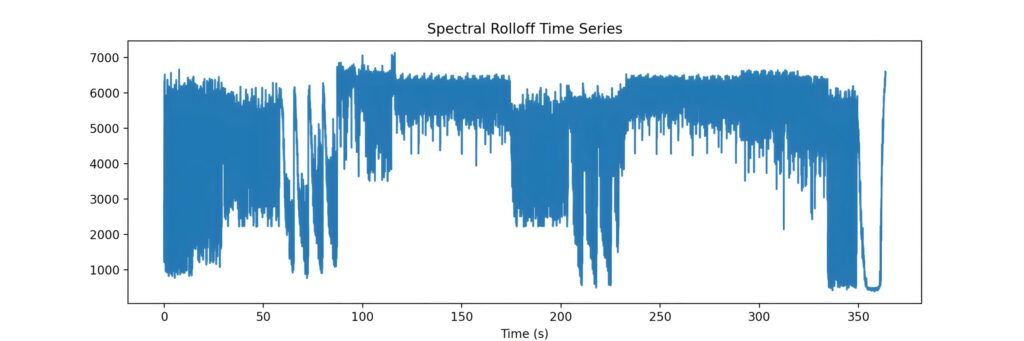
85% of the energy is concentrated below 4.8 kHz, eliminating unnecessary high-frequency noise while preserving clarity and air.
Spectral Bandwidth (~2,193 Hz)
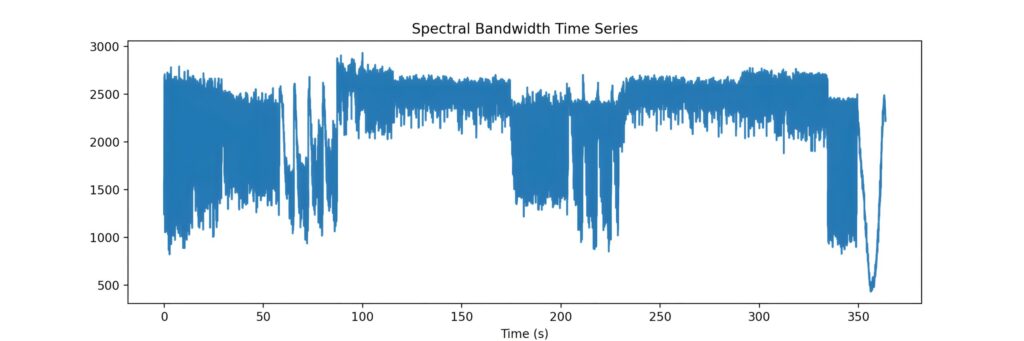
Indicates a wide and dense sonic spread, producing a rich, multi-layered texture rather than a linear sound profile.
Spectral Centroid (~2,092 Hz)
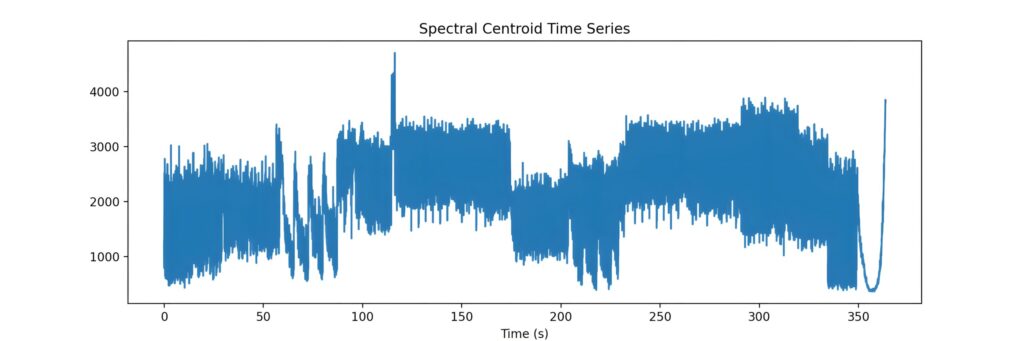
Suggests a bright yet controlled tonal balance, maintaining clarity without harshness.
Spectral Flatness (24.89)
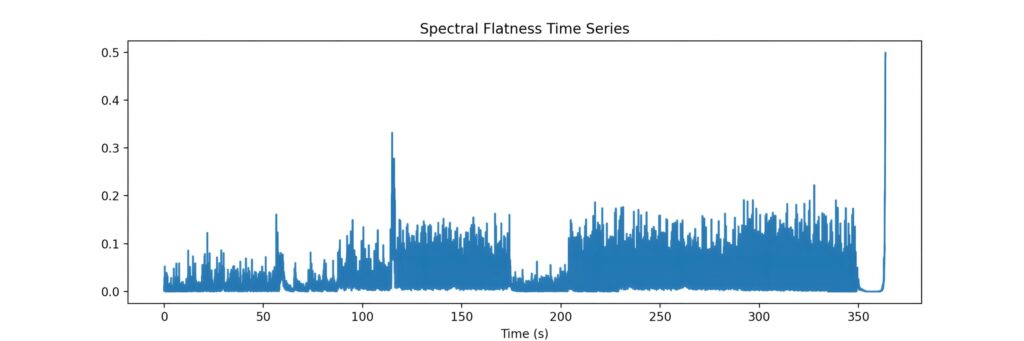
Reflects a highly filled spectral space, indicating a dense and refined layering structure.
Spectral Contrast (Band 5: 52.82)
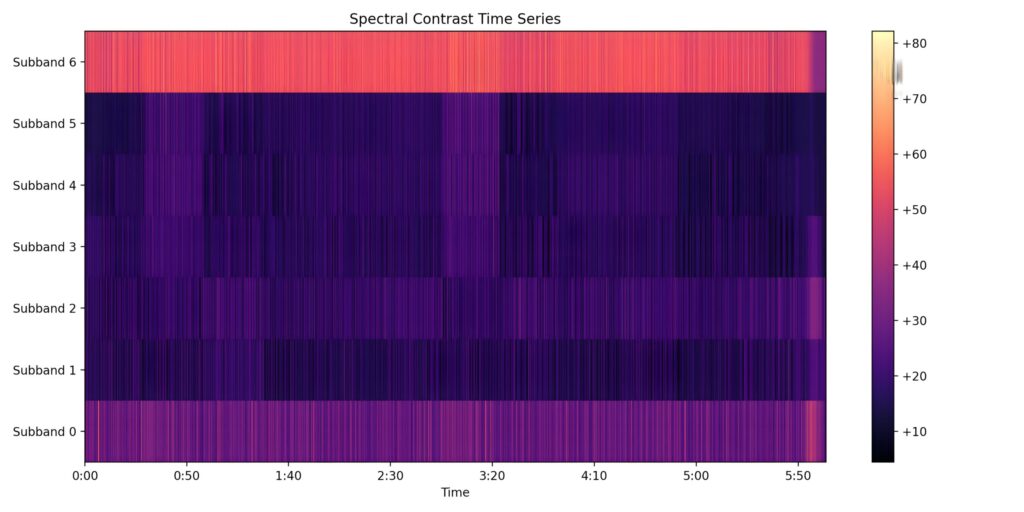
Demonstrates strong articulation around 4 kHz, allowing percussive transients to manifest as crystalline ‘points’ within the soundstage.
MFCC Mean 2(72.48)
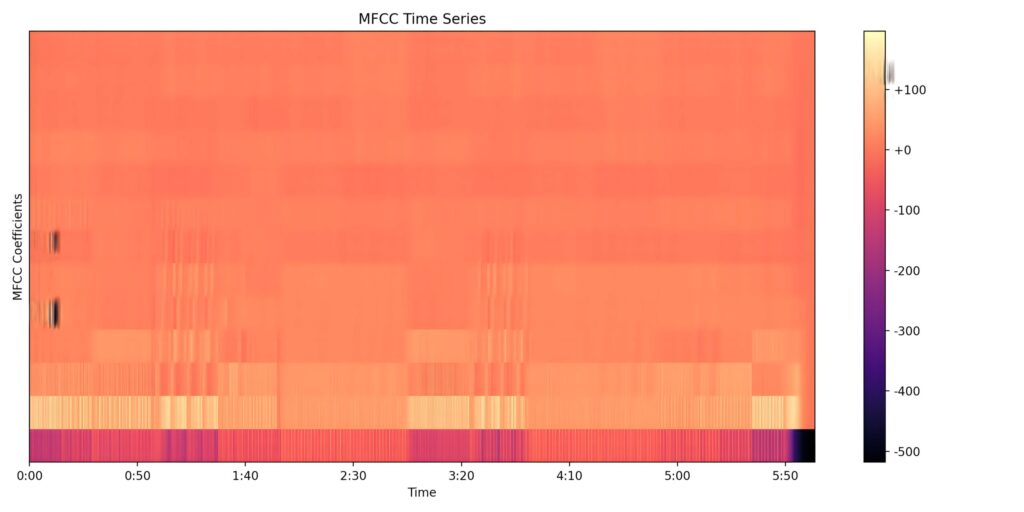
Indicates a balance between a stable low-frequency foundation and detailed mid-high frequency content.
Zero Crossing Rate (0.096)
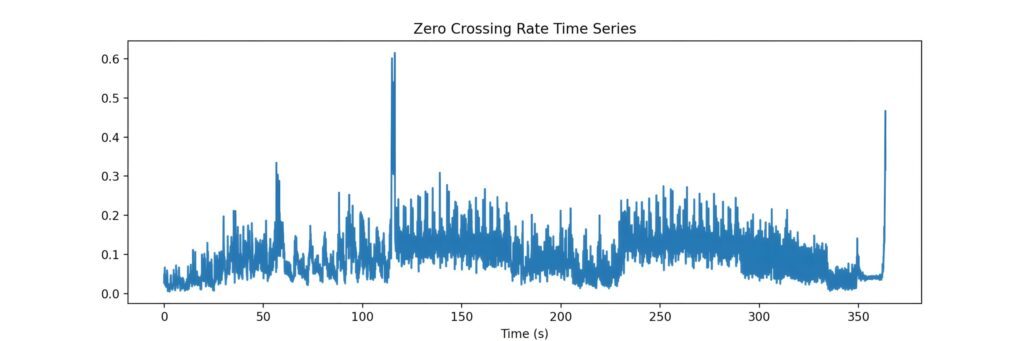
Suggests a clean waveform with minimal distortion, allowing complex arrangements to remain transparent.
This perceived “cleanliness” is not static.
On a micro-temporal scale, each sound undergoes rapid cycles of emergence and decay; the continuity of these events produces what is perceived as stillness.
Energy and Dynamics
Although rhythmic elements drive the forward motion, the perceived “wall of sound” is primarily generated by sustained harmonic components.
RMS (Harmonic: 0.156) > RMS (Percussive: 0.042)
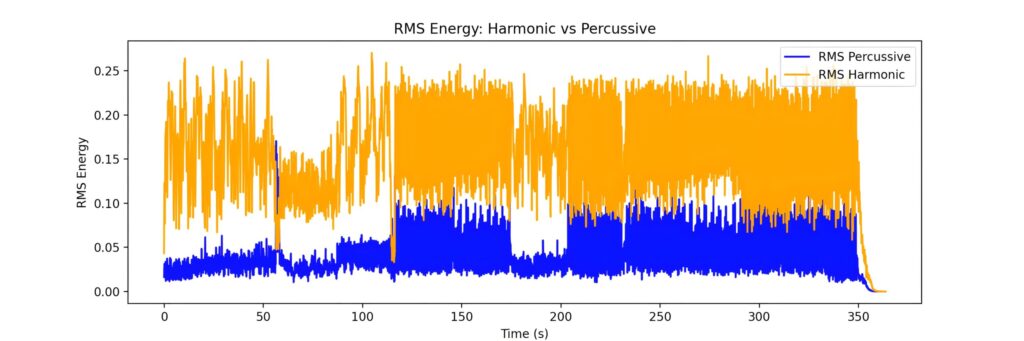
This imbalance reflects a design philosophy that prioritizes the density of sustained resonance over transient impact.
Listening Guide
Listeners are encouraged to focus first on the transient attacks around 4 kHz.
These elements appear as sharply defined “points.”
Shifting attention to the low-frequency range reveals a stable “plane” that supports the entire structure.
This duality—point (high-frequency transients) and plane (low-frequency foundation)—forms the perceptual core of the piece.
Chapter 2: The Architecture of Tonality (Skeleton)
Key Strength / Stability / Tonal Geometry
The tonal framework of the piece exhibits extreme stability while unfolding geometric complexity internally.
Chroma Distribution
| Chroma Index | Pitch | Mean Intensity | Musical Role & Interpretation |
| Chroma 7 | F# | 0.721 | Root: The absolute core that binds all sonic cells of the composition together. |
| Chroma 5 | E | 0.646 | Minor 7th: Introduces modal resonance and evokes a sense of cosmic floating. |
| Chroma 6 | F | 0.588 | Passing Tone: Functions as a neighbor tone to F#m, adding subtle tension and shading. |
| Chroma 8 | G | 0.545 | Decorative Color: Provides organic fluctuation and vital movement to the track. |
| Chroma 9 | G# | 0.504 | 2nd Interval: Forms lyrical progression and intellectual accents. |
| Chroma 2 | C# | 0.448 | 5th Interval (Dominant): A robust anchor that vertically supports the entire structure. |
| Chroma 10 | A | 0.412 | Minor 3rd: Defines the minor key’s character, where melancholy and stoic coldness coexist. |
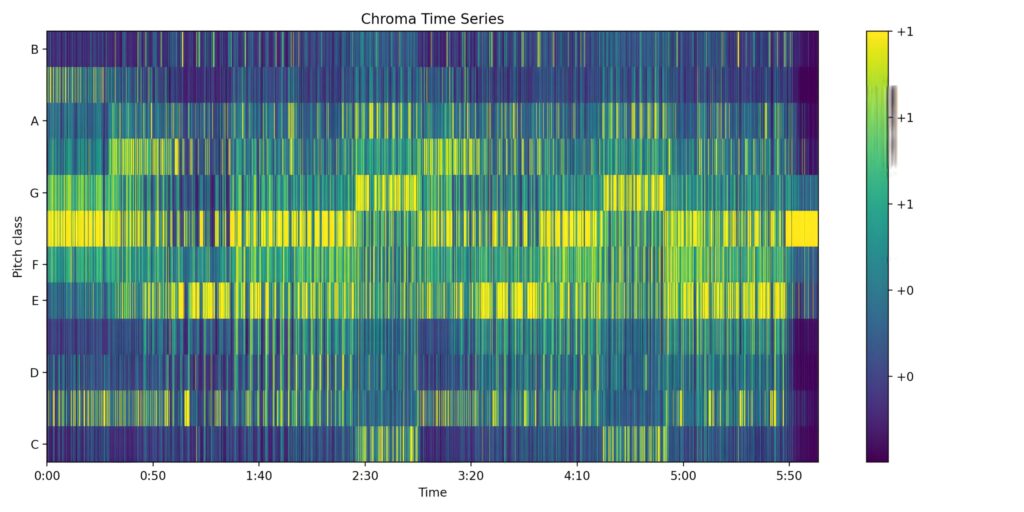
Chroma
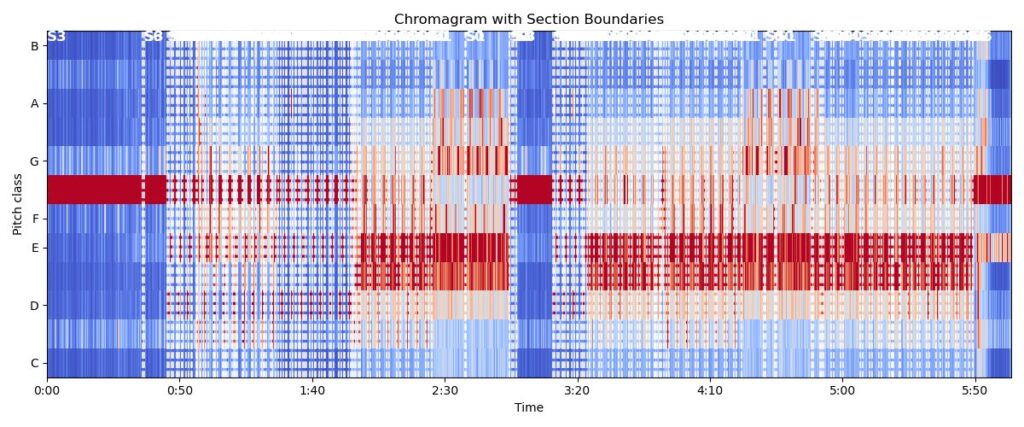
Chromagram with Section Boundaries
F♯ functions as the dominant tonal center, supported by a rich upper structure:
- Strong presence of E (minor 7th) introduces modal ambiguity
- C♯ reinforces structural stability as the dominant
- G and G♯ contribute expressive and melodic motion
Global Key Analysis
| Estimated Key | Strength | Interpretation |
| E minor | 0.913 | Another “shadow” tonality lurking within the composition. |
| D# minor | 0.908 | A distinct resonance that pushes tension to its limit. |
| F# minor | 0.905 | The primary key, serving as the spiritual and structural backbone of the piece. |
| C# minor | 0.899 | The dominant key supporting F#, providing cosmic breadth and depth. |
Key Strength Trajectory (F# m → E maj → F maj)
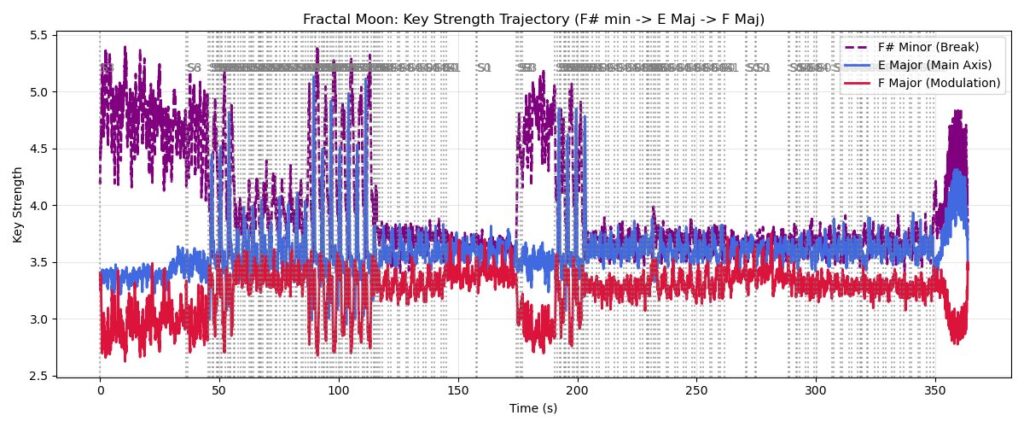
Multiple key candidates exhibit nearly equivalent strengths:
- E minor (0.913)
- D♯ minor (0.908)
- F♯ minor (0.905)
- C♯ minor (0.899)
This indicates a multi-layered modal resonance rather than a single fixed tonality.
Tonnetz and Harmonic Geometry
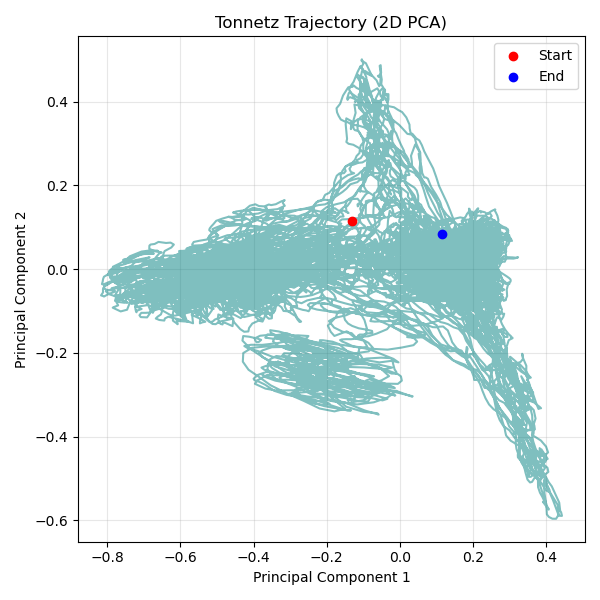
Correlation between Tonnetz_5 and F♯ minor: 0.919
This high correlation suggests that the tonal structure aligns closely with geometric relationships in harmonic space, particularly along the major third axis (A–C♯).
The perceived “coherence” of the harmony is thus mathematically grounded.
Tonnetz Representation
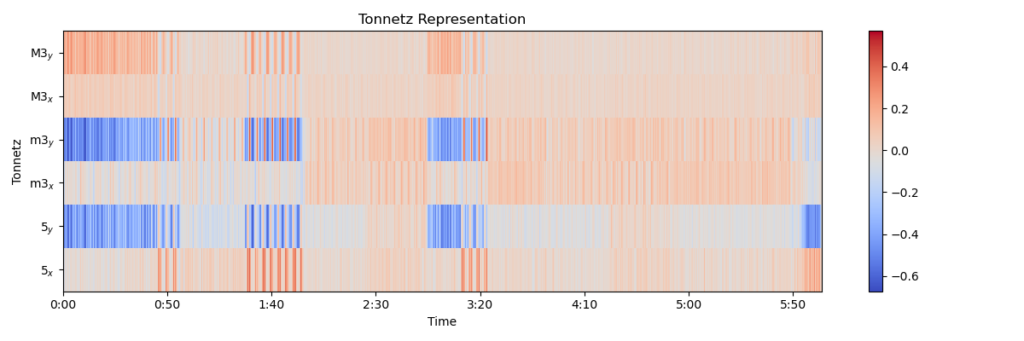
Tonnetz Trajectory (2D PCA)
Temporal Singularity (Harmonic Collapse)
Around the 300-second mark, the strength of F♯ minor rapidly decreases, and Tonnetz vectors become unstable.
This transcends the convention of a ‘fade-out’; it is an intentional dissolution of the harmonic ego.
It represents the gradual disintegration of an imposed tonal order.
The harmonic system does not merely weaken—it dissolves.
What remains is sound stripped of relational structure, returning to a state of independent particles.
This moment reveals music not as structure, but as a physical phenomenon.
Chapter 3: The Temporality of Narrative (Story)
Sections / Synchronicity / Harmonic Density
Music unfolds through time, and its structure is defined by controlled fluctuations.
Rhythm and Drive
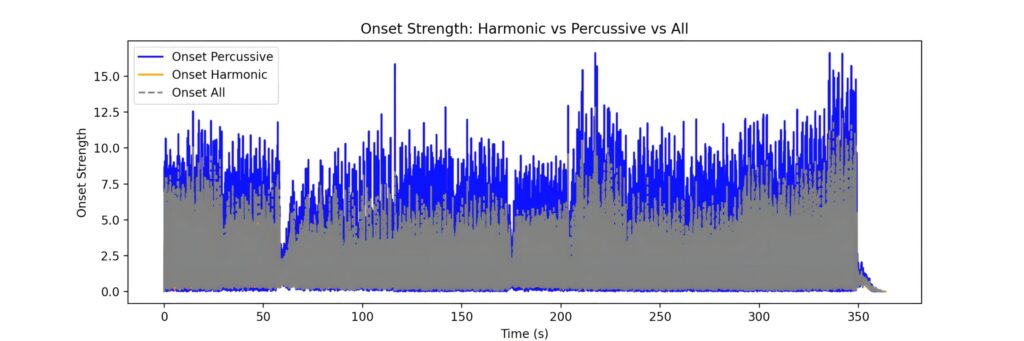
- Tempo: 133.93 BPM
- Onset (Percussive: 2.43) > Harmonic (1.36)
The design prioritizes rhythmic immediacy, delivering continuous perceptual stimulation.
Onset Strength Harmonic vs Percussive vs All
Decoupling of Rhythm and Harmony
Correlation between onset strength and harmonic change: approximately 0
Onset vs Harmonic Change
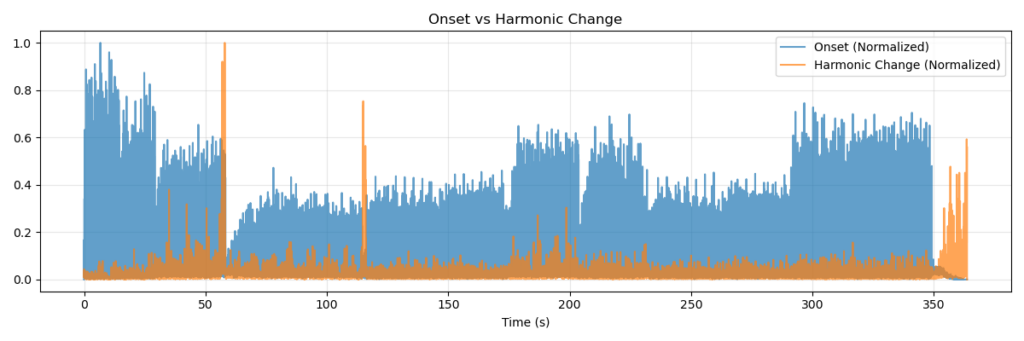
This indicates that rhythmic intensity and harmonic motion operate independently:
- Percussion emphasizes temporal precision
- Harmonic layers introduce tonal evolution
Synchronicity and Independence
At key moments, rhythmic and harmonic peaks align perfectly, producing strong cognitive and physical impact.
Simultaneously, independent rhythmic events (e.g., hi-hats) create additional layers of complexity.
Harmonic Density and Perceptual Limits
Average harmonic density: ~5 changes per second (max: 6.58)
| Section | Start Time (s) | End Time (s) | Duration (s) | Key | Key Strength | Harmonic Density |
| 3 | 0.00 | 36.15 | 36.15 | F#4 Major | 0.768 | 2.35 |
| 6 | 36.15 | 36.60 | 0.45 | F#4 minor | 0.889 | 4.46 |
| 3 | 36.60 | 45.24 | 8.64 | F#4 Major | 0.768 | 2.35 |
| 5 | 45.24 | 46.14 | 0.91 | D4 Major | 0.891 | 3.37 |
| 2 | 46.14 | 47.05 | 0.91 | E4 Major | 0.885 | 3.92 |
This approaches the upper threshold of perceptual tracking.
As a result, the music bypasses conscious analysis, directly engaging the listener’s neurobiological entrainment.
This leads to entrainment, where bodily rhythms—breathing, movement, even gaze—synchronize with the music.
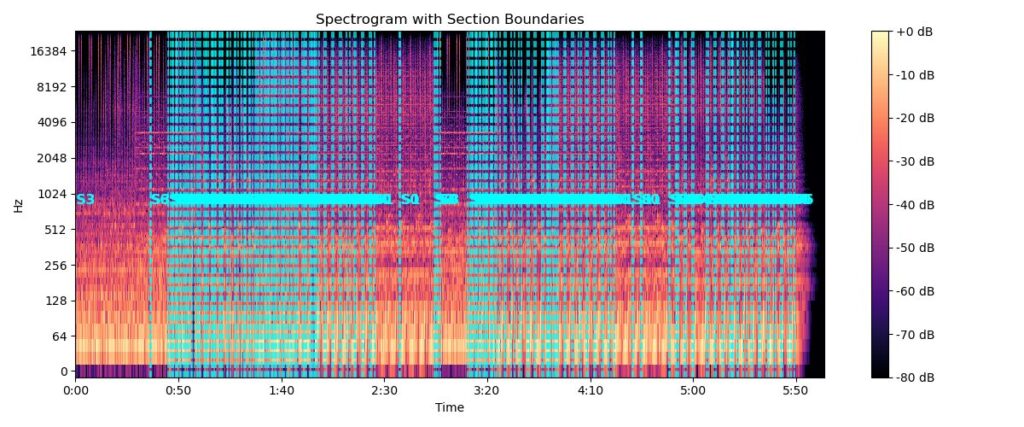
Spectrogram with Section Boundaries
Section Transition Similarity (Sim Data)
| Transition | Similarity | Structural Interpretation |
| S3 → S6 | 0.867 | A shift from light to dark. Deepening emotional resonance while maintaining consistent sonic texture. |
| S3 → S5 | 0.573 | Singularity: The lowest similarity in the entire piece. A structural rupture or “rift.” More than a simple change, it is a phase discontinuity where the temporal continuity is momentarily severed. |
| S5 → S2 | 0.782 | Reconstruction into a new palette of sonic colors. |
| S0 → S1 | 0.958 | Extremely high continuity toward the finale. A transition like a single ray of light gradually fading away. |
In this state, listeners do not merely “hear” the rhythm; they “synchronize” with it almost unconsciously. Every movement—from the tapping of a toe and the rhythm of breath to the subtle shifting of one’s gaze—is drawn into the sonic cycle.
Structural Discontinuity (Rift)
The transition with the lowest similarity represents a structural rupture:
Not merely variation, but a phase discontinuity—a break in temporal continuity.
“Fractal Moon” possesses a structure that is analyzable, yet simultaneously penetrates beyond analysis into perception.
Chapter 4: Sonic DNA (Signature)
MFCC / Spectral Structure / Texture
The identity of “Fractal Moon” can be reduced to three core elements:
- Hyper-resolution
Extreme spectral contrast defines precise attacks and decays. - Mathematical elegance
Strong alignment between tonal structure and geometric harmonic space. - Dense transparency
Coexistence of a grounded low end and a highly defined high-frequency range.
Conclusion: An Interface Between Structure and Perception
“Fractal Moon” operates as an interface between structure and perception.
A fully controlled geometric system coexists with fluid, evolving cognition.
Through their interaction, sound transforms from information into experience.
On the Compositional Process
The data reveals a consistent duality:
rigid mathematical structure alongside organic sonic texture.
A stable tonal and low-frequency foundation supports a dynamic, high-frequency articulation—where precision and expression coexist.
“Fractal Moon” is a composition that constructs an immovable spatial framework within a high-velocity temporal flow, embedding sharply defined sonic particles into that space.
Whether this is music, or merely a byproduct of perception—
that boundary can no longer be clearly determined.
The distinction between musical structure and perceptual byproduct is effectively neutralized.
Epilogue: Beyond the Data
Through the mirror of “Fractal Moon,” we touch upon the mathematical truths hidden within sound and the profound mysteries of the brain that interprets them. While data itself never lies, the way that data is sublimated into a living “experience” depends entirely on the artist’s single, decisive strike—much like the art of Iai.
When you return to the music after journeying through this analysis, I believe new synapses will connect within you. Perhaps, in that moment, a “Moon” of far greater resolution will rise within your mind than ever before.