 Akihito Kimura
 Listen: Way Out / Tetsujin (Akihito Kimura)
Overview
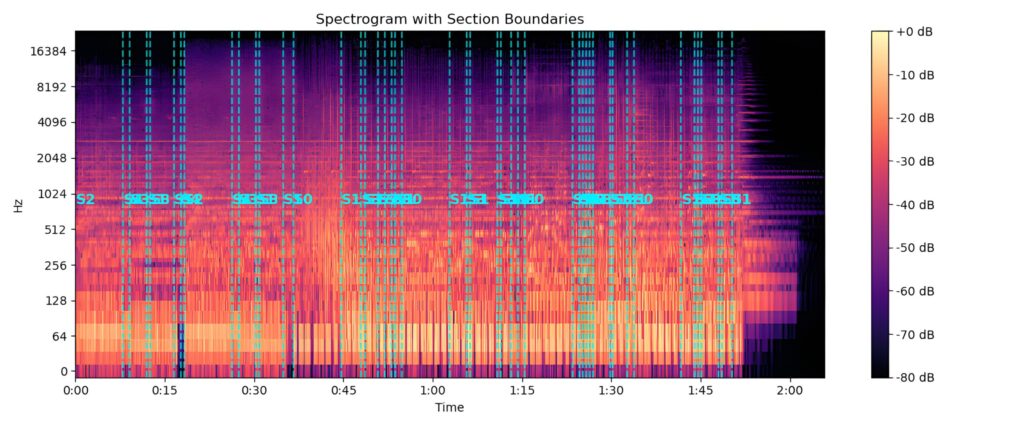
Figure 0: The acoustic architecture of “Way Out.”
The dense vertical boundaries represent 47 discrete perceptual sections (states) designed within a 125-second duration.
This analysis proposes a simple but radical premise:
This track is not designed around sound.
It is designed around perception.
What appears to be “high information density” is not the result of more notes, but of how attention is controlled across time and frequency.
1. Three-Band Salience: Managing Attention Across Layers
The listening experience of Way Out is built on a functional separation of three frequency bands.
This is not just spectral mixing—it is temporal allocation of perceptual focus.
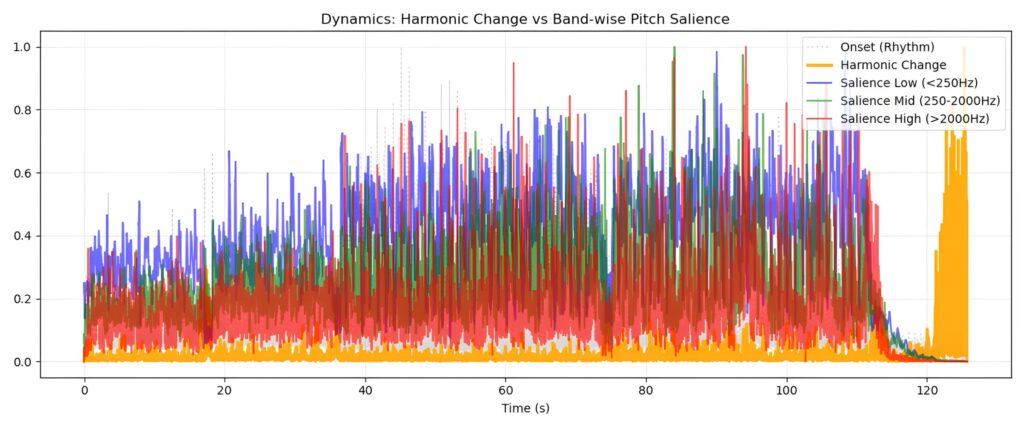
Figure 1: Band-wise salience analysis.
A visualization showing how Low (physical anchor), Mid (informational forest), and High (sensory awakening) bands operate with distinct temporal characteristics.
| Frequency Band | Role | Waveform Shape & Interpretation | Psychological Effect |
| Low Band (< 250 Hz) | Physical Synchronization | Regular, clear spikes. The core of the drums acts as a metronome, “stamping spatial coordinates at equal intervals.” | Sense of Security / Foundation of Trance. An anchor for surrendering the body to the rhythmic flow. |
| Mid Band (250–2000 Hz) | Intellectual Information Processing | High-density, continuous fine vibrations. The essence of “Harmonic Density: 11.05 peaks/sec,” where information is constantly updated. | Sustained Intellectual Curiosity. High-frequency updates with suppressed individual salience allow for deep immersion without fatigue. |
| High Band (> 2000 Hz) | Sensory Arousal | Sharp spikes with strategic “gaps.” Overtones and attack edges function as “noise of consciousness.” | Clarification of Resolution. Pinpoint stimulation of consciousness that might otherwise be buried, allowing for a rich perception of texture. |
Low Band (< 250 Hz): Stable Gravity (Embodied Anchor)
- Waveform: Regular, clean, periodic spikes
- Interpretation: The core of drums and bass acts as a metronomic grid
- Function: Anchors the listener’s body
Because salience here is stable and predictable, the body can “lock in” safely.
This frees cognitive resources, allowing attention to migrate upward.
Mid Band (250 Hz – 2000 Hz): The Forest of Information
- Waveform: Extremely dense, continuous micro-fluctuations
- Interpretation: This is where the harmonic density (~11.05 peaks/sec) lives
- Function: Drives structural and cognitive processing
The key is not high salience—but high frequency with controlled amplitude.
Information is constantly updated, yet never overwhelming.
This prevents fatigue while eliminating boredom.
High Band (> 2000 Hz): Edge and Awakening
- Waveform: Sharp spikes with intentional gaps
- Interpretation: Harmonics, transients, and attack edges
- Function: Captures and redirects attention
These spikes act as perceptual triggers, momentarily sharpening resolution and preventing attentional drift.
Integrated View: Temporal Focus Control
These triad layers constitute a hierarchical system of attentional management:
- Low → stabilizes the body
- Mid → saturates cognition
- High → punctuates awareness
This is not simultaneous overload—it is controlled distribution of attention over time.
2. Redefining Dynamics: From Amplitude to Perceptual Update Rate
Core Definition
Dynamics is not amplitude variation.
It is the rate of perceptual state updates.
(Delta): The Engine of Motion
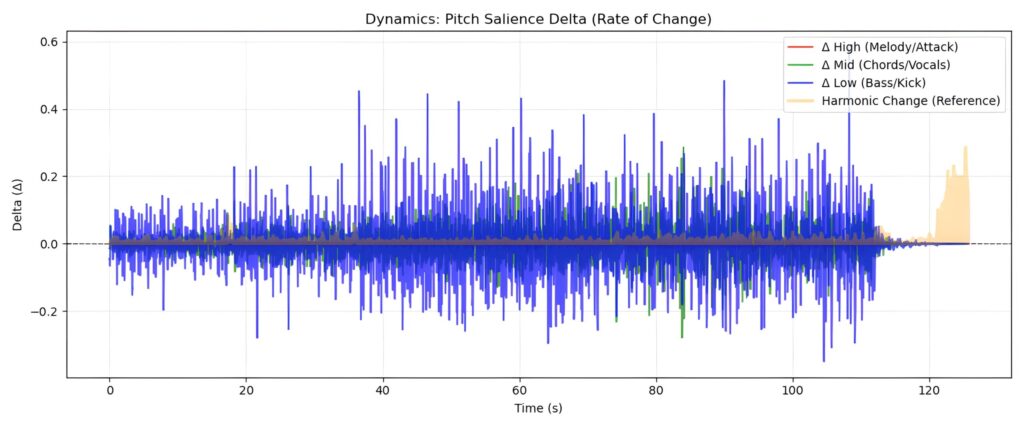
Figure 2-1: Perceptual update rate ().
The true propulsive force of the track, driven by the rate of change in salience rather than simple amplitude variations.
Instead of volume, this track is driven by (change rate of salience).
- Even at low RMS (physical quiet),
- strong spikes create a sense of intensity and urgency
This is why the track feels “pressing” without being loud.
State Transition Speed = Information
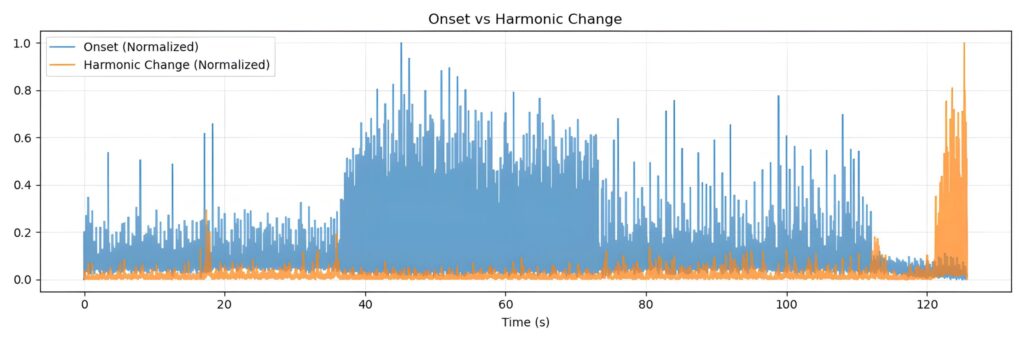
Figure 2-2: Synchronization of onsets and harmonic changes.
Visual proof of the beat forcibly updating the harmonic world to prevent cognitive habituation.
The harmonic density (~11.05 peaks/sec) represents:
How often perception is forced to update.
Each spike triggers:
- Collapse of the current predictive model
- Reconstruction of a new perceptual state
This rapid cycle transforms a short duration into what feels like a maze of information.
as Kinetic Energy
If PCA trajectories represent position,
represents velocity.
- Micro-fluctuations near the tonal center (C minor)
- Sudden accelerations during deviations
This variation in speed becomes the propulsive force of the track.
Negative Δ: The Power of Subtraction
- Positive → information injection (attack)
- Negative → withdrawal (decay, release)
This “add–remove” cycle:
- prevents cognitive overload
- creates breathing space
- enhances perceived richness without fatigue
Reset Speed (Flicker)
The track’s defining trait is not change itself, but:
How quickly the system resets after each change
Sharp negative dips rapidly push past states into “the past,”
making room for new perception.
This high-speed flicker locks attention into the present moment.
3. Stealth Modulation: Maintaining Prediction While Updating Perception
Entropy vs Surprise
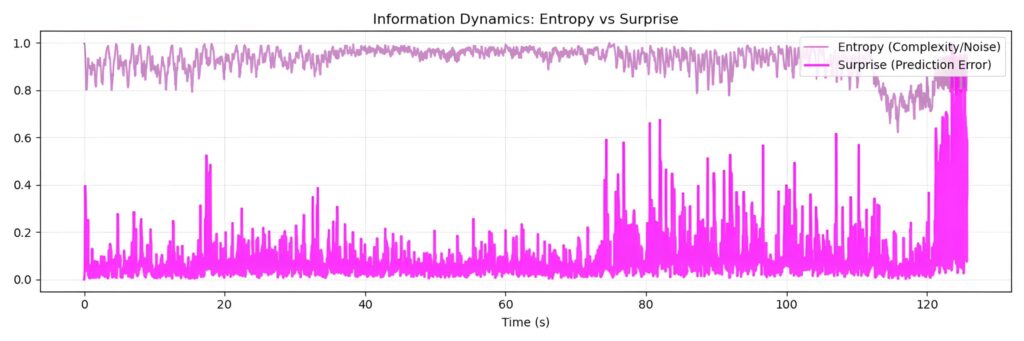
Figure 3-1: Entropy vs. Surprise.
A demonstration of “Stealth Modulation,” maintaining micro-uncertainty (Entropy) while keeping prediction error (Surprise) low to avoid fatigue.
- Low Surprise (~0.0056) → stability, no fatigue
- High / fluctuating Entropy → continuous micro-uncertainty
Result:
The brain stays comfortable, but never stops exploring.
Change occurs—but remains below the threshold of conscious detection.
Cross-Band Decoupling
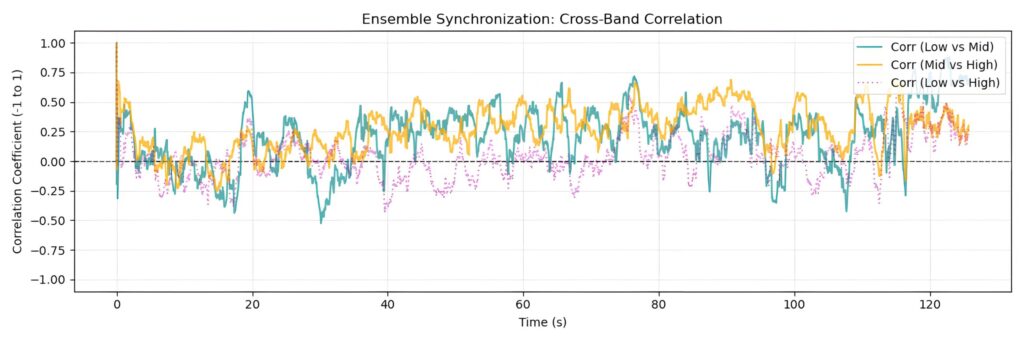
Figure 3-2: Cross-band correlation analysis.
The near-zero correlation (0.034) between Low and High bands validates the decoupling of the embodied anchor and sensory attention.
Low–High correlation ≈ 0 (0.034)
This implies:
- Body (Low) and attention (High) operate independently
- Multiple perceptual streams run in parallel
This decoupling transforms a loop into a multi-layered experience.
Transient Density & Harmonic Density
~10 transients/sec ≈ ~11 harmonic changes/sec
This alignment creates:
A steady stream of “perceptual clicks”
Combined with entropy (~3.29), the system sustains high-resolution unpredictability.
Flux, Autocorrelation, and Resolution
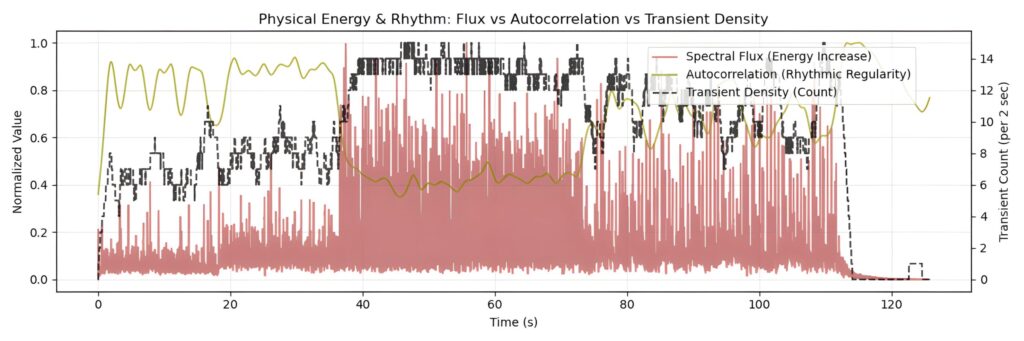
Figure 3-3: Evolution of information density.
As spectral flux and transient density rise after 38 seconds, autocorrelation drops, physically increasing the informational resolution.
Around ~38 seconds:
- Spectral flux and density rise together
- Autocorrelation drops (less predictability)
This effectively increases informational resolution over time,
pulling the listener deeper into the structure.
(Acceleration): Perceptual “Jerk”
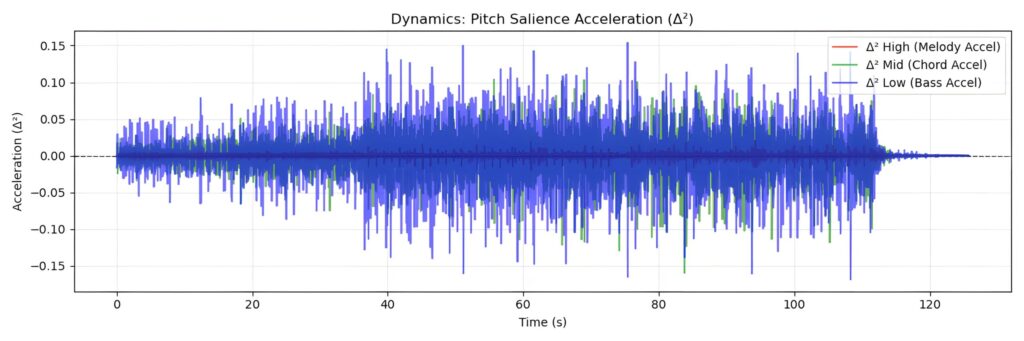
Figure 3-4: Perceptual acceleration ().
Sharp spikes indicate “quantum jumps” in harmonic states, defining the sharp resolution of the attack edges.
By analyzing the second derivative:
We observe not smooth transitions, but discrete jumps
These spikes produce:
- sharp attack perception
- unexpected high-frequency events
- strong cognitive imprinting
4. Redefining the Loop
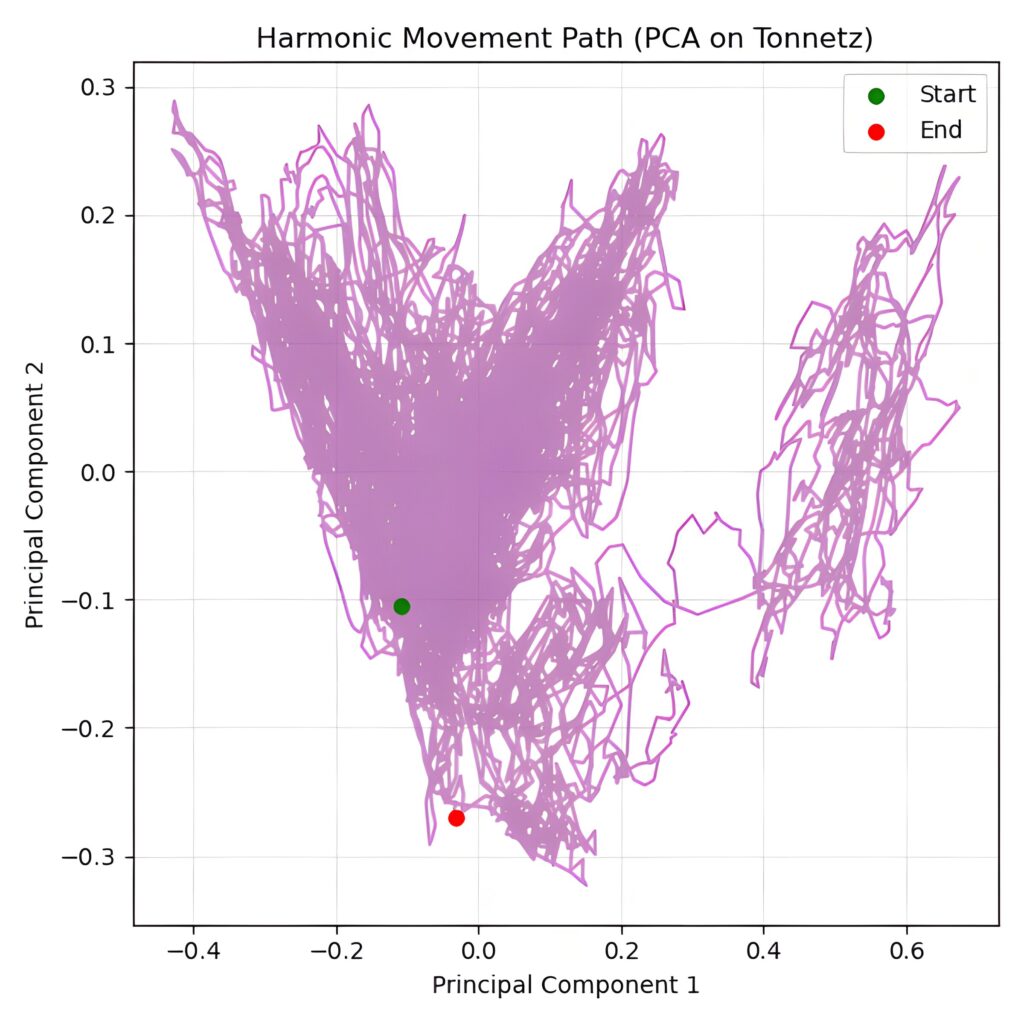
Figure 4: Harmonic trajectory (PCA on Tonnetz).
Visualizing the “particle accelerator” structure where consciousness cycles through deviations and returns to the tonal gravity of C minor.
Traditional loop:
A closed circle (repetition)
This system:
A perceptual particle accelerator that cycles the consciousness at relativistic speeds
- The orbit remains stable
- But each cycle updates perceptual state
Final Definition
Dynamics
Rate of perceptual state updates under constrained predictability
Loop
Not repetition, but a stable frame for continuous perceptual renewal
Conclusion
Way Out can be understood as:
A system that maintains temporal predictability
while continuously refreshing perceptual states
- Body (Low) is stabilized
- Consciousness (High) is accelerated
- Information (Mid/Entropy) forms a turbulent field
- injects bursts of perceptual energy
“Time is a loop. Content is not.”
This is no longer just sound design.
It is a control system for perception itself.
Listen: Way Out / Tetsujin (Akihito Kimura)