 Akihito Kimura
 Listen: High-Pressure / Akihito Kimura
You feel it before you understand it.
Sound keeps moving—yet never leaves its center.
This track is designed to confine continuous motion within a fixed field.
It creates a paradoxical sensation: everything is changing, yet nothing escapes.
Three Axes
This piece is built on three interacting forces:
- Micro: the acceleration of pitch salience (the force of continuous motion)
- Macro: sectional structure (the framing of time)
- Gravity: the key of C Minor (belonging and constraint)
These three operate simultaneously, allowing freely moving sound to remain contained within a defined space.
Tempo / Rhythm
~133.9 BPM.
A standard tempo for dance music, yet with strong onset energy.
The beat is sharply defined and physically assertive.
This is not just speed—
it functions as pressure that pulls the body forward.
Timbre / Texture
The spectral centroid (~2,312 Hz) leans toward the higher range,
resulting in a bright, hard, and clear sonic image.
ZCR and spectral flatness indicate a dense texture rich in overtones and noise.
However, this is not mere “information density”—
it is perceived as a sustained layer of energy.
Harmony / Gravity
Key: C Minor.
An average strength of 3.8 indicates that this tonality is firmly maintained throughout the track.
Rather than developing through modulation,
tension is created by remaining in the same place.
The largest harmonic shift appears near the end (~285s),
suggesting a slight distortion of a long-sustained gravitational field.
Density / Flow
Harmonic Change Density: 6.39 peaks/sec.
While the rate of change is high, salience remains low.
Individual changes are not perceived as discrete events,
but as a continuous flow.
In other words:
Things keep changing—yet feel unchanged.
Structure
Each section organizes pitch density and timbre with clarity,
creating a distinct contrast between “filling” and “withdrawing.”
This contrast gives the track its breathing.
Spectrogram analysis shows full-band transitions at section boundaries,
indicating a highly logical structural design.
Harmonic Field
Trajectories derived from Tonnetz and PCA converge
within a constrained region centered on C Minor.
Harmony does not disperse widely,
but revolves around its center in a stable orbit.
This constraint sustains immersion.
Salience / Motion
Pitch salience increments and acceleration reflect
the momentum of sound itself.
What matters here is not just change,
but the perception of acceleration.
This micro-level motion generates tension and vitality.
Band / Cohesion
Low frequencies remain consistently dominant, forming a physical foundation.
Mid and high frequencies evolve across sections.
All bands move in sync with the rhythm.
Sound does not behave as isolated elements,
but as a unified entity.
Entropy / Surprise
Entropy remains consistently high,
providing continuous stimulation.
Within this, spikes of “surprise” act as triggers
that pull attention back.
The balance between prediction and deviation
sustains immersion.
Conclusion
This music has no single correct way to be heard.
“High-Pressure” creates freedom through constraint.
At the micro level, everything fluctuates.
At the macro level, structure contains it.
And through tonality, everything is pulled back toward the center.
Within this inescapable pressure field,
the listener experiences both the pulse of their own body
and the shimmer of sonic particles.
You can analyze it.
Or simply surrender to it.
That choice is yours.
Analysis Archive (Deep Analysis)
The following is an analytical data set and detailed examination of this track. This section is curated for those who wish to explore the composition on a deeper, more technical level.
Chapter 1: The Trajectory of Time and Pulsation (Tempo / Rhythm)
This section presents the analysis of the temporal framework governing “High-Pressure” and the percussive elements designed to resonate physically with the listener.
1. Temporal Specification (Tempo)
The tempo—the “heart rate” of the track—is set to maintain a relentless, high-pressure tension.
- Detected Tempo: Approx. 133.9 BPM
- Analysis: This speed sits within the “common tempo range” for high-energy dance music and up-tempo rock. It embodies the title “High-Pressure,” suggesting a rigid adherence to speed that creates a “field” of continuous energy, leaving no room for the listener to catch their breath.
2. Physical Characteristics of Pulsation (Onset / Dynamics)
Data regarding the “attack” (onset) and “intensity” (dynamics) of the sound prove that this track possesses an extremely percussive and physical magnetic field.
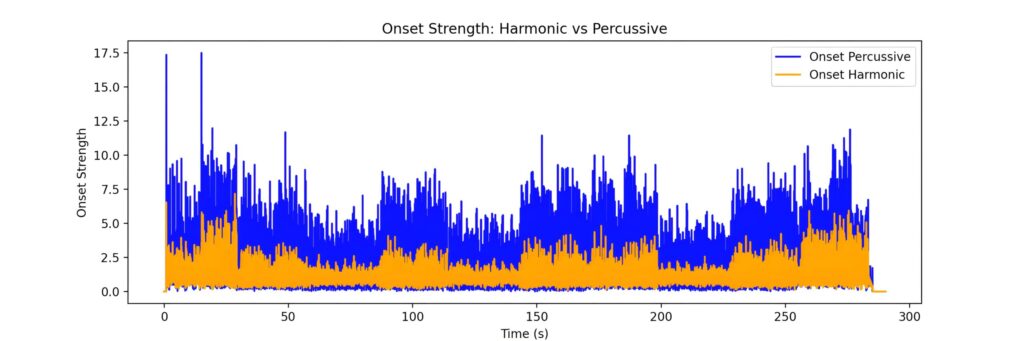
Figure 1-1: Onset Characteristics:
An accumulation of sharp, robust percussive components that convert a 133.9 BPM pulse into physical pressure.
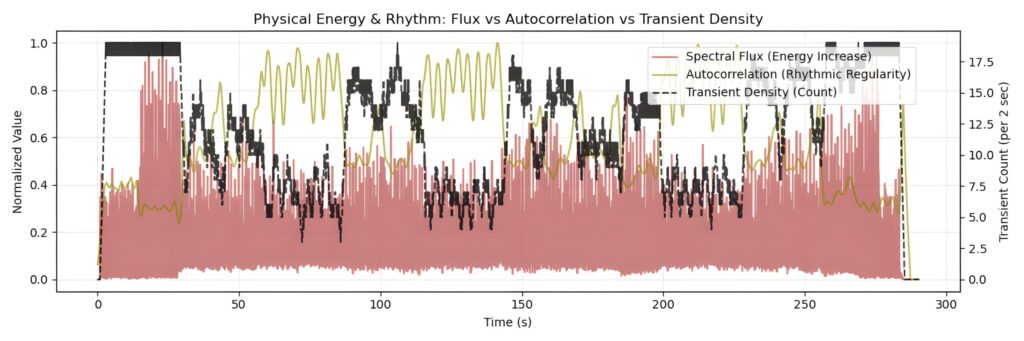
Figure 1-2: Correlation between Transients and Spectral Flux:
A design where the rate of tonal change is tightly synchronized with rhythmic density, making the timbre itself function as a component of the beat.
- Onset Strength: Average 2.00
- Analysis: As seen in Figure 1-1, the attack of percussive elements is exceptionally sharp, providing a hyper-defined contour to the beat.
- Transient Density:
- Analysis: Analysis of Figure 1-2 reveals that rhythmic density is closely synchronized with spectral flux (tonal change). This creates a highly engineered “pulsation” where the sound textures themselves act as rhythmic drivers.
- Dynamic Waves:
- Intro (0–30s): Begins with peak Onset Strength, immediately pulling the listener into the sonic field.
- Mid to Final (150s / 250s+): Percussive elements surge at sectional transitions. Notably, during the “drops,” the percussive energy overwhelms the melodic components.
3. Temporal Cohesion (Correlation)
This metric indicates how consistently each frequency band adheres to the primary rhythm.
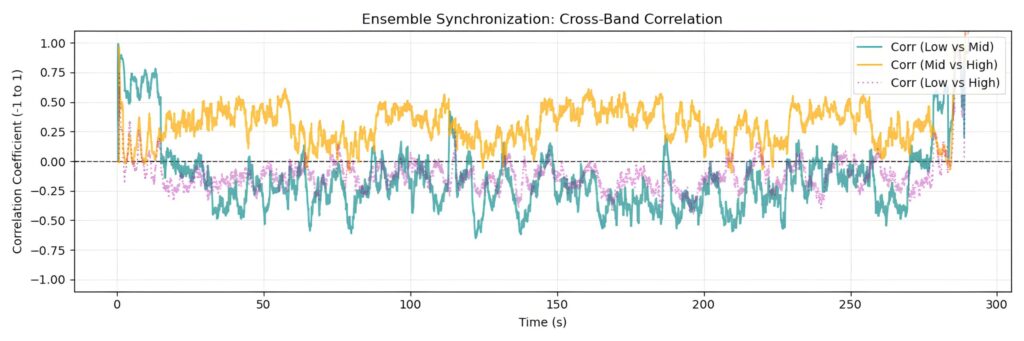
Figure 1-3: Cross-Band Correlation:
Evidence of the Low, Mid, and High frequencies synchronizing as a single “organism” to form an unwavering groove.
- Cross-Band Correlation:
- Analysis: Figure 1-3 shows extremely high correlation values across the Low, Mid, and High frequency bands. This signifies that the kick, bass, and synthesizers operate as one massive “sonic organism,” maintaining a flawless, unified rhythm.
4. Cognitive-Psychological Rhythm (Entropy / Surprise)
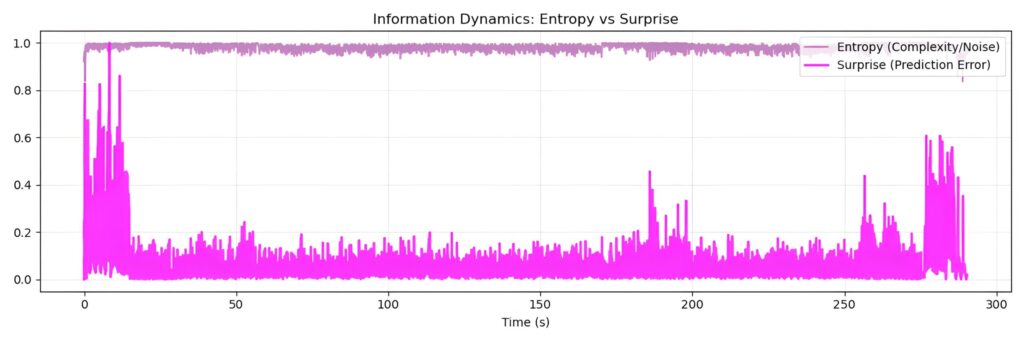
Figure 1-4: Entropy and Surprise:
Spikes of “Surprise” are calculated and placed within a high-complexity information flow to keep the listener’s consciousness anchored.
- Information Complexity and Surprise:
- Analysis: From Figure 1-4, we observe that while the rhythmic predictability (Entropy) remains at a consistently high level, periodic “Surprise” spikes (deviations) are strategically placed. This structure immerses the listener in a steady beat while simultaneously preventing their attention from drifting.
Summary: The Essence of “High-Pressure” in Chapter 1
The data confirms that the high-speed 133.9 BPM pulse, the razor-sharp Onsets, and the perfectly synchronized cross-band groove function together as a “temporal orbit.” It is a structure designed to capture the listener, controlling energy with mathematical precision.
Chapter 2: Textures of Mist and Particles (Timbre / Texture / Salience)
In this chapter, we deconstruct the sonic particles that comprise “High-Pressure,” revealing how they layer and coalesce to create the specific “tactile” experience delivered to the listener.
1. “Sonic Luminosity” Defined by the Spectrum
The handling of high-frequency components often dictates the first impression of a track.
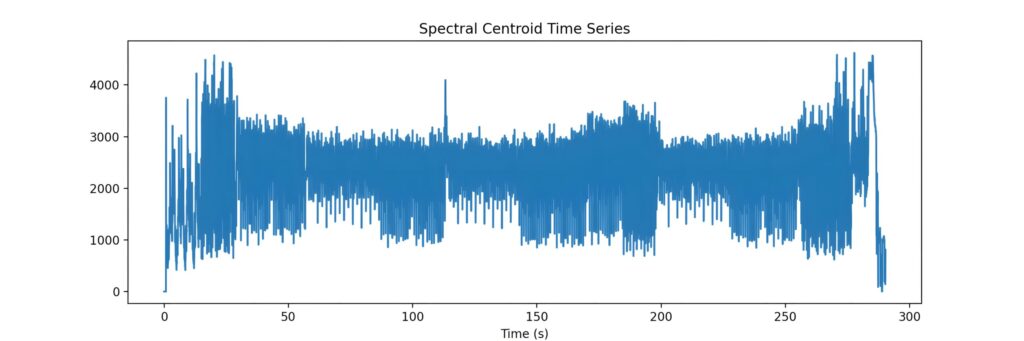
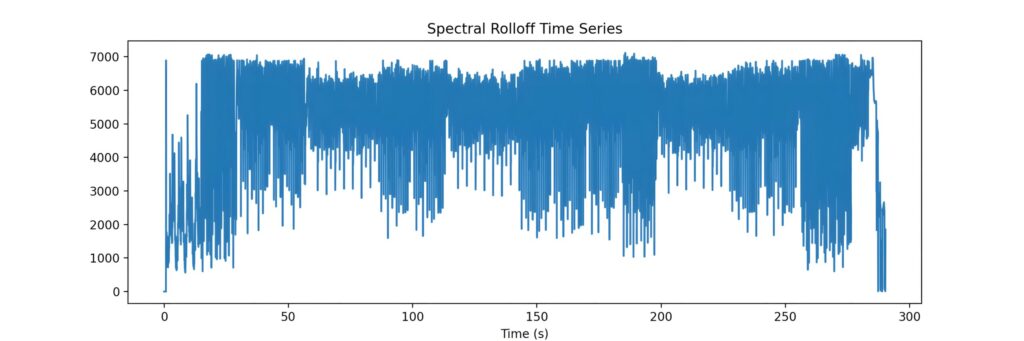
Figure 2-1: Spectral Centroid and Rolloff:
The centroid of 2,312 Hz rises over time; as the filters open, high-frequency particles expand like a spreading mist.
- Brightness and Hardness (Spectral Centroid): Average 2,312 Hz
- Analysis: As shown in Figure 2-1, the centroid leans toward the higher frequencies. This translates to a texture described as “bright,” “hard,” or “sharp.” It indicates a piercing transparency that exists even within the overarching “Pressure.”
- High-Frequency Expansion (Spectral Rolloff):
- Analysis: The movement in Figure 2-1 visualizes the deliberate filter work. At points where the centroid rises, synth filters open up, creating a sense of euphoria as high-frequency particles diffuse like mist.
2. Particle Friction and Noise (ZCR / Flatness)
Rather than opting for smooth tones, the track intentionally incorporates “grit” to provide a sense of speed and density.
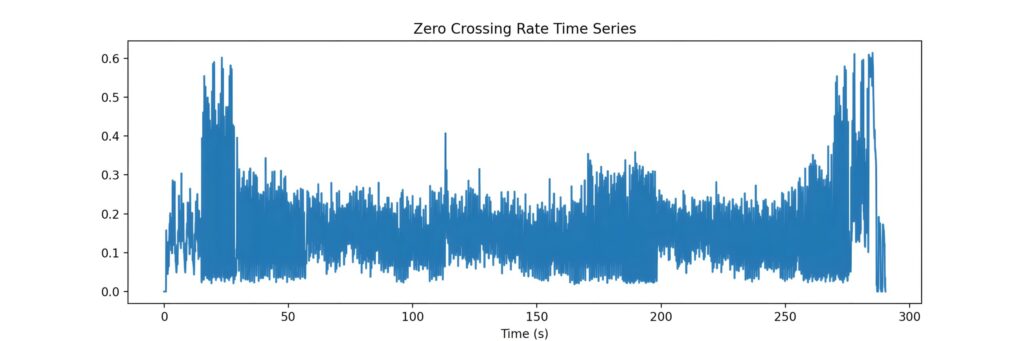
Figure 2-2: Zero Crossing Rate (ZCR):
A visualization of “frictional heat” caused by noise components, giving the track its edge and fine-grained texture.
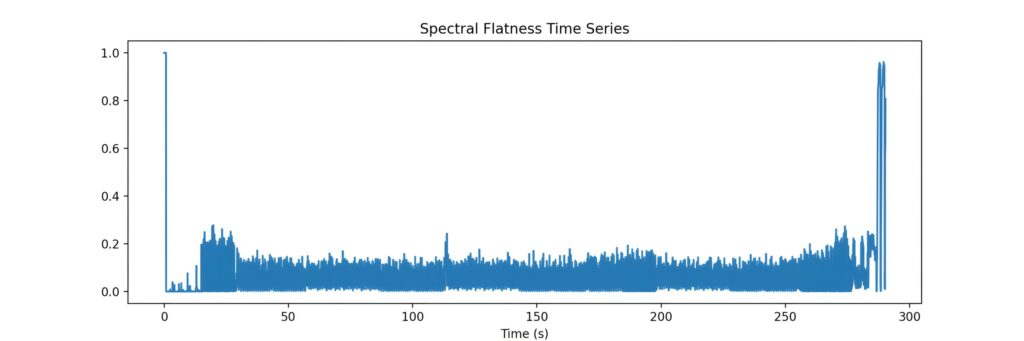
Figure 2-3: Spectral Flatness:
Proof of a high-density, inescapable texture where harmonics and noise saturate the frequency space.
- Noisiness (Zero Crossing Rate): Average 0.148
- Analysis: The high average value in Figure 2-2 points to the aggressive use of snares, cymbals, distorted synths, and white noise. This imparts a sensation of “velocity” and “frictional heat” to the music.
- Information Saturation (Spectral Flatness):21.43
- Analysis: Figure 2-3 confirms a sound profile far from pure tones—rich in harmonics and noise. This creates a “thick,” “high-density” texture where the sound fills every corner of the stereo field, leaving the listener with no escape.
3. Sonic Sculpture and Spatial Expansion
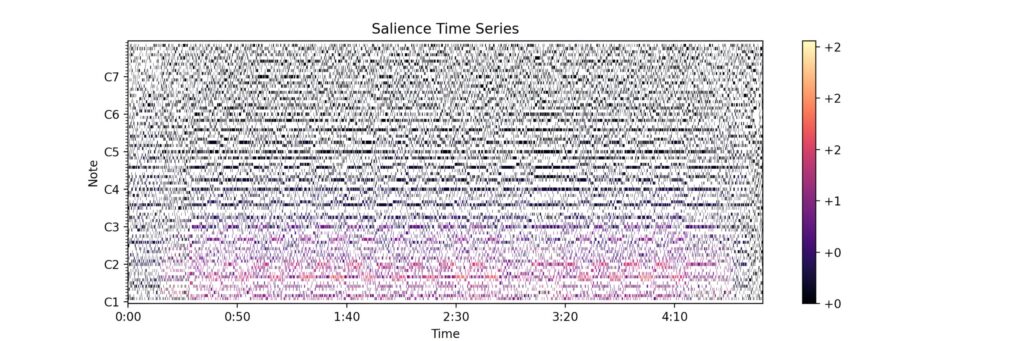
Figure 2-4: Pitch Salience:
A hierarchical structure featuring an overwhelming Low-end foundation and Mid-High ranges that shift expression by section.
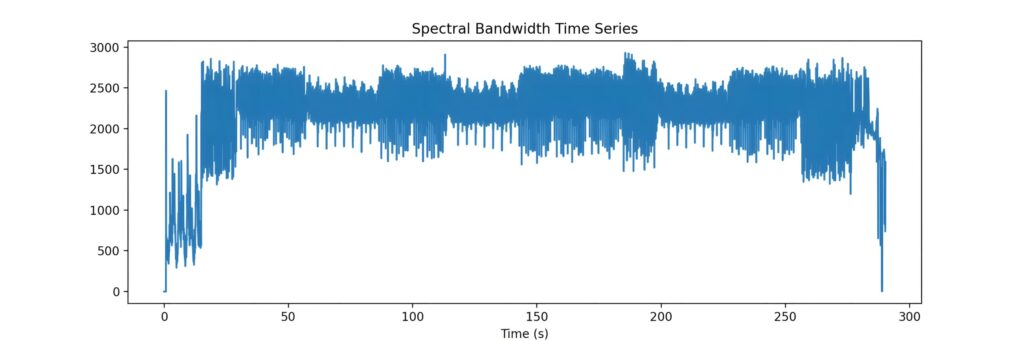
Figure 2-5: Bandwidth Transition:
The expansion of the soundstage via full-range synth pads and spatial effects, illustrating the “mist” settling over the composition.
- Frequency Presence (Salience):
- Analysis: In Figure 2-4, while the dominant “Low” frequencies form the physical foundation, the energy in the Mid-High range fluctuates in sync with each section. This is evidence of precisely controlled spatial effects (reverb, delay) and filter automation.
- Soundstage and Bandwidth:
- Analysis: The expansion seen in Figure 2-5 represents the “lateral widening of the soundstage” through spatial effects and full-range pads. The data captures the exact moments where the sound dominates the space like a rising fog.
4. Timbral Fingerprints and Fluidity
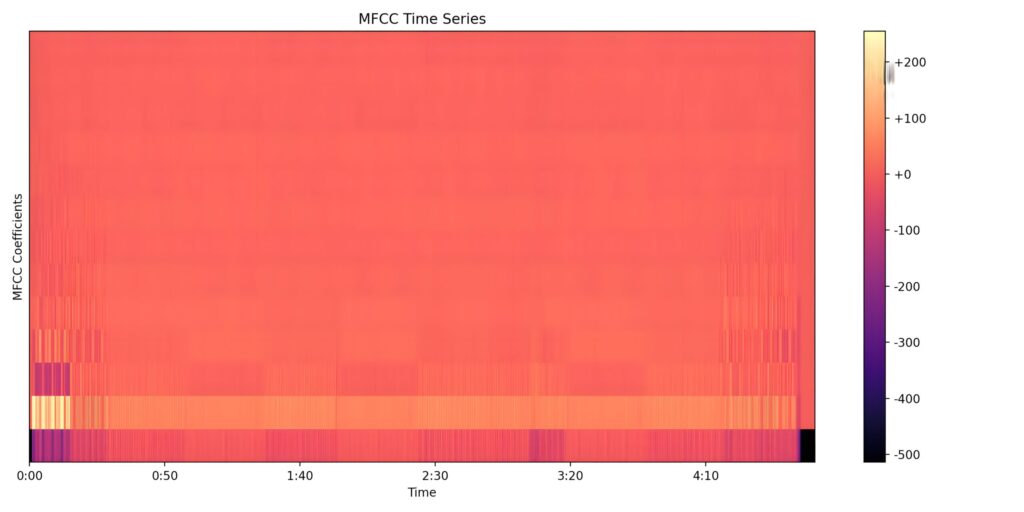
Figure 2-6: MFCC (Mel-Frequency Cepstral Coefficients):
A heatmap capturing the consistent texture alongside meticulous timbral shifts between sections.
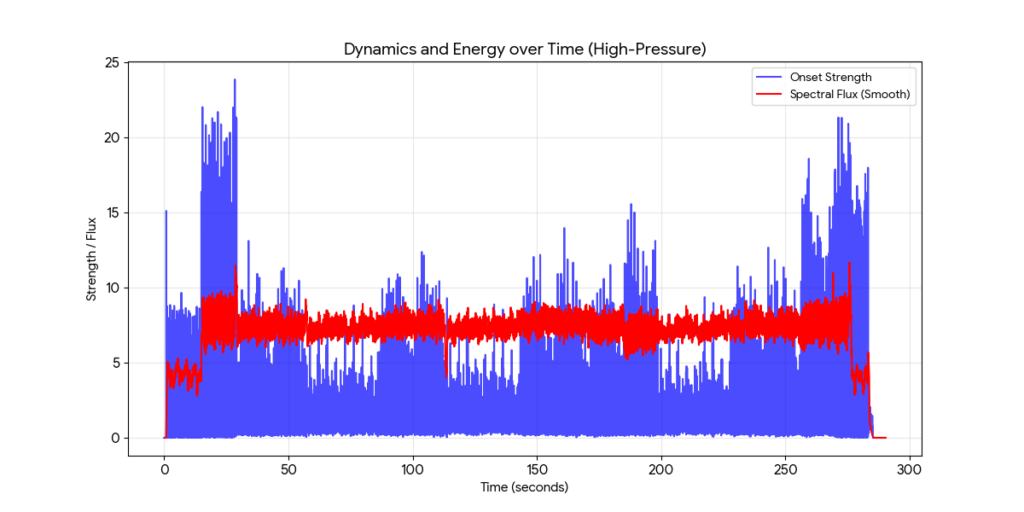
Figure 2-7: Spectral Flux:
The rate of timbral change. The timbre itself pulsates in sync with rhythmic density, providing dynamic momentum.
- Timbral Fingerprint (MFCC):
- Analysis: The heatmap in Figure 2-6 clearly captures both the unity and the transition of tone colors. Vertical color shifts pinpoint the introduction of new instruments (particles), showing how a meticulous arrangement manifests as a “change in texture.”
- Spectral Fluidity (Spectral Flux):
- Analysis: Figure 2-7 shows that the Spectral Flux is linked to rhythmic density. The timbre behaves like pulsating particles, constantly shifting its shape to drive the track forward.
Summary: Acoustic Texture of Chapter 2
The “feel” of “High-Pressure” is built upon a foundation of high-density harmonic layering and precisely engineered noise particles. The elevated 2,312 Hz centroid combined with intentional noise components (ZCR) allows a “sharp friction” to coexist with a “mist-like expansion,” creating a tactile acoustic space that keeps the listener fully engaged.
Chapter 3: The C Minor Gravitational Field (Harmony / Gravity / Harmonic Field)
In this chapter, we analyze the formidable tonal identity of “High-Pressure” and the minute fluctuations of energy that occur at its boundaries.
1. Unwavering Dominance (C Minor Tonic)
The track tethers the listener to a singular emotional domain through an overwhelming allegiance to a specific key.
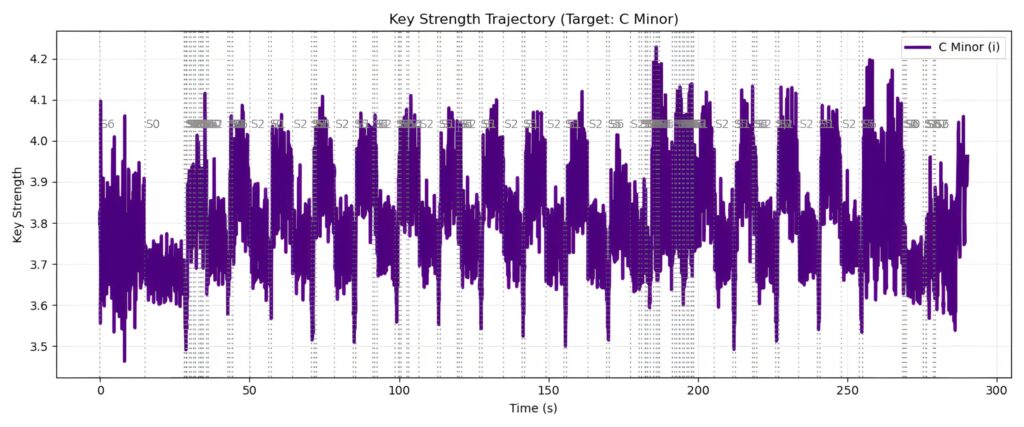
Figure 3-1: Key Strength Trajectory:
“Unwavering Conviction”—C Minor strength is maintained at an extremely high level (3.5–4.0) throughout the duration.
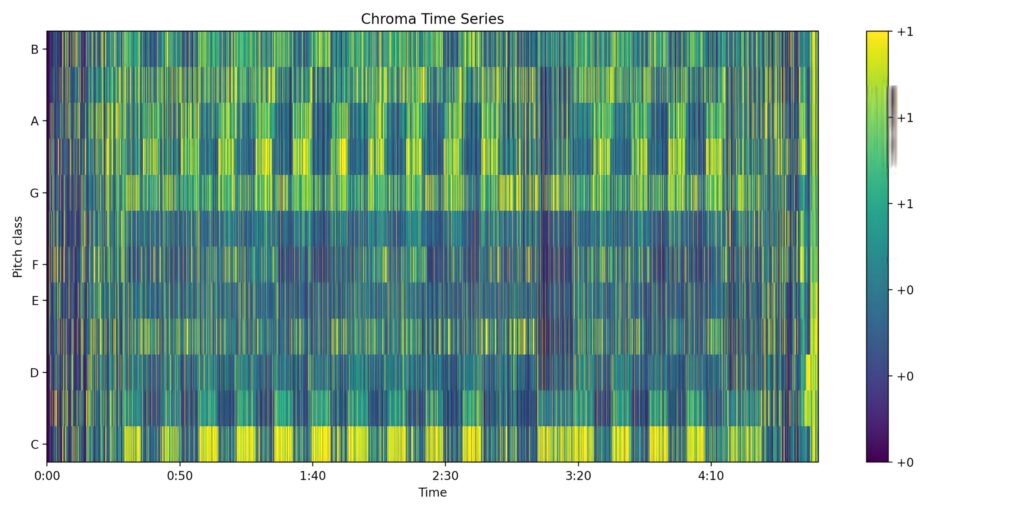
Figure 3-2: Chromagram:
The absolute dominance of C Minor, anchored by C, G, and G#.
Table 1: Chroma Values (12-Tone Analysis)
| Note | Mean Intensity | Std Dev |
| C | 0.6212 | 0.3144 |
| C# | 0.4482 | 0.2545 |
| D | 0.4155 | 0.2426 |
| D# | 0.4763 | 0.2888 |
| E | 0.4076 | 0.2494 |
| F | 0.4365 | 0.2811 |
| F# | 0.4205 | 0.2333 |
| G | 0.5976 | 0.2672 |
| G# | 0.5428 | 0.2897 |
| A | 0.5295 | 0.2703 |
| A# | 0.5447 | 0.2811 |
| B | 0.5172 | 0.2504 |
- Estimated Key & Strength: C Minor (Mean: 3.8040 / Max: 4.2288)
- Analysis: As seen in Figure 3-1, C Minor is maintained near its theoretical maximum. Rather than utilizing modulation to seek relief, the composition amplifies tension by remaining strictly within a single key.
- Chroma Vector Components: C, G, G# (Ab)
- Analysis: Figure 3-2 and Table 1 highlight the prominence of these notes. They form the signature of C Minor, providing the musical evidence for the track’s cool, serious, and inescapable sense of “Pressure.”
2. Harmonic Gravity and Path
Musical movement unfolds like a satellite orbit, always centered around the core nucleus of “C.”
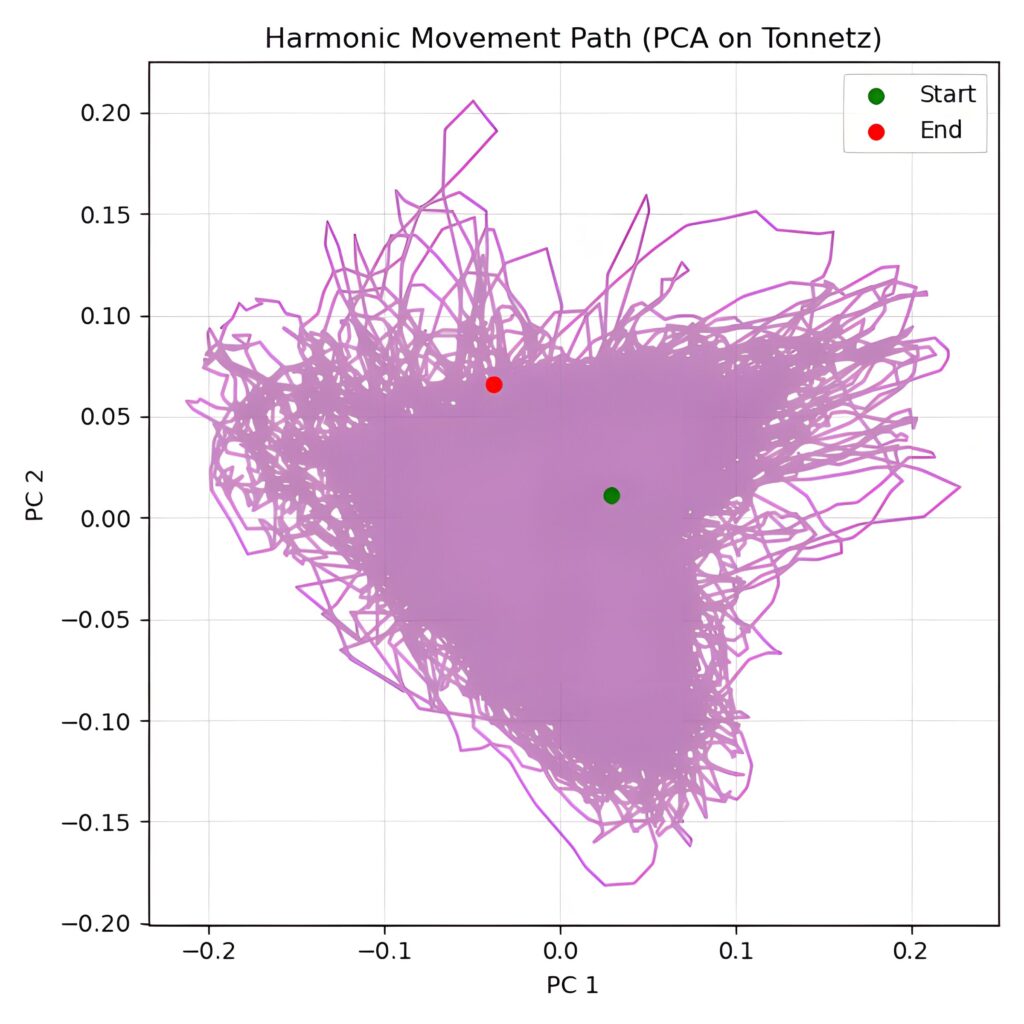
Figure 3-3: Harmonic Path (PCA):
Harmonic movement akin to a satellite orbit, circling the center without ever escaping the gravitational field.
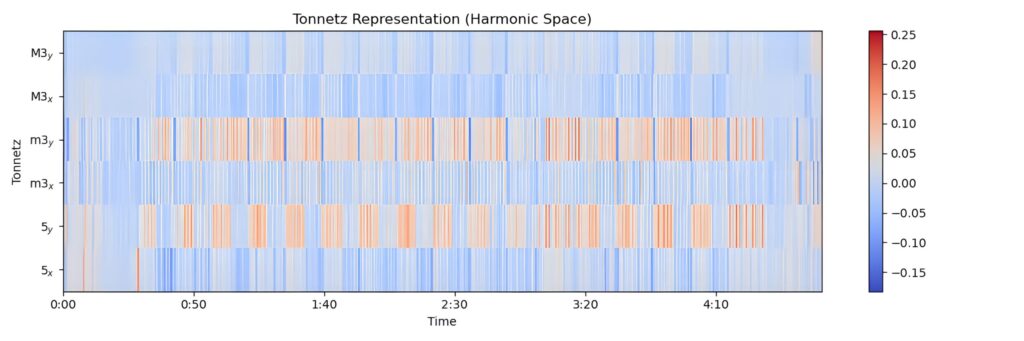
Figure 3-4: Harmonic Distribution in Tonnetz Space:
A dense concentration of notes around the C Minor nucleus. This “constraint” generates a profound sense of immersion.
- Harmonic Trajectory (Tonnetz / PCA):
- Analysis: Figures 3-3 and 3-4 show a dense clustering of data points in a specific region. This represents an “intentional constraint” designed to induce a deep trance-like state without confusing the listener, ensuring they never drift away from the massive gravity of C Minor.
- Harmonic Stability:
- Analysis: According to Figure 3-1, the key strength remains at a peak level of 3.5–4.0. This “unwavering conviction” is what solidifies the track’s identity.
3. High-Density Informational Swells (Density & Change)
While the tonality remains static on a macro level, intense activity occurs from a microscopic perspective.
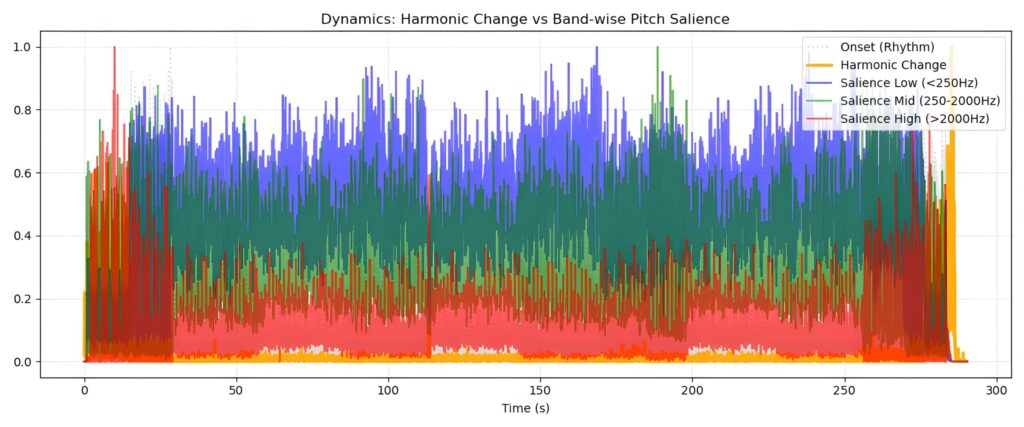
Figure 3-5: Contrast between Harmonic Change and Salience:
Micro-informational swells pulsating more than 6 times per second over the C Minor skeletal structure.
- Harmonic Change Density: 6.39 changes / sec
- Analysis: Tonal and harmonic variations occur at a staggering frequency of over six times per second. This does not refer to chord progressions, but rather to rapid arpeggios and complex synth layering that pulse like a “constant life force” over the C Minor framework.
- Texture of Change (Salience): 0.0052
- Analysis: The low value indicates that these changes are not “abrupt disruptions” but are expressed as a smooth, continuous “swell” of energy.
4. The “Physics” of Tonality and Dramatic Development
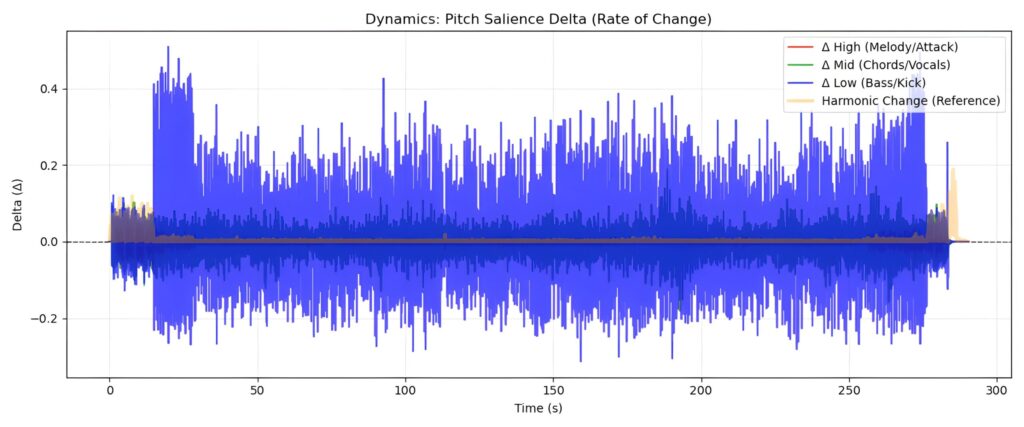
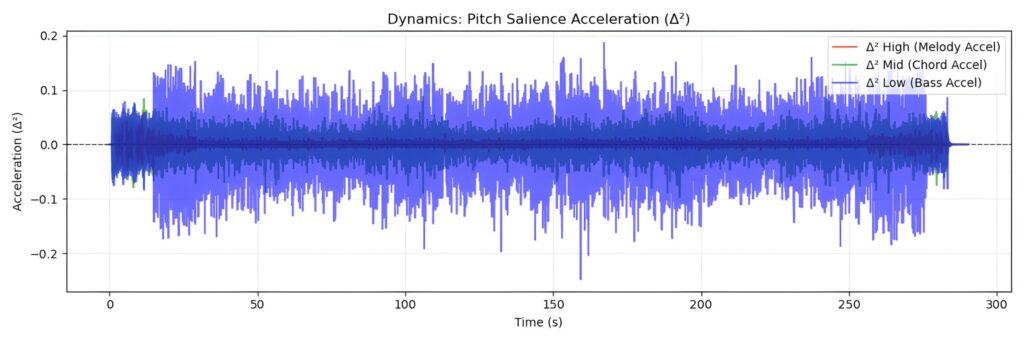
Figure 3-6: Pitch Increment and Acceleration:
Micro-motions that never rest. Changes accompanied by acceleration breathe tension and vitality into the track.
- Sonic Acceleration (Salience Delta & Acceleration):
- Analysis: In Figure 3-5, synth modulation and minute pitch shifts are visualized as “acceleration.” This perpetual harmonic fluctuation continuously injects “tension” into the heavy C Minor world-view.
- Maximum Harmonic Shift (at 285.22s):
- Analysis: The maximum harmonic variance is detected near the 4’45” mark. This point encapsulates the dramatic climax heading into the outro, suggesting an escape from—or the collapse of—the gravitational field.
Summary: The Tonal Field of Chapter 3
“High-Pressure” is a fortress built around a rigid C Minor gravitational field. While listeners surrender to its overwhelming stability, they are simultaneously exposed to a high-density wave of acoustic information arriving six times per second. The contrast between this “solid skeleton” and the “fluid details” is the secret behind the track’s irresistible immersion.
Chapter 4: The Boundary Between Logic and Surprise (Information / Logic / Cohesion)
In this final chapter, we examine the “Aesthetics of Composition”—how “High-Pressure” is constructed with mathematical precision to continuously stimulate the listener’s brain.
1. The Blueprint of Immersion through Information Theory
The reason listeners are drawn into the track without losing interest lies in the calculated uncertainty of information.
- Control of Expectation and Subversion (Entropy vs. Surprise):
- Analysis: Referring back to Figure 1-4, the Entropy (informational complexity) remains at a consistently high level, providing continuous stimulation to the brain.
- Attentional Triggers:
- Analysis: The “Surprise” spikes in Figure 1-4 indicate the occurrence of unexpected acoustic events. By placing these periodically or at calculated intervals, the track employs a cognitive-scientific approach that maintains a state of trance-like immersion while keeping the listener’s consciousness alert.
2. Mathematical Structure and Sectional Logic
The track’s development is dictated not only by emotional intuition but by extremely logical boundaries.
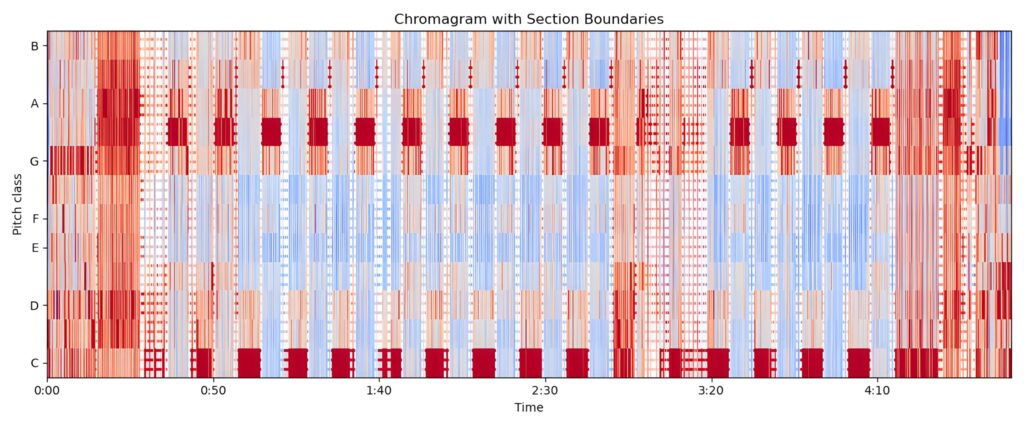
Figure 4-1: Sectional Boundaries:
A logical sectional structure partitioned with mathematical precision.
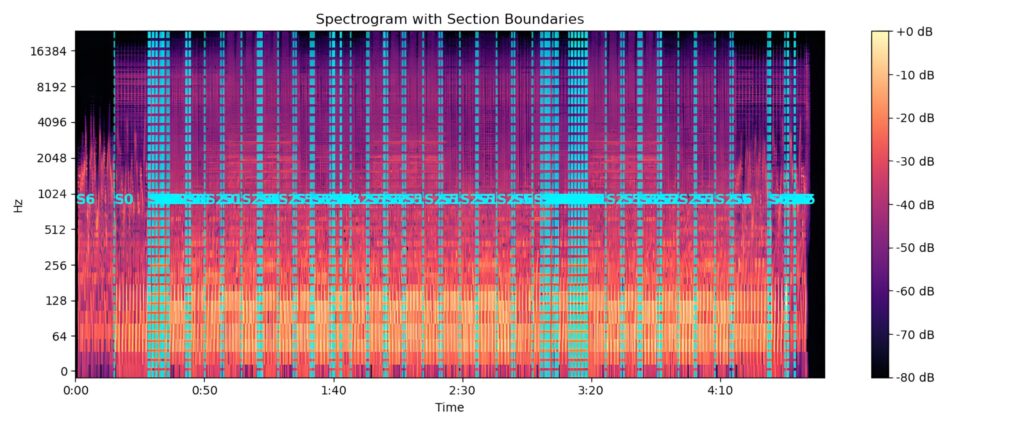
Figure 4-2: Spectrogram Analysis:
“Vertical Walls” where all frequency bands switch simultaneously—a sonic sculpture where emotional waves are controlled by logical lines.
- Clarity of Sectional Boundaries (Chromagram / Spectrogram):
- Analysis: In Figure 4-1, specific pitch classes (C, G, Eb/D#) are arranged in an orderly fashion. The density and intensity of these pitches are mathematically controlled as the sections transition.
- Sonic Sculpting:
- Analysis: The “Vertical Walls” observed in the Figure 4-2 spectrogram show energy shifting across the entire spectrum (from Low to High) at once. This serves as physical proof that the “subtraction” and “addition” within the arrangement are executed with rigorous logic.
3. Organic “Cohesion” Across All Bands
This metric evaluates how disparate instrument sounds function as a single, unified “Pressure.”
- Cross-Band Correlation:
- Analysis: The extremely high correlation between the Low, Mid, and High bands (Figure 1-3) indicates that the entire track breathes as a single “sonic organism.” Specifically, the rhythm and energy across all bands are perfectly synchronized, proving a tight, transparent, and exceptionally high-quality mix.
4. Contrast Between Stability and Change (Contrast / Flatness)
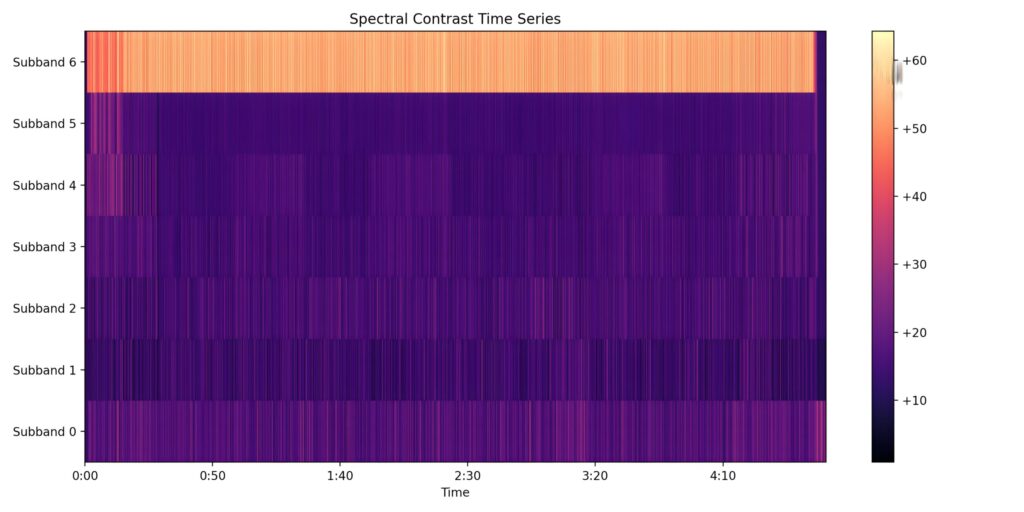
Figure 4-3: Spectral Contrast:
“Logical Transparency” born from the Low and High ends fulfilling their roles without interference.
- Clear Contrast in Texture:
- Analysis: Figure 4-3 shows that high Spectral Contrast is maintained throughout. The Low end (bass) and High end (leads/noise) do not interfere with each other, allowing each to fulfill its specific role. This “depth” and “clarity” result in a “logical transparency” that effectively communicates the complex structure to the listener.
5. Microscopic Vitality and “Acceleration”
- The Physics of Tonality (Salience Delta & Acceleration):
- Analysis: As visualized in Figure 3-6, the acoustic data is never static; it evolves with “acceleration.” It is not merely a sequence of pitches; rather, the “momentum of the sound’s movement” itself is controlled via modulation and LFOs, granting the track its unique tension and vitality.
Conclusion: The True Identity of “High-Pressure” Revealed in Chapter 4
This track is a crystallization of “Controlled Complexity.” While possessing an overwhelming information density—including over six harmonic changes per second—it converges within the rigid logic of C Minor through mathematical synchronization across all frequency bands.
The listener’s attention is perpetually captured by “Surprise” stimuli and overwhelmed by the “Cohesion” of the sonic pressure. We conclude that this meticulously engineered structure is the true essence of the 290.29-second experience known as “High-Pressure.”
Afterword
“High-Pressure” is a sonic architecture where freedom is paradoxically born from restraint.
On a microscopic level, it is a realm of perpetual fluctuation; on a macroscopic scale, it is a fortress of structure, its gravity pulling every soul back toward its tonal center. Within this inescapable “High-Pressure,” the listener experiences a singular synchronicity—the frantic racing of their own pulse intertwined with the shimmering brilliance of acoustic particles.
There is no “correct” way to perceive this music. Whether you choose to dissect it through a clinical lens or simply surrender to its force, the choice is yours. I leave this blueprint here not as a set of rules, but as the firmament upon which your own experience is built.
Listen: High-Pressure / Akihito Kimura