 Akihito Kimura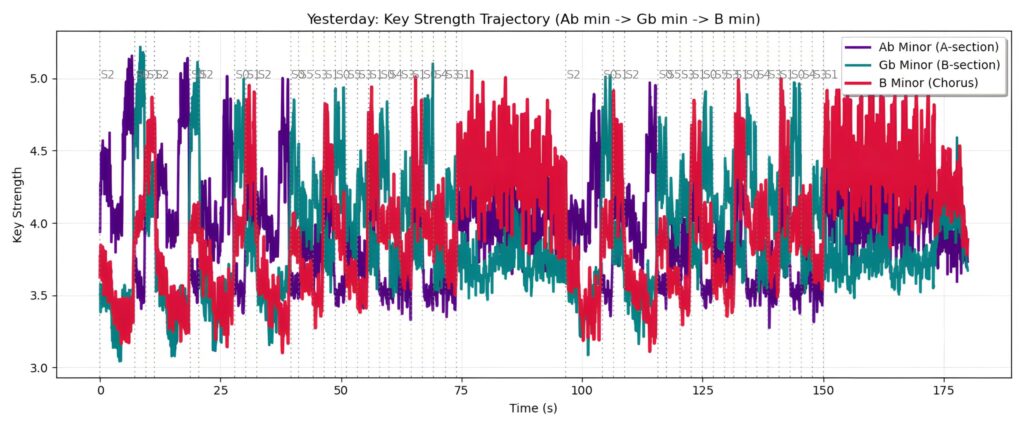
“Sound is something you can touch.”
The moment I felt this was the starting point of this track.
Today, I will analyze “Yesterday,” a track from the 2024 album “No More Tears,” released under the name Tetsujin (Akihito Kimura).
Harmonic Structure: The Narrative of Modulation
1. Verse (Ab minor) → Pre-Chorus (Gb minor)
- The “Whole-Step Down” Modulation:
Moving from Ab minor (seven flats, or G# minor equivalent) to Gb minor (enharmonically F# minor). This downward shift causes the “center of gravity” to drop, creating an effect of sinking slowly into a more introspective realm. The worldview established in the Verse descends into a deeper place during the Pre-Chorus.
2. Pre-Chorus (Gb minor) → Chorus (B minor)
- The “Perfect 4th Up (or 5th Down)” Modulation:
If we view Gb minor as F# minor, the Chorus in B minor functions as a i to iv relationship. The energy that submerged during the Pre-Chorus―quietly accumulating in the heavy, flat-rich world of Gb minor―is suddenly liberated. Moving to B minor (a world of two sharps) creates a relatively more “open” resonance, highlighting the urgency and strength of the Chorus.
Overall Impression:
While the score is heavy with flats, the acoustic reality is a progression where “sharps gradually increase” (increasing brightness and tension). It is a process where emotional contours are slowly exposed. True to its title, the structure is dramatic: reminiscing about the past (Verse/Pre-Chorus) before emotions overflow in the Chorus.
Yesterday / Tetsujin (Akihito Kimura)
Chapter 1: The Texture of Sound (The Cells)
Spectral / MFCC / RMS / ZCR
In designing the sound for “Yesterday,” I pursued “warm harmony” rather than “sharpness.” The sound does not “assert” itself; it is designed to “touch” the listener quietly. While the texture feels like it is enveloping the ears, the internal energy management is extremely precise.
■ Acoustic Characteristics Summary
| Metric | Value | Musical & Data Interpretation |
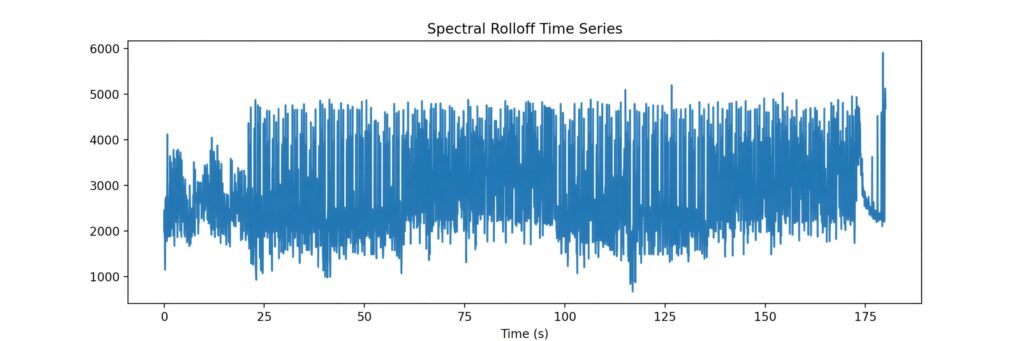
| Spectral Rolloff | ≈ 2,796 Hz | 85% of energy is concentrated below 2.8 kHz. High frequencies that cause ear fatigue are suppressed, prioritizing “warmth” and “mid-range density.” |
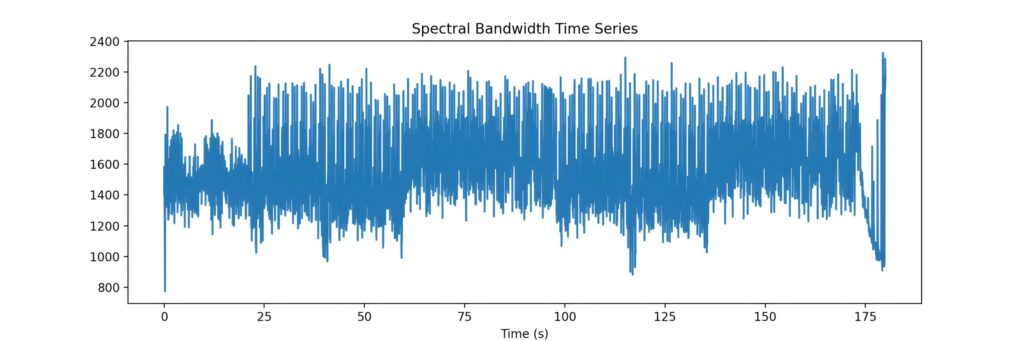
| Spectral Bandwidth | ≈ 1,555 Hz | Spatial spread. By avoiding excessive diffusion, a focused core is maintained at the center, creating an “intimate distance” for the listener. |
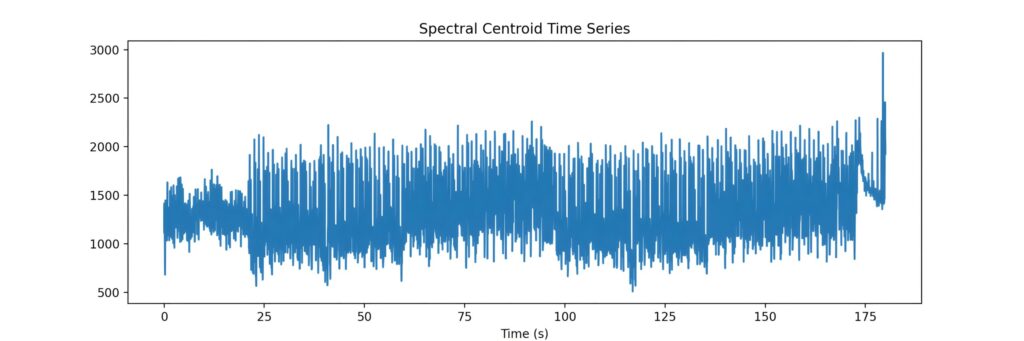
| Spectral Centroid | ≈ 1,313 Hz | The center of “brightness.” Shows that within a calm tone, the warmth of the human voice and rich harmonics are comfortably placed. |
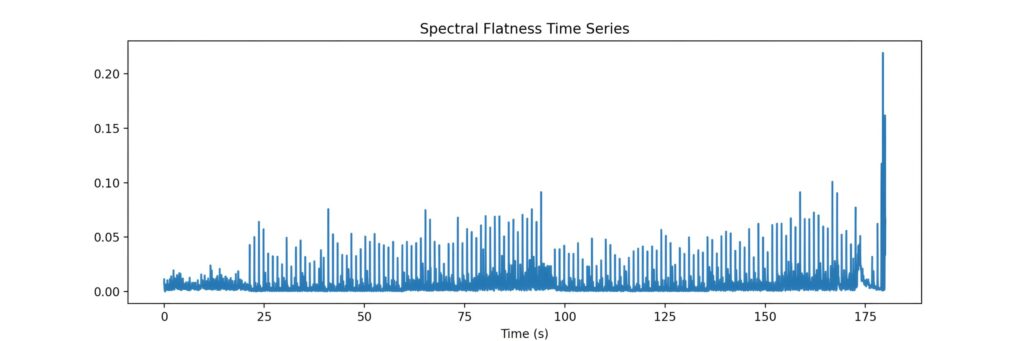
| Spectral Flatness | 26.58 | Complexity of sound. A layered structure that balances organic “fluctuation” with a sense of fullness and life. |
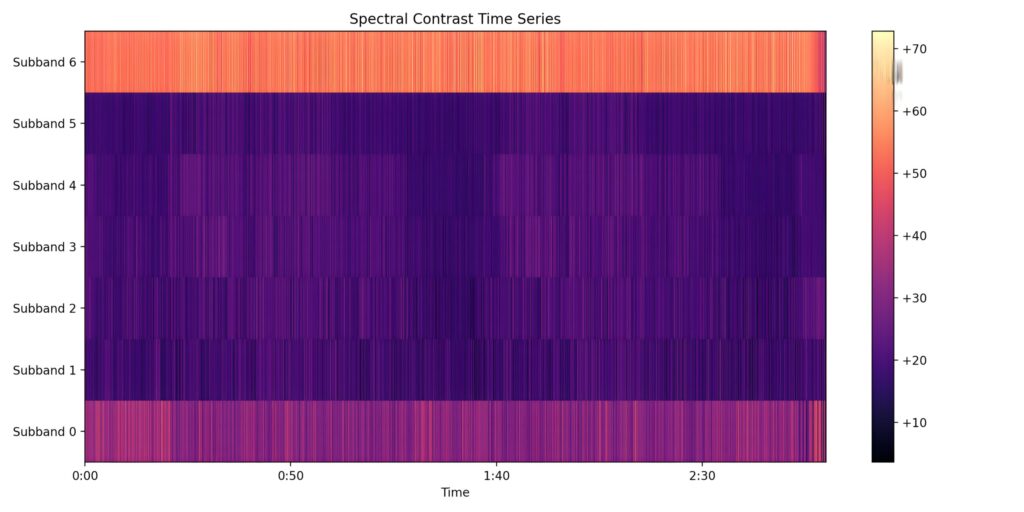
| Spectral Contrast (Band 5) | 54.02 | Significant definition around 4 kHz. Mathematical proof that details of attack and “air” exist as a hidden brilliance against the warm low-mids. |
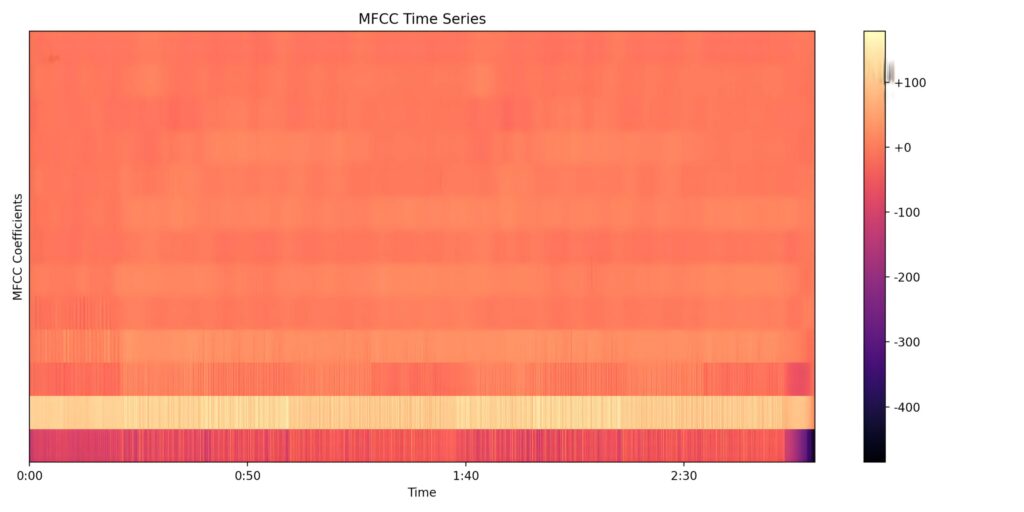
| MFCC Mean 2 | 112.76 | The skeletal timbre. Proves the “body” of the track is lush, where modern tightness coexists with traditional richness. |
| Zero Crossing Rate | 0.070 | Purity of waveform. By eliminating noise to the extreme, a “transparent density” is achieved where multiple harmonies never muddy the sound. |
This clarity is not a static beauty; it is a “process of harmony” that fluctuates minutely over time.
■ Energy and Dynamics
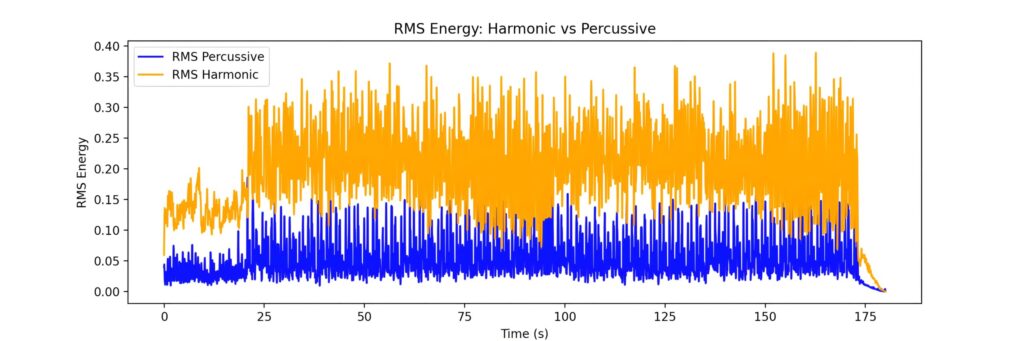
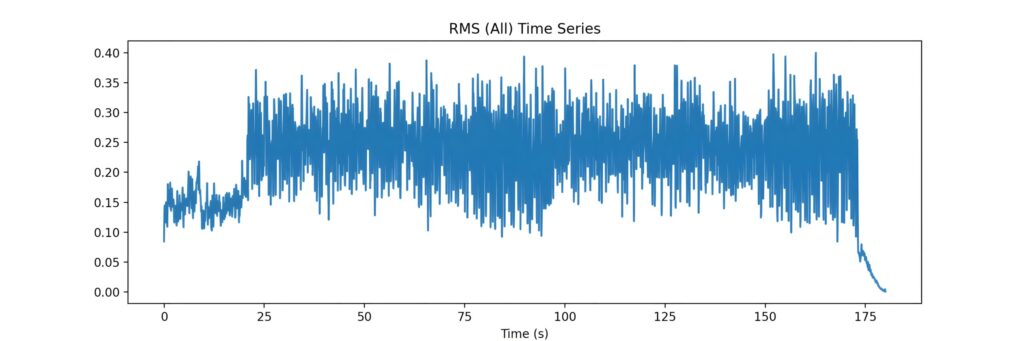
While moderate rhythm provides propulsion, the essence of the “emotion” lies in the heavy chord work and sustained pads (Harmonic components).
- RMS_Harmonic_Mean (0.201) > RMS_Percussive_Mean (0.054)
This overwhelming four-fold difference reflects a design philosophy that emphasizes the “depth” and “resonance” of the aftermath rather than the instantaneous stimulus of an impact.
Chapter 2: The Tonal Skeleton (The Bones)
Key Strength / Stability / Tonal Geometry
In the transition from Ab minor to B minor, the song unfolds an emotional and geometric progression that feels like it is “shifting its axis” rather than revolving in a circle.
■ Key Harmony (Chroma Features)
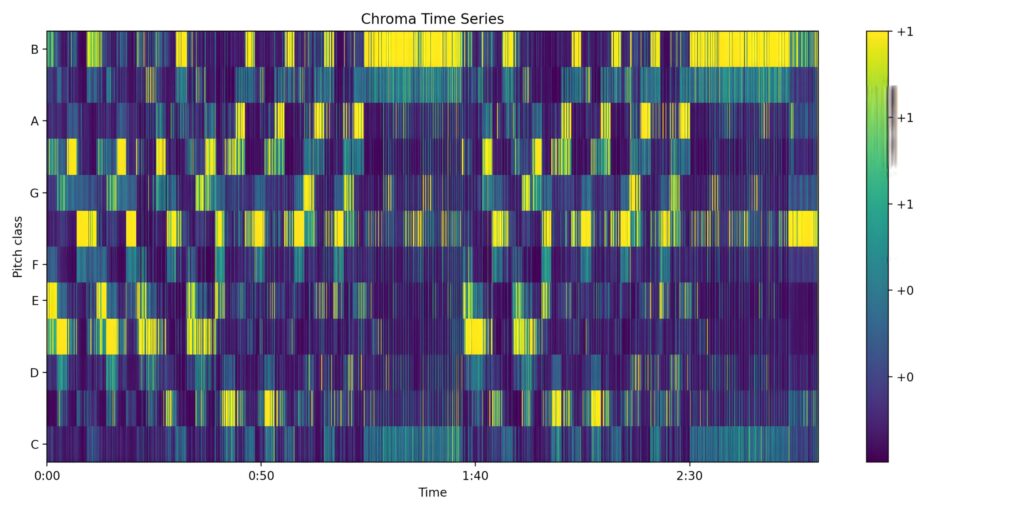
The chroma vector highlights the dominance of B (B Major/minor) as the tonic, supported by a strong skeleton of F#.
| Index | Note | Mean Intensity | Musical Role & Interpretation |
| Chroma 12 | B | 0.478 | Root: The absolute nucleus. The destination for the emotions released in the Chorus. |
| Chroma 7 | F# | 0.433 | Dominant: The vertical pillar. Connects Bm and Abm, providing stability. |
| Chroma 9 | G# / Ab | 0.290 | Verse Nucleus: The start of a melancholic tale. The source of longing for the tonic. |
| Chroma 11 | A# / Bb | 0.288 | Leading tone role: Oscillates on the tonal boundary, creating tension. |
| Chroma 8 | G / Gb | 0.281 | Pre-Chorus Color: As the tonic of Gbm, it invites deep introspection. |
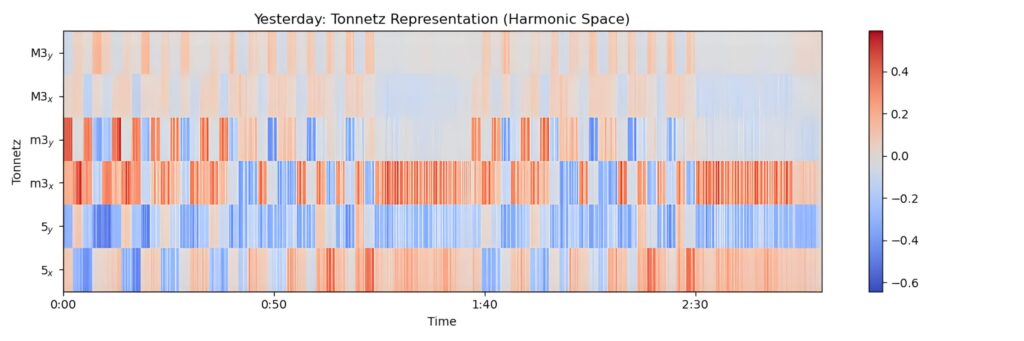
■ Emotional Backbone in the Tonnetz
- Negative Correlation between Tonnetz_5 and Key_Min_B: -0.224
This negative correlation suggests that the B minor key of the Chorus does not simply settle into stability in the Tonnetz space (harmonic geometric space); it possesses energy that intentionally “deviates” from the existing structure. It is a movement that chooses to “sway within stability.” The “heart-wrenching” sensation felt by the listener is intentionally generated by this mathematical fluctuation.
Chapter 3: The Narrative Timeline (The Story)
Section Structure / Synchronicity / Harmonic Density
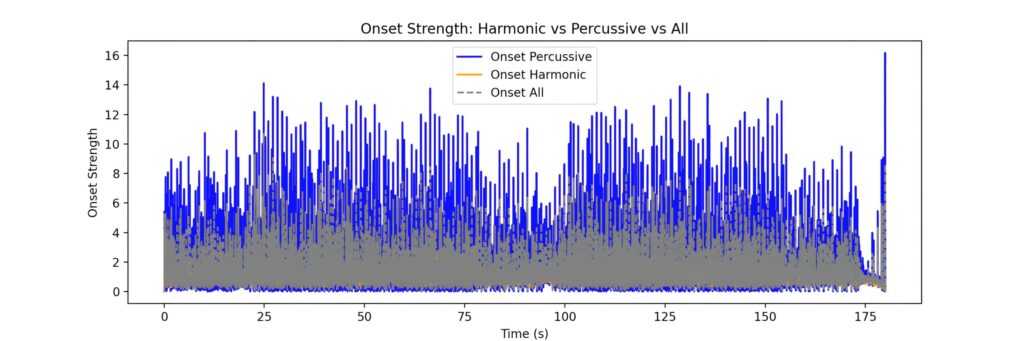
■ Rhythm and Silence
- Detected Tempo: 104.17 BPM
- Onset_Percussive (2.16) > Onset_Harmonic (1.07)
Despite the medium tempo, the rhythmic onset is sharper than the harmonic changes. Combined with the previously mentioned RMS where harmonics dominate, this creates a unique drive: “gentle on the ears, yet with a distinct heartbeat.”
■ Independence of Physical Impact and Harmonic Color
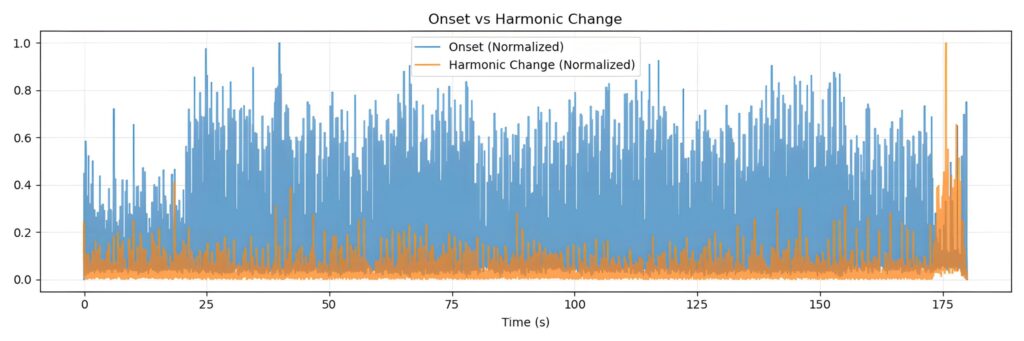
- The correlation coefficient between Onsets and Harmonic Changes is 0.003.
This means the two function completely independently. The rhythm section maintains a constant beat (Invariable), while the harmony changes colors freely and boldly (Variable). This is a highly sophisticated separation of layers―designed, not accidental.
■ Structural Timeline Analysis
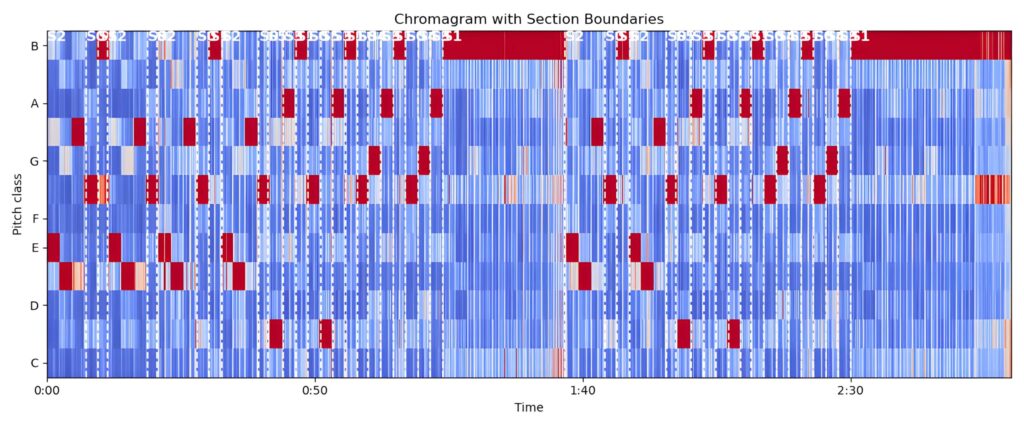
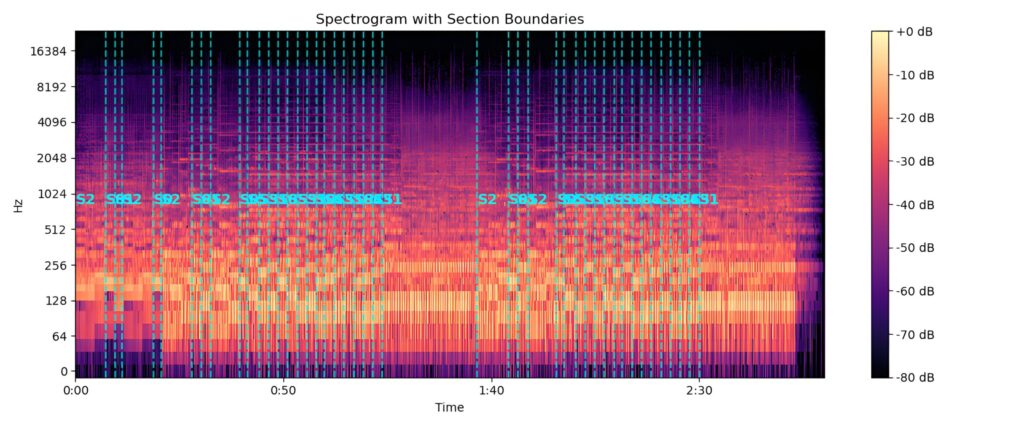
| Section | Start Time (s) | Key | Key Strength | Harmonic Density |
| 2 (Verse) | 0.00 | G# 4 minor | 0.950 | 3.52 |
| 0 (Pre-Chorus) | 7.29 | F# 4 Major | 0.866 | 3.01 |
| 1 (Chorus) | 9.58 | B 4 Major | 0.909 | 3.65 |
The average harmonic density is approximately 3.5. This rate of 3 to 4 changes per second is close to human breathing or walking, a setting that “induces a deep return to self while providing a sense of security.”
Chapter 4: The DNA of Sound (Acoustic Fingerprint)
MFCC / Spectral Flatness / Texture Analysis
The DNA forming the identity of “Yesterday” is summarized by three elements:
- “Resolution of Benevolence”: The coexistence of warmth and clarity shown by high Spectral Contrast and low Spectral Centroid.
- “Trinity of Tonality”: An emotional 3D structure connecting the poles of Abm, Gbm, and Bm with a high strength of 0.9 or greater.
- “Independent Pulse”: The perfect separation of stable rhythm and fluid melody achieved by decoupling onsets and harmonic changes (0.003 correlation).
The Spirit of the Creator
My creative process manifests as the integration of seemingly contradictory elements: “The structure is strictly logical (mathematical independence)” while “The texture is profoundly emotional (spectral design).”
This piece is a testament to my musical philosophy: constructing an unwavering space of “stillness” and meticulously placing particles of “motion”―in the form of sorrow―within it. It is a reminiscence of the past, reconstructed here and now as the immutable truth of data. Through the mirror of “Yesterday,” we witness how passed time is sublimated into a present experience. While maintaining silence, it is within that very silence that the most intense emotional fluctuations are hidden.