 Akihito Kimura
 Listen to Way Out / Tetsujin (Akihito Kimura)
■ Why This Track Changes 11 Times Per Second―Yet Feels Calm
This track updates its musical state 11 times per second―yet it feels controlled, minimal, and strangely cohesive.
How can extreme density avoid sounding chaotic?
At 104 BPM, the body remains stable, almost grounded.
But at the perceptual level, harmony, texture, and micro-timing are constantly shifting.
The result is a subtle dissociation:
your body rests, while your perception accelerates.
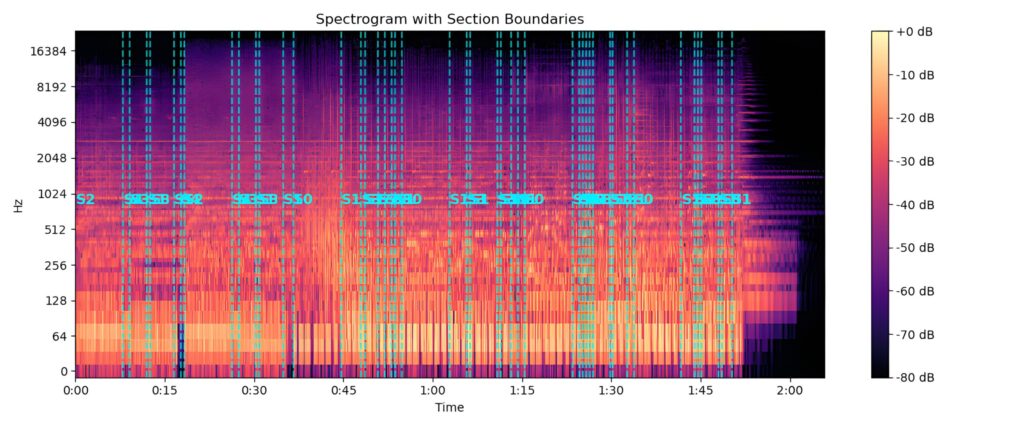
[Spectrogram]
Dense vertical boundaries = continuous state transitions (~11/sec)
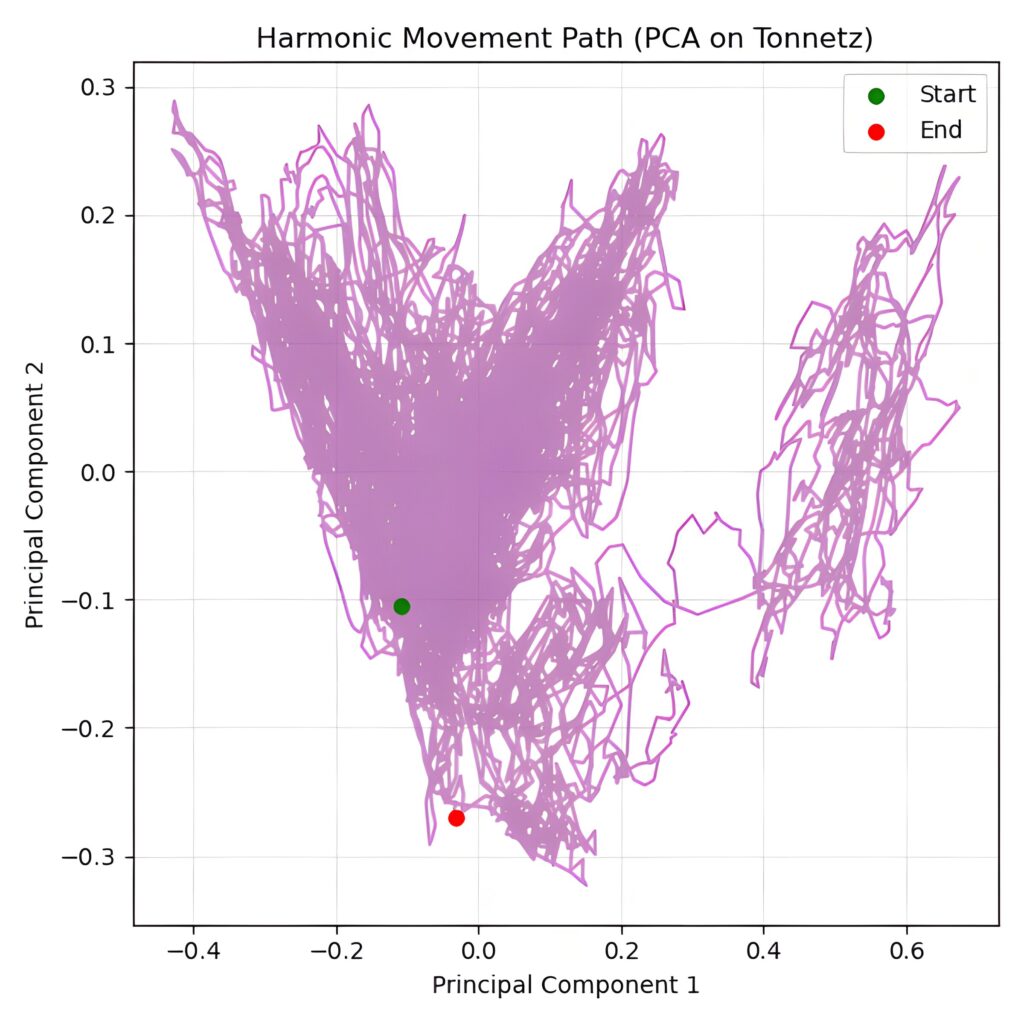
[PCA Trajectory]
Movement within a constrained space—not chaos, but controlled deviation
This is not just a composition.
It’s a system for designing perception under constraint.
■ The track is anchored in C minor / G minor, forming a strong harmonic “gravity field.”
Occasionally, it escapes into G# Major―not as a modulation, but as a controlled deviation.
Instead of increasing note density, the system rewrites perception itself:
- micro-variations in overtones
- millisecond-level attack design
- subtle spectral shifts
Result: continuous change without perceptual overload.
This creates a paradox:
low apparent complexity, high perceptual activity.
This is not randomness.
It is a controlled probability system:
The listener is allowed to drift―but always returns to a center.
Intellectual Loop:
A stable “home” with constant micro-change—
keeping the brain engaged without increasing complexity.
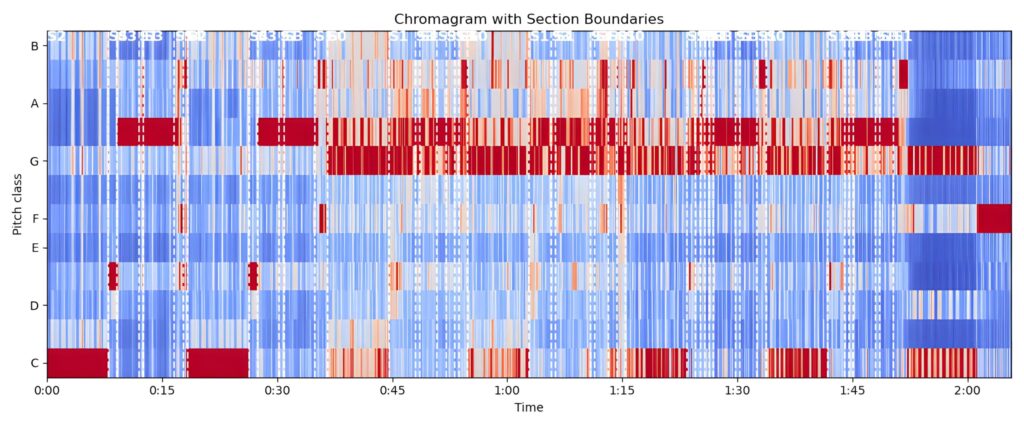
[Chromagram]
Strong tonal bands (C / G) anchor the system—stability within motion
■ “Way Out” is not about leading the listener to an exit.
It destabilizes the very idea of an exit itself.
Because when perception is continuously updated,
there is no fixed place to arrive.
Deep Dive: How “Way Out” Controls Perception
Below are the core mechanisms behind the experience.
1. Perceptual Update Rate (11.05 peaks/sec)
Rather than increasing note density, the track increases state transitions.
At ~11 updates per second, the listener’s predictive model is continuously rewritten.
This is achieved through:
- Micro-variations in harmonic content
- Subtle spectral modulation
- Glitch-level timing adjustments
Importantly, these changes are below the threshold of conscious tracking.
You don’t hear “many notes”―you feel “continuous change.”
2. Rhythm as Attention Control
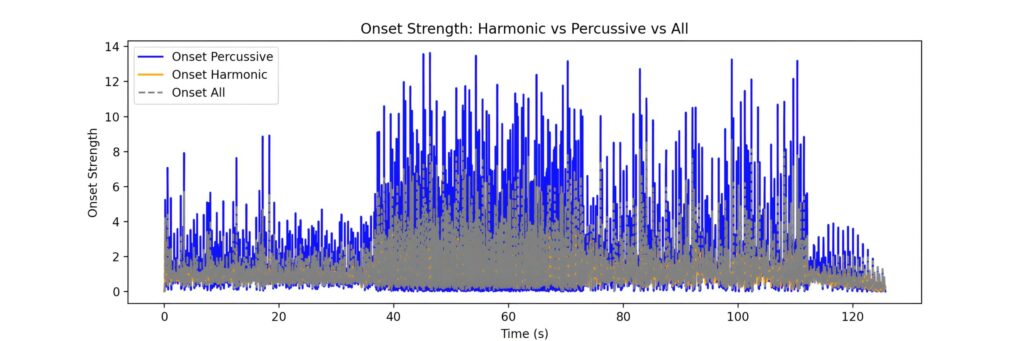
[Onset Strength]
Sparse energy with sharp peaks—attention is triggered, not sustained
The rhythm design is deliberately minimal:
- Low average onset energy
- Occasional sharp peaks (up to 12.0)
Instead of constant impact, the track uses contrast:
- Silence → Pulse → Silence
This conserves cognitive resources,
then reactivates attention at precise moments.
3. Body vs Perception (104 BPM)
At ~104 BPM:
- The body perceives stability (walking/heartbeat range)
- The mind processes high-speed changes
This creates a split:
- Physical time is slow
- Perceptual time is fast
A controlled dissociation emerges.
4. Spectral Design & Depth
The sound is intentionally “matte” rather than bright:
- Spectral centroid ~1642 Hz → reduced harshness
- High spectral flatness → rich, textured noise components
This results in:
- Depth over sharpness
- A “scan-able” sound field
Listeners can shift focus and discover new layers over time.
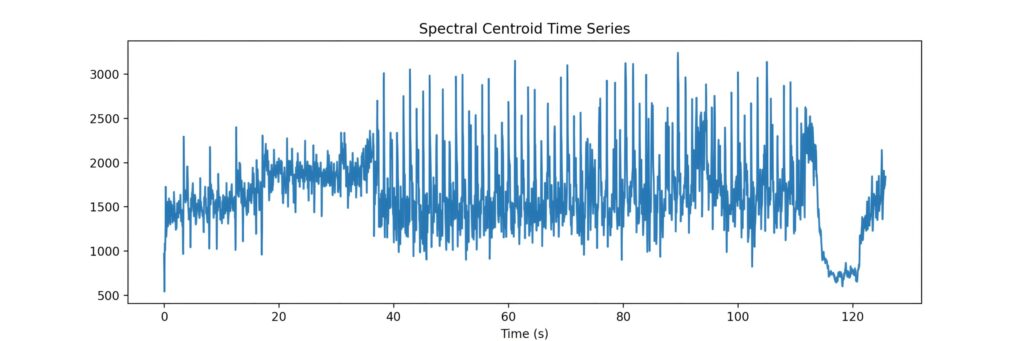
[Spectral Centroid]
Centered energy (~1642 Hz) reduces harshness—depth over brightness
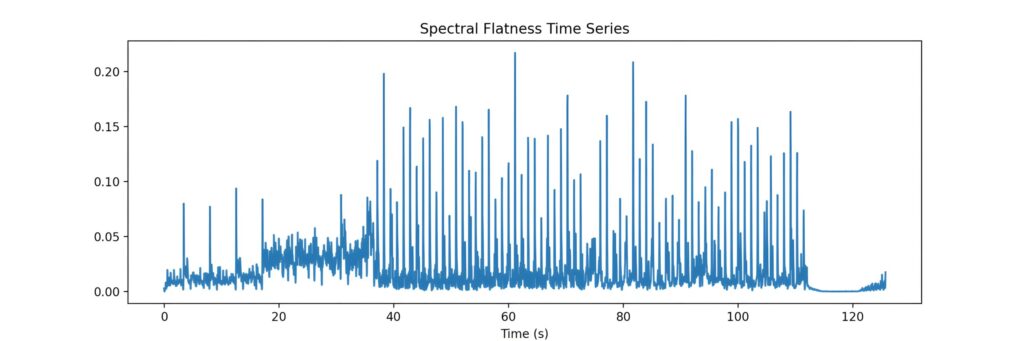
[Spectral Flatness]
Controlled noise adds texture, making the sound “scan-able”
5. Multi-Layer Listening Modes
Different listeners will experience entirely different tracks:
- Rhythm-driven → minimal groove
- Harmony-driven → structured system
- Texture-driven → evolving soundscape
- Cognitive-sensitive → controlled tension
- Trance-oriented → time distortion
The track does not enforce a single perspective.
It adapts to the listener’s perceptual focus.
■ “Way Out” is not a fixed musical object.
It is a perceptual scanning system—
one that continuously rewrites how you experience sound.
- Stability enables deviation
- Simplicity enables complexity
- Constraint enables freedom
Everything is interdependent.
Listen to “Way Out.”
Where does your attention go—
body, rhythm, or texture?
What are you actually hearing?
And if you create music:
How would you design perception—
instead of just sound?
Try listening again.
You may hear a completely different track.